
A priest at a church I attend told me this story, and I’m passing it along with the details changed just enough to protect the innocent, although I think we both know that nobody is innocent.
Recommended Stories



It happened last week, before evening prayer, which is one of the small services Episcopalians call, with our unflagging love of off-putting fancy language, the Daily Office. It’s the kind of service that usually draws a congregation you could count on one hand, assuming the hand belonged to someone careless with power tools. But you never know. Sometimes people feel a call and walk in for the first time.
That’s what happened to my friend last week. A woman came in early, and while she waited, she drifted over to the church bulletin board, which is the same in every Episcopal church: a dense mosaic of casserole sign-ups, choir rehearsals, and reminders about the need for stewardship, which is another unnecessarily oblique way we remind you that we need your money to keep this thing going.
And there, pinned between the Flower Guild and the food pantry, was a flyer for the children’s Halloween parade.
“Isn’t that,” she asked the priest, lowering her voice the way people do when they don’t want God to overhear, “a little, I don’t know, satanic?”
Which is a fair question, actually.
Here’s the answer the priest gave: Halloween is short for All Hallows’ Eve, the night before All Saints’ Day on Nov. 1, which is followed by All Souls’ Day on the 2nd. That’s a three-day block on the church calendar given over entirely to dead people: first the famously dead — the saints — and then the rest of the normal dead.
From the start, Christians have treated death with something close to contempt. St. Paul taunts it outright (“O death, where is thy sting?”) and medieval painters show skeletons dancing with popes and kings. Martin Luther advised that when scripture won’t drive off the devil, you should jeer at him because the one thing he can’t bear is scorn.
That’s what the costumes and the candy are for. It’s joy, and it’s unauthorized. Death never signed off on it, and he doesn’t have to. We were cleared by something bigger.
The newcomer took this all in with a skeptical look. She seemed unconvinced. Which, again, is fair. Despite the theological overlay — sort of a Christian doctrine Instagram filter — Halloween feels pretty pagan.
But there’s a Mexican folk tale that might help — or, at least, I think it’s a folk tale. It might just be something I imagined I heard one time.
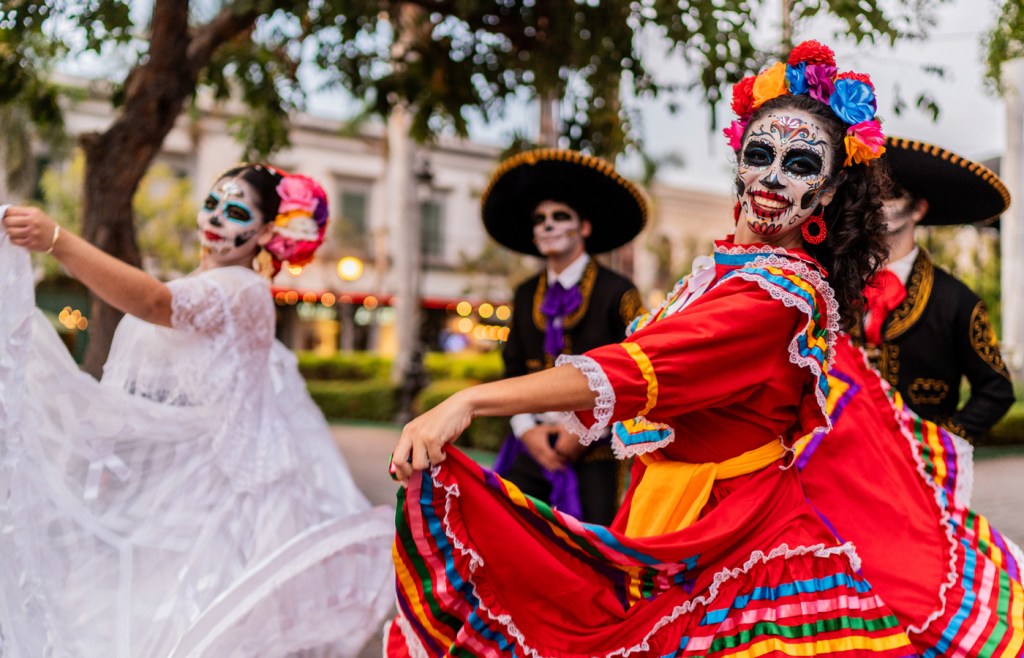
It’s the Day of the Dead in a small Mexican village. The Diá de Muertos is celebrated across the two key feast days, All Saints’ and All Souls’, and is probably the top layer of a holiday that goes way, way back, before the first Christian missionaries arrived in the New World and brought the message of peace and universal Christian brotherhood. Among other things.
So everyone in the village is partying in the square: there’s a band, lots of food, children with painted skull faces, old women who’ve seen 80 of these and still get up to dance. Staggering through the middle of it is the town drunk, dressed as Death himself in a black cloak, with a cardboard scythe and a skull mask slightly askew. He lurches around, swings the scythe at the mayor, and collapses theatrically into the laps of grandmothers. The village roars. This is his big day.
But then, out of nowhere, Death appears. The real one.
And he is not amused by all of this unauthorized joy. Death, as you might expect, has no sense of humor. Death is zero laughs. He stands at the edge of the square, glowering and insulted. The music stops. The laughter dies. Mothers pull their children close, and the village goes silent.
“Go ahead,” Death says bitterly. “Laugh. Dance. But every one of you is going to meet me. I know the hour and the minute and the day, and you do not. So the joke’s on you.”
Nobody moves for a moment. Then the drunk — the shabby, swaying mirror image of glaring Death — shuffles a bit and shrugs.
“We know that,” he says. “We know you know. But we dance anyway. So the joke’s on you.”
There’s a long, dreadful silence. Then a guitar starts, then a trumpet. The drunk begins to dance, the village begins to sing, and Death slinks away, defeated. For now, anyway.
The church parade is Saturday. Because the best way to beat the devil is with unauthorized joy.
Rob Long is a television writer and producer, including as a screenwriter and executive producer on Cheers, and the co-founder of Ricochet.com.