

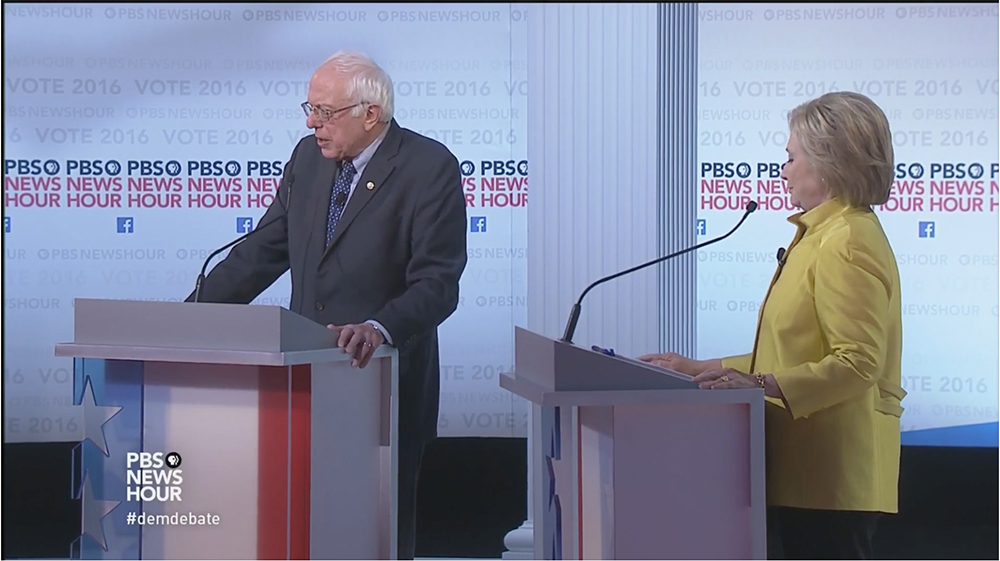
The hottest moment of the PBS-Facebook Democratic presidential debate in Milwaukee came at the end, when Hillary Clinton attacked Bernie Sanders for calling President Obama weak and a disappointment and urging that someone run against him in the primaries in 2012. Sanders replied heatedly that that was a “low blow,” that he valued the president very much but reserved the right to disagree — and that only one of them had run against Obama in 2008.
The exchange needs to be seen in the context of the upcoming South Carolina primary. In 2008, 55 percent of Democratic primary voters were black. Clinton throughout made a point of praising Obama, clinging as it were to his coattails. She believes (rightly, I think) that most black voters believe Obama has been both an excellent president and one who is disrespected by very many non-black Americans.
Recommended Stories


History and current polling both suggest Clinton will get upwards of 88 percent of blacks’ primary votes, but given Sanders’ demonstrated appeal to young voters, she evidently feels she can’t be sure. She also made a shout-out to another group, white working class voters, especially in coal country. She carried the coal and Appalachian states running west to Arkansas and Oklahoma by huge margins in 2008 primaries—they were her very best states—but her weak performance among “beer Democrats” in Iowa and New Hampshire must be making her nervous about whether she can repeat that performance.
There was tension, however, between Clinton’s repeated praise of Obama and both Clinton’s and Sanders’s depiction of American life today. Clinton gamely suggested that race relations were better than in 2008 although moderator Judy Woodruff said “almost everyone” believes that’s not true. Both candidates repeatedly denounced the campaign finance system, even though this campaign has made it clearer than ever that money doesn’t automatically buy votes (ask Jeb Bush) and that lack of big contributors doesn’t prevent launching a successful campaign (ask Bernie Sanders). More broadly, they depicted a country with a sagging economy, lack of opportunities for young people and yyyyuuge barriers to blacks, women and LGBT people.
I thought moderators Judy Woodruff and Gwen Ifill asked good questions, although not the questions Republican partisans might like, starting with Woodruff’s good question to Sanders about how much he would expand government and up to what limit — a question to which I think Democrats never give a moment’s thought. The question underlines the absurdity of Bernie Sanders’ promises of free healthcare, free college and free Ben & Jerry’s ice cream. (I’m kidding about the last one: you have to pay for his Vermont friends’ product.) But give Sanders credit for setting the agenda for this campaign. He’s got Clinton singing a lot of his tune and in her closing statement, she whacked Wall Street, the pharmaceutical companies and oil companies.
One final thought. Both Clinton and Sanders endorsed “fundamental policing reform.” Some of their ideas have gotten bipartisan agreement: A good case can be made for reducing mandatory minimum sentences, for example, and for providing better preparation for convicts re-entering the community.
But their premise that there is something like a crisis in police shooting unarmed blacks is unsubstantiated by the facts, and the alarming rise in homicides in many major cities since the demonstrations over Ferguson suggests that campaigning against “overpolicing” is politically risky.
I have noticed that Republican presidential candidates in campaign events get standing applause when they call for thanks to law enforcement officials. The policies Sanders and Clinton endorse could come uncomfortably close to the policies which made Detroit what it is today. Clinton is campaigning hard to maintain her seeming strength with black voters and Sanders is campaigning to weaken it. But there may be a risk here for their party in the general election more than they appreciate.
