
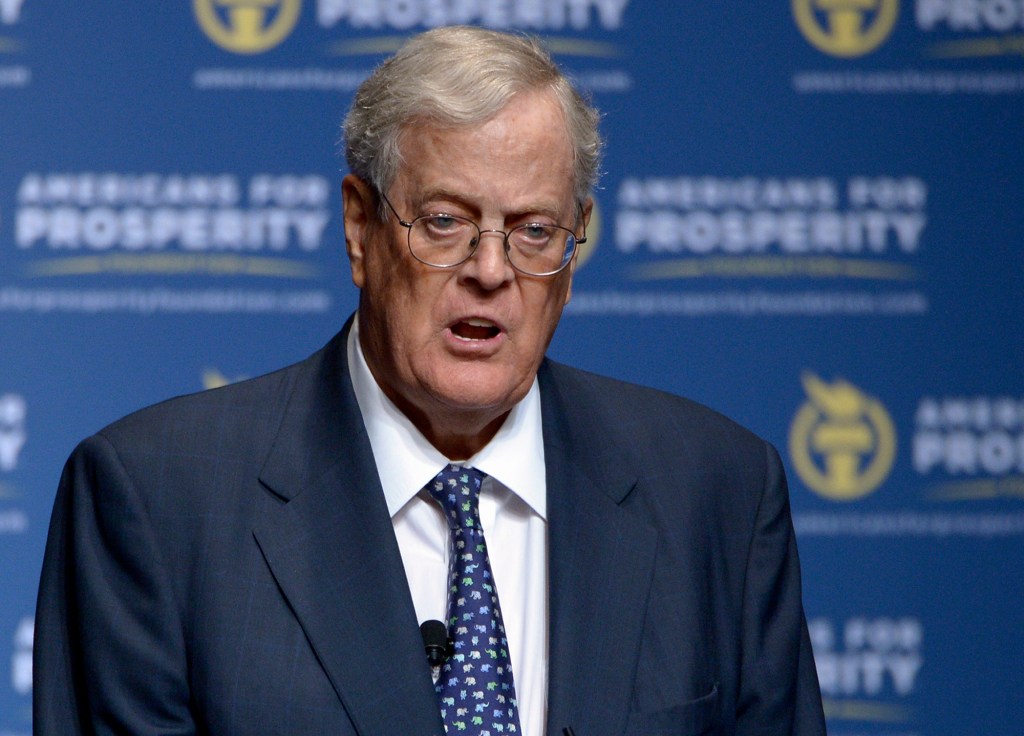
The grassroots empire of billionaire businessmen Charles and David Koch may be notably absent when Republicans gather to pick the party’s presidential nominee in Cleveland this summer.
Sources with knowledge of the plans told the Washington Examiner that the brothers have withdrawn their political network’s presence from the festivities surrounding the Republican National Convention.
As Republicans fret about disgruntled supporters of Donald Trump and Ted Cruz walking away from the party, some of the party’s leading financiers and donors could become the first to shun the GOP.
Freedom Partners, a right-leaning organization within the Koch’s network, canceled its convention-week reservation at the prominent Union Club in Cleveland.
A source with knowledge of Freedom Partners’ plans said the Koch network’s decision to forego the convention was made because of its political concerns.
“Amidst a contested convention potentially, and amidst the environment that has a lot of name-calling and whatnot where you’re not really talking about a lot of big issues, it’s hard to get out your message,” the source said. “So the value proposition immediately diminishes.”
The Koch brothers’ decision to pull out of the convention represents a change of course. In April of 2015, Charles Koch reportedly told USA Today his political network was considering supporting a presidential candidate from a list of five contenders — former Florida Gov. Jeb Bush, Wisconsin Gov. Scott Walker, Florida Sen. Marco Rubio, Kentucky Sen. Rand Paul, and Texas Sen. Ted Cruz.
Only Cruz remains in the race.
By November of 2015, Charles Koch told USA Today he had no plans to support anyone in the primary, but would likely help the GOP nominee in the general. The convention plans may signal that is up in the air too.
“If during the general election cycle, a candidate were able to garner support from the public with a positive message in support of the issues we care about, and did not engage in personal attacks and mudslinging, we would consider potentially getting involved,” said Mark Holden, chairman of Freedom Partners board, in a statement. “That hasn’t happened yet and there is no indication that this will happen given the current tone and tenor of the various campaigns.”
The Koch brothers’ actions may lead others to follow suit. Apple, Google and Walmart have already begun assessing what presence, if any, they want to have at this summer’s GOP convention, according to the New York Times.
Matthew Cox, a Republican lobbyist in Ohio helping groups prepare for the convention via GOP Convention Strategies, told the Examiner other groups appear to be abandoning the festivities around the convention as a result of Donald Trump’s rise.
“I mean there has been some other activity that we’ve seen where events are either having a hard time getting sponsors or sponsors have pulled out of certain events,” Cox said. “I think that may have been just like a little overreaction to some of the Trump demonstration stuff.”
If the party manages to unify the warring factions of donors, activists, and elected officials, the glue may be opposition to Hillary Clinton’s Democratic presidential bid.
Former Republican National Committee chairman Haley Barbour said he believes there is a chance the party’s disgruntled donors could stick with the GOP out of fear that Clinton would function as a third-term of President Obama.
“Would those people risk an Obama third term under the leadership of Hillary Clinton? Well, we’ll see,” Barbour said. “But there’s certainly more risk of it than if you had just kind of regular nomination contests where it was decided in the spring and everybody knew who the nominee was going to be well in advance of the convention.”
Regardless of who the party selects as its nominee, Barbour thinks the party is poised to lose ground to the Democrats immediately following a convention that could become mired in controversy.
“I think it’s fairly certain that we will not get a bump out of the convention that instead we’ll get a dip,” Barbour said. “One of the good things is the convention is earlier so if we have a dip, which I think is likely, we have a long, we have about a month longer for people to get over it and get back on board and be active for the nominee. But the fact that they did that in 1976 obviously doesn’t guarantee they’ll do it in 2016, 40 years later.”
