

The burden of filling out IRS forms has reached an insane level, a manpower cost of $170 billion lost in the 8.1 billion hours spent filling out 1,054 forms, according to a sobering new analysis of the impact of this year’s Tax Day.
The report from American Action Forum considers the costs associated with all Internal Revenue Service forms, such as those corporations and doctors fill out, often for customers or patients, but it also breaks down the impact of tax season on individuals who face a Tuesday filing deadline.
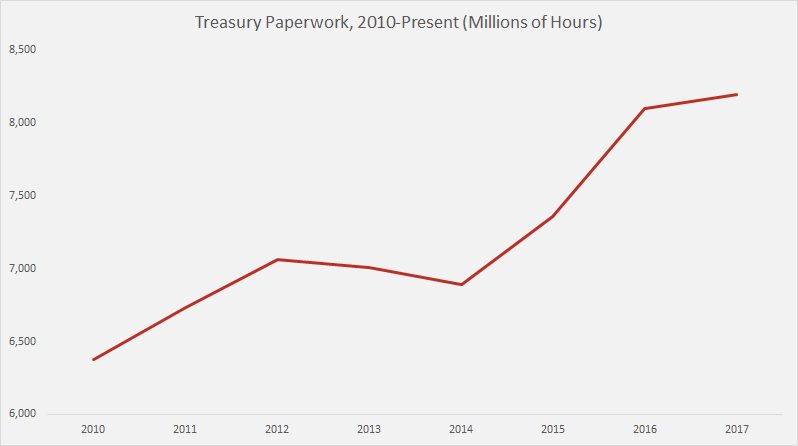
“IRS currently imposes 8.1 billion hours of paperwork and generates more than 1,000 tax forms. To put these incredible burdens into perspective, that is 25 hours per person in the U.S. or 54 hours per taxpayer. In other words, the average working American spends more than a week sifting through paperwork and preparing to file,” said the report.
“What is the cost of all of this? According to the IRS, it’s $86 billion annually, but the agency only monetized a small fraction of its more-than-seven-hundred distinct paperwork collections. When assuming every hour of paperwork imposes some cost, the actual burden jumps to around $170 billion annually, which exceeds the gross domestic product of Kenya,” it added.
AAF’s Sam Batkins, director of regulatory policy, and Gordon Gray, director of fiscal policy, suggested that costs could be even higher. In one note, for example, they said that the government’s estimate costs for business filings is just $17 an hour and $12 for individuals, far lower than tax accountants charge.
The IRS, for example, reported this month that more than half of all tax returns received were filled out by accountants. In coming up with its cost numbers, AAF used an average “compliance officer” charge of $33.77.
Batkins and Gray made the case that the IRS burden facing taxpayers and corporations this year should be the battle cry for tax reform. Both President Trump and congressional Republican leaders have pledged to push “fundamental” reforms through this year.
“If reform is ‘fundamental,’ even reducing the regulatory burden of compliance by 10 to 20 percent could produce massive regulatory benefits and savings for the average American,” the duo wrote in their report provided to Secrets.
“Consider, a 10 percent cut in IRS paperwork would save 814 million hours, the equivalent of 407,414 workers (at 2,000 hours annually) no longer dedicated to tax compliance. It would also save $17 billion each year, the equivalent of a $170 billion tax cut during a ten-year budget horizon. A 20 percent reduction would double these figures: 1.6 billion hours of savings, 814,829 worker-equivalent, and produce $34 billion in annual savings ($340 billion over 10 years),” they wrote.
Their conclusion in the analysis titled Tax Day Facts: IRS Paperwork Generates 8.1 Billion Hours Of Paperwork, 1,000 Forms:
The benefits of fundamental tax reform are not just fiscal or direct economic rewards. There are substantial tertiary regulatory benefits possible if tax compliance costs were reduced. With 8.1 billion hours of paperwork and at least $170 billion in direct costs, there is plenty of low-hanging fruit available. By this time next year, Americans could be paying less taxes and spending less time negotiating the more than 1,000 federal tax forms.
Paul Bedard, the Washington Examiner’s “Washington Secrets” columnist, can be contacted at [email protected]
