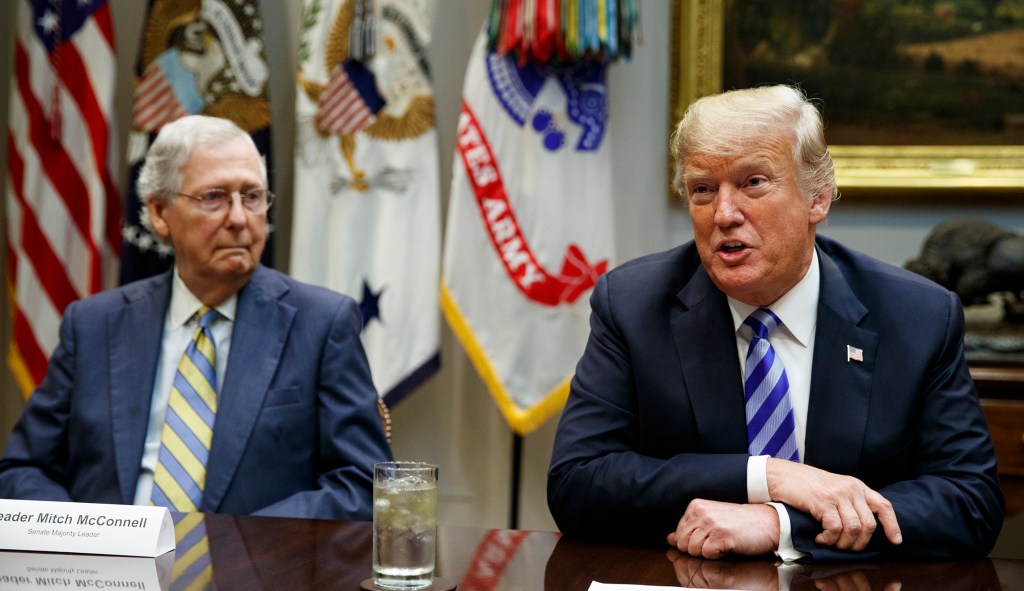
Senate Majority Leader Mitch McConnell, R-Ky., announced this week that the Senate would take up the First Step Act, a much-needed criminal justice reform measure that a few Republican senators have been obstructing.
McConnell is doing the right thing, and so is President Trump, whose urging in recent weeks was the real impetus that forced this vote. The reforms will make the federal prison system more humane, just, and proportionate in its punishments.
How did the “law-and-order” presidential candidate of 2016 become the most important advocate for criminal justice and sentencing reform? In a general sense, of course, a law and order candidate wants a system that works properly, so there is no contradiction even in theory. But in the current case, there is justification aplenty in empirical data.
Supreme Court Justice Louis Brandeis once famously referred to the states as “laboratories of democracy.” And when Jared Kushner, the president’s son in law, has pressed Trump on reform, he has dwelt on the fiscal benefits and public safety benefits demonstrated in red states that have reformed their criminal justice systems. Kushner and others convinced Trump that it was time for the federal government to adopt evidence-based practices that are already working in some of the most diverse states.
Experimentation began 11 years ago in Texas, when Republican lawmakers, unwilling to raise taxes, faced impossibly high costs to build new prisons. They decided instead to use long-term incarceration more sparingly as a punishment. They shifted the focus for small-time offenders toward treatment and diversion programs. It has been a brilliant success story.
Texas has saved $3 billion in the past decade without increasing the crime rate. Whereas the need to build and staff big, expensive new prisons once seemed inevitable, it has been avoided without any corresponding spike in crime.
Since South Carolina embraced similar reforms in 2010, its savings have been estimated at $500 million. The state’s prison population is down by double digits, and recidivism, crime, and violent crime have all declined.
Georgia estimates that it has saved nearly $200 million since 2011. As a state report on the situation noted earlier this year, the number of minor offenders taking up expensive beds in Georgia prisons has fallen, such that “Georgia’s most serious offenders” now take up 68 percent of them, up from just 58 percent in 2009. Nor was public safety sacrificed. Georgia’s has enjoyed a 24 percent decrease in statewide crime and a 6 percent decline in prison admissions since 2008. The number of black Georgians entering prison last year hit a 30-year low.
The First Step Act won’t be the last word on criminal justice, but it is, as advertised, a great first step and a shining example of what a bipartisan majority can do in an age of sharp political division.