

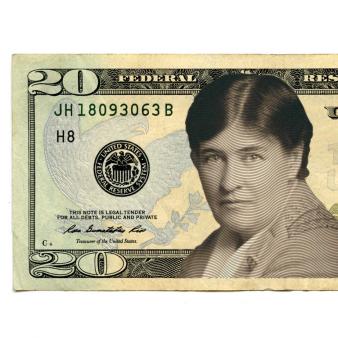
No one really knows why, in 1928, Andrew Jackson supplanted Grover Cleveland on the $20 bill. It may be because that year was the centennial of Jackson’s election as president. Or perhaps it was because Congress, very much controlled by Republicans at the time, thought that honoring Old Hickory would be a harmless bipartisan gesture to the Democrats.
Anyway, while the reasons for Jackson’s appearance on the twenty are obscure, the arguments for his disappearance are explicit. In the mind of the party of which he once was patron saint, Andrew Jackson, the old Indian fighter and Manifest Destiny man, is now anathema. Senator Jeanne Shaheen, a New Hampshire Democrat, has introduced a bill to remove Jackson from the twenty and replace him with a woman; Rep. Luis Gutiérrez of Illinois has done the same in the House, and with these memorable words: “If this is a country that truly believes in equality, it is time to put our money where our mouths are, literally, and express that sense of justice and fairness on the most widely used bill
in circulation.”
Stay informed.Stay ahead.
Join Washington Examiner for unlimited access to the news, analysis, and commentary that matter most.
Already a member? Log in
Truth to tell, The Scrapbook is generally indifferent to such matters. Our nation’s currency has tended to feature Founders and certified national heroes—Thomas Jefferson, Ulysses S. Grant, Benjamin Franklin, Abraham Lincoln, etc.—and in fact, The Scrapbook is just old enough to remember when there were dimes in circulation that did not feature Franklin D. Roosevelt. Times change, life goes on, reputations rise and fall, and The Scrapbook has never found it necessary to count how many men, women, Republicans, Democrats, German-Americans, or transgendered persons are featured on bills and coins.
On the other hand, on those rare occasions when Congress has risen up to demand statistical balance—the Susan B. Anthony dollar comes to mind—the project has been an embarrassing failure. For whatever reason, Americans tend to be creatures of habit, and as proponents of the metric system and the Sacagawea dollar coin can attest, we often resist attempts to impose what Rep. Gutiérrez calls “justice and fairness” in realms of life where such terms don’t apply.
Nor is this tempest in a teapot without irony. A left-wing organization called Women On 20s has taken the lead in publicly excoriating Jackson and demanding his replacement with someone from its own list of candidates. But of course, up until very recently, Jackson was the great hero of the Democratic party: The champion of what some might call “everyday Americans” in his time, Jackson was the sworn enemy of bankers and aristocrats, a proponent of the Union and strong central government, and the subject of an Arthur M. Schlesinger Jr. hagiography (The Age of Jackson, 1945) before Schlesinger discovered the Kennedys. All across America, state Democratic parties would kick off their campaigns with Jackson
Day Dinners.
Now, in the manner of the old Soviet encyclopedia, Women On 20s has rendered Jackson a nonperson, and its list of nominees is a tale in itself: Alice Paul, Betty Friedan, Shirley Chisholm, Sojourner Truth, Rachel Carson, Rosa Parks, Barbara Jordan, Margaret Sanger, Patsy Mink, Clara Barton, Harriet Tubman, Frances Perkins, Eleanor Roosevelt, Elizabeth Cady Stanton, Susan B. Anthony, Wilma Mankiller. Anyone detect a trend? One environmentalist, one abortion advocate, two career feminists, one Indian “activist,” one Democratic cabinet member, one Democratic first lady, three Democratic congresswomen—and so on and so on.
A tribute, as it were, to the philistinism of the left. For if it were up to The Scrapbook, we would save the expense and leave poor Jackson alone. And yet, why must the honor be reserved for politicians? A $20 bill featuring, say, Mary Cassatt or Emily Dickinson or Maria Mitchell or Leontyne Price or Willa Cather seems more appealing to us. Especially, of course, since Willa Cather was a Republican.
