On Sunday, I got a chance to stop by the Occupy Wall Street protest in downtown New York City, where a few hundred protesters have been gathering and camping out in a park to demonstrate against…well, that’s not so easy to say. Unlike the Arab Spring movements that inspired them, the Occupy Wall Streeters don’t have any clear set of demands other than a generalized angst against the American social order that they see as too skewed toward the benefit of the rich.
I found the protesters I met to be friendly, welcoming and earnest — though totally misguided. Within minutes of arriving, a young woman encouraged me to join along in the fun and pointed me toward the free food (there’s a section of canned food and other groceries that have been donated to the protesters who are living in the park). “I’m going to give you a blessing,” the woman told me, then began waving a smoking piece of sage around my face and body. She handed me a pamphlet about the agenda of the American Legislative Exchange Council, a group that urges state legislatures to pass conservative policies. “Through ALEC, Global Corporations Are Scheming to Rewrite YOUR Rights and Boost THEIR Revenue,” the handout read.

Recommended Stories
From what I saw, the protesters have an outsized sense of their own importance — many think that they are getting on the ground floor of a movement that is genuinely going to sweep the nation. The crowd I saw was a lot different than the crowds I’d see in the early days of the Tea Party movement.
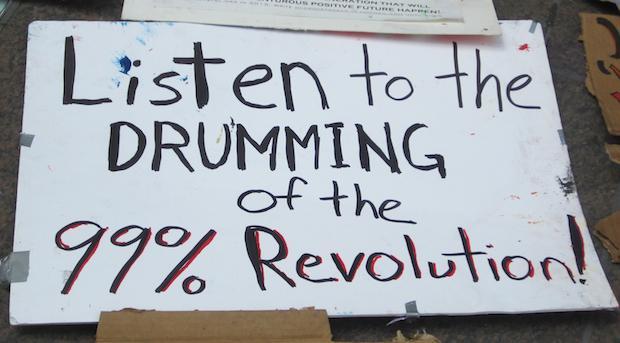
Most of the people I ran into at the Occupy Wall Street protest were twenty-somethings, whereas from the early days the Tea Party movement skewed older and attracted a lot of families. Tea Party rallies took place throughout the nation, including smaller towns and rural communities — where as thus far Occupy Wall Street has been an urban phenomenon. This is important, because on any given day in a large city, there are people protesting stuff — what I saw here wasn’t much different than what I’ve seen many times on any given day when I lived in New York City, in places like Union Square or Columbus Circle. This just happened to be a higher concentration of people in one place. Also, the Tea Party movement’s backlash against big government is a lot closer to a mainstream opinion in America than the socialist, Marxist and anarchist messages of the Occupy Wall Street protesters. Also, in the early days, Tea Party groups didn’t block a major transportation hub like protesters did when they decided to march across the Brooklyn Bridge, then spilled into the car traffic lanes. As with all protest movements, it isn’t fair to view all protesters monolithically. Below, I’ve compiled some of the photos I shot at the scene so you could get a sense of some of the protesters’ messages.
There’s a constituency for cannibalism, evidently.
As I wrote, they don’t really have any demands — but some have offered suggestions like this…
They seem to think they represent most Americans, and that their influence is immense.
Making a sign that will read, “This is what the collapse of civilization looks like.”
Randians need not apply.
Wouldn’t be a liberal protest without griping about Israel.
It’s like a city within a city, protesters sleep on air mattresses like this one…
and they’ve even published their own local newspaper.
Here’s some other scattered signs.