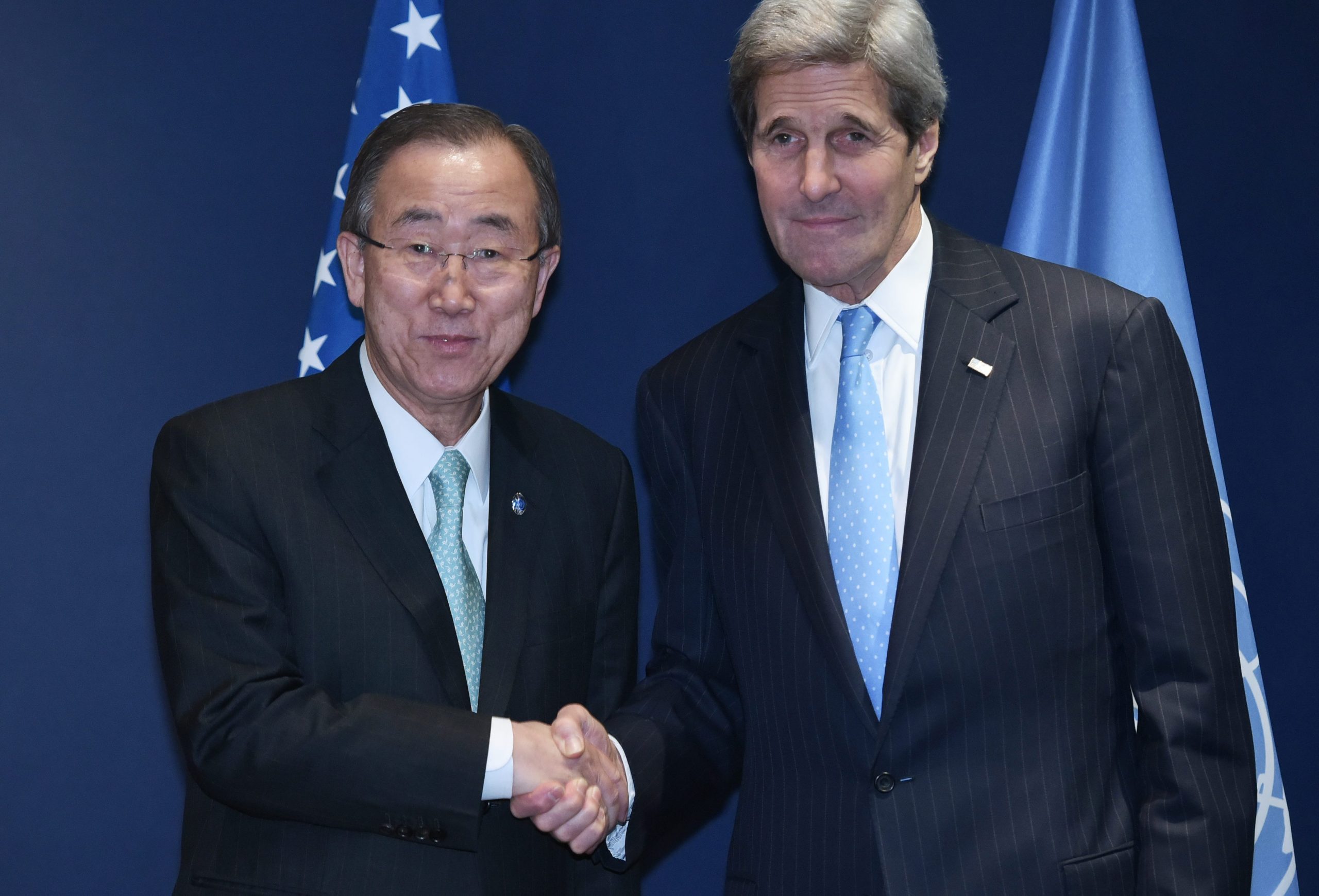
Secretary of State John Kerry hailed the Paris Agreement, the world’s first agreement on climate change, as a victory for all the nations of the world.
Kerry, speaking after all 196 countries at the 21st Conference of the Parties unanimously adopted the agreement, called the last week he spent in Paris nailing down the agreement as the leader of the American delegation one of the most rewarding experiences of his life.
“This is a tremendous victory for all of our citizens, not for any one country or any one block, but for everybody here who has worked so hard to bring us across the finish line,” Kerry said. “It is a victory for the planet and for future generations.”
The pact between 196 countries allows each of them, voluntarily, to set emissions reductions targets that will be reviewed every five years starting in 2023. The United States has pledged to cut its greenhouse gas emissions between 26 and 28 percent over 2005 levels by 2030.
The agreement seeks to hold global temperature rise “well below” 2 degrees Celsius, about 3.6 degrees Fahrenheit, with an eye toward keeping it below 1.5 degrees Celsius, or 2.7 degrees Fahrenheit.
The agreement would see the countries agree to peak greenhouse gas emissions “as soon as possible,” with rapid reductions coming after emissions peak. Although it is couched in diplomatic terms, the agreement also calls for countries to work toward 100 percent renewable energy.
The language in the agreement states countries have “common but differentiated” responsibility to fight climate change, which will be seen as a win by developing countries who seek to blame developed nations for causing climate change with greenhouse gas emissions. Countries with low emissions will be required to do less under the agreement than high-emission nations.
President Obama will address the nation at 5:30 p.m. Saturday from the White House to talk about the agreement.
Kerry echoed many who spoke after the agreement was adopted by saying it is not a perfect deal. However, Kerry said it would send a strong message to inventors and entrepreneurs that it is time to invest in and explore clean energy.
“We are sending, literally, a critical message to the global marketplace,” he said. “Many of us here know that it won’t be governments that make the decision or make the product or make the technology (to solve climate change), it will be the genius of the American people.”
Kerry hailed all the countries’ willingness to work together and come to a huge multilateral agreement.
The U.S. delegation ended up getting much of what it wanted from the deal. Parts of it will be dependent on Congress, such as the money sent to a so-called Green Climate Fund, but there is no legally mandated amount that must be spent by each nation. There are also mandates on how transparent each country must be as it works toward its greenhouse gas emission reduction goals, which was something American diplomats pushed hard.
It is perhaps the most significant diplomatic moment in Kerry’s career. But, he recognized that implementation will be much more difficult than agreeing with other countries that climate change is bad.
“What we do next … that is what will determine whether we’re actually able to address one of the most complex challenges humankind has ever faced,” he said.
