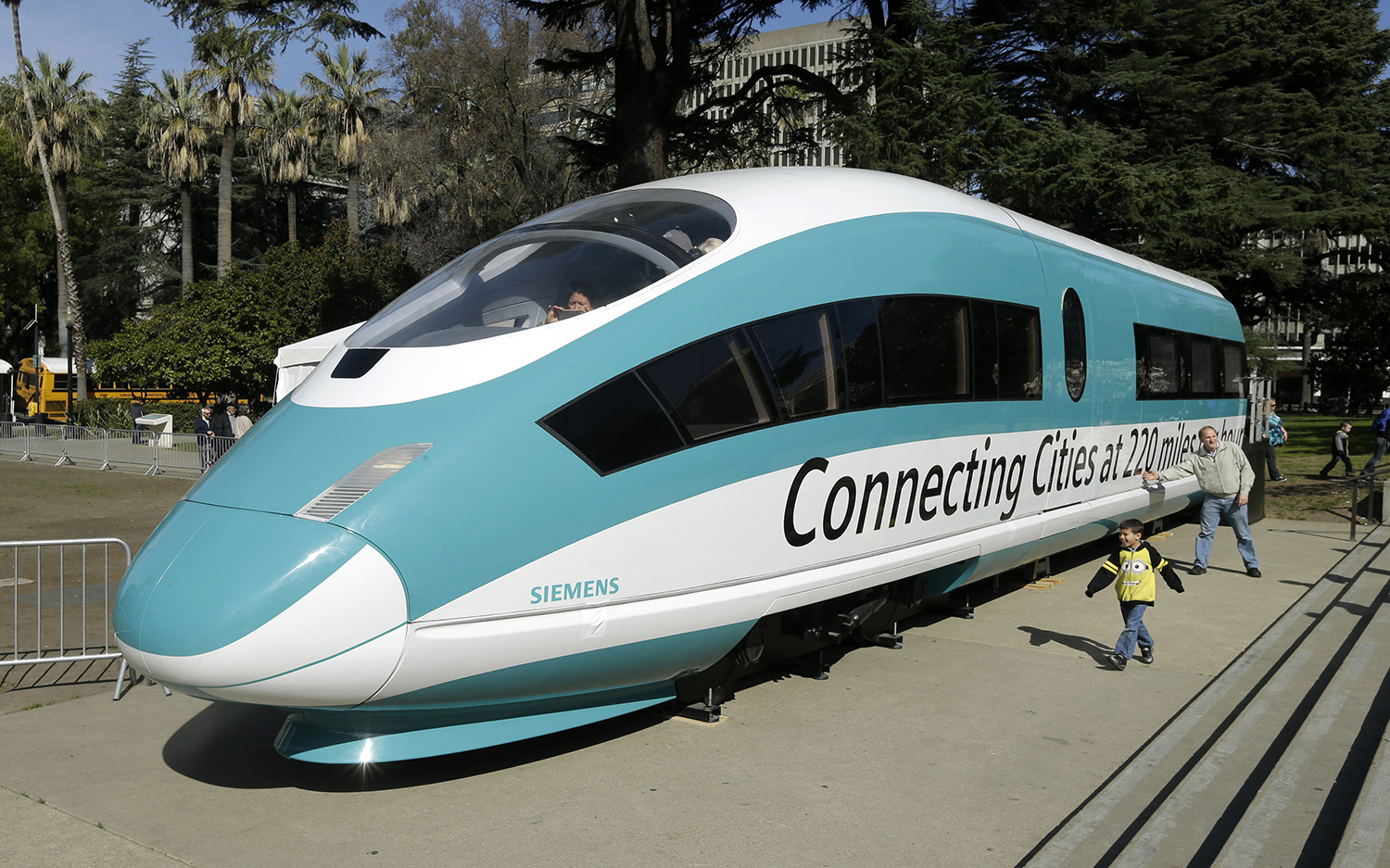
Obama’s legacy: What ever happened to high speed rail?

If you’re old enough, you might remember the 2009 stimulus package, and all the speeches and promises about how with a bit of federal funding, high-speed rail was going to change the way we travel.

Nearly all of the states selected for such rail projects (Wisconsin, Ohio, Florida) turned down the federal money, reasoning that no amount of it was worth embarking on such a project that was so unlikely to prove useful for travelers. At the time, people attributed this to partisanship, as Republican governors made the decision to reject them.

But the one state that plodded on with its rail project continues to serve chiefly as a warning to anyone else who might consider such a thing in the future. California now faces massive cost and time overruns in constructing just the first few parts of its rail project, which aspires to connect Los Angeles with San Francisco — and might even get there in a few decades.

The L.A. Times reported on Friday:

California’s bullet train could cost taxpayers 50% more than estimated — as much as $3.6 billion more. And that’s just for the first 118 miles through the Central Valley, which was supposed to be the easiest part of the route between Los Angeles and San Francisco.

A confidential Federal Railroad Administration risk analysis, obtained by The Times, projects that building bridges, viaducts, trenches and track from Merced to Shafter, just north of Bakersfield, could cost $9.5 billion to $10 billion, compared with the original budget of $6.4 billion.

The important thing to remember is that very, very few people will have much use for a bullet train that travels between Merced and Shafter. Yet just that part of the project, supposedly the easiest part to build, won’t be done until at least 2024, the report suggests. This is in large part thanks to onerous and unexpectedly expensive environmental reviews — those won’t even be done until 2020.

Meanwhile, the independent agency charged with building the system suffers from low employee morale and high turnover of senior staff. It is trapped between likely cost overruns and the need to spend grant money fast enough to meet targets and convince the federal government that the project is actually ever going to be finished. The project is sufficiently bogged down at this point that bipartisan opposition is beginning to develop at the state level.

If you have a few moments, this is one loose end of Obama’s legacy that’s well worth reading up on.

Related Content
