
It was a decision in a small town in the nation’s smallest state, but the controversy is part of a much larger battle.
The contest has been called “the culture wars,” said to have begun as far back as the Scopes Monkey Trial of the 1920s. Whenever it started, the fray continues unabated.
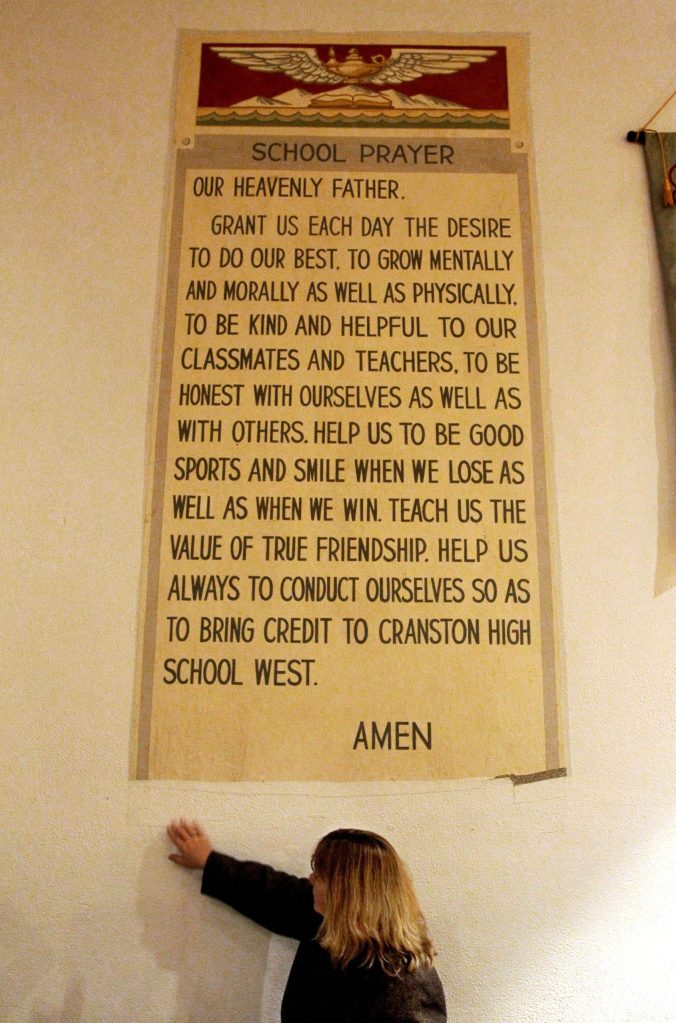
Last week, in the unassuming hamlet of Cranston, R.I., the school board caved in to federal pressure and removed a prayer banner that had hung in a public high school auditorium since 1963.
According to a story on the Web site www.reuters.com, the banner contained the words “Our Heavenly Father” and ended with “Amen,” words that Jessica Ahiquist, a junior at the high school and an atheist, said made her feel “excluded.”
Fully aware of the America she’s been living in all her life – and the one we’ve been living in the past 50 years – Ahiquist concluded she had a “right” not to be excluded by religious language, a “right” found nowhere in the First Amendment’s mention of religion.
“Congress shall make no law respecting an establishment of religion, or prohibiting the free exercise thereof.”
Astute observers might note that there is nothing there either about freedom “from” religion, which has been the latest liberal rant since the Obama administration had to scuttle its contraceptive policy regarding religious institutions.
The emphasis on the word “Congress” is my own. We have to remind liberals – and judges I love to call “penumbra raiders” – of this constantly, don’t we?
It is Congress that’s restricted by the First Amendment, and, by extension, the federal government. The feds can’t establish a religion; nor can they prevent the free exercise of it, which means if the people of Cranston, R.I. want a prayer banner in their high school auditorium they should bloody well be allowed to have one.
That does nothing for young Ms. Ahiquist and her feelings of exclusion, of course, but that’s just the way it is. But actually, that isn’t the way it is.
Since the 1963 Supreme Court ruling in Murray v. Curlett, courts have preferred to protect the rights of those who feel excluded, not the rest of us.
The Murray case began in Baltimore, where a local judge named J. Gilbert Pendergast read the atheist’s intentions perfectly.
“It is abundantly clear,” Pendergast said, “that petitioners’ real objective is to drive every concept of religion out of the public school system.”
The Maryland Court of Appeals ruled that “neither the First nor the 14th Amendment was intended to stifle all rapport between religion and government.” Too bad that view didn’t prevail.
What did prevail is the view we have today, that the Constitution “erected a wall of separation between church and state,” language that isn’t in the First Amendment either.
But, to many Americans, federal judges have erected no “wall of separation” between church and state. Instead, they’ve become the enemies of the church, and religion.
I don’t know the numbers of how many Americans favor a return of prayer to public schools, but I do know support for such comes from places and people liberals wouldn’t expect.
Several years ago, I listened as Philadelphia’s departing mayor and police commissioner – both African Americans – talked about the city’s high homicide rate and the victims of it. Young black men, poorly educated, from fatherless homes.
The mayor and top cop said they’d talked to members of Philadelphia’s black community who saw a link between those grisly stats and no school prayer. Overwhelmingly, they wanted prayer back in schools.
When we kick religion out of the classroom, we’d better be darned sure we kick something of equal value back in.
