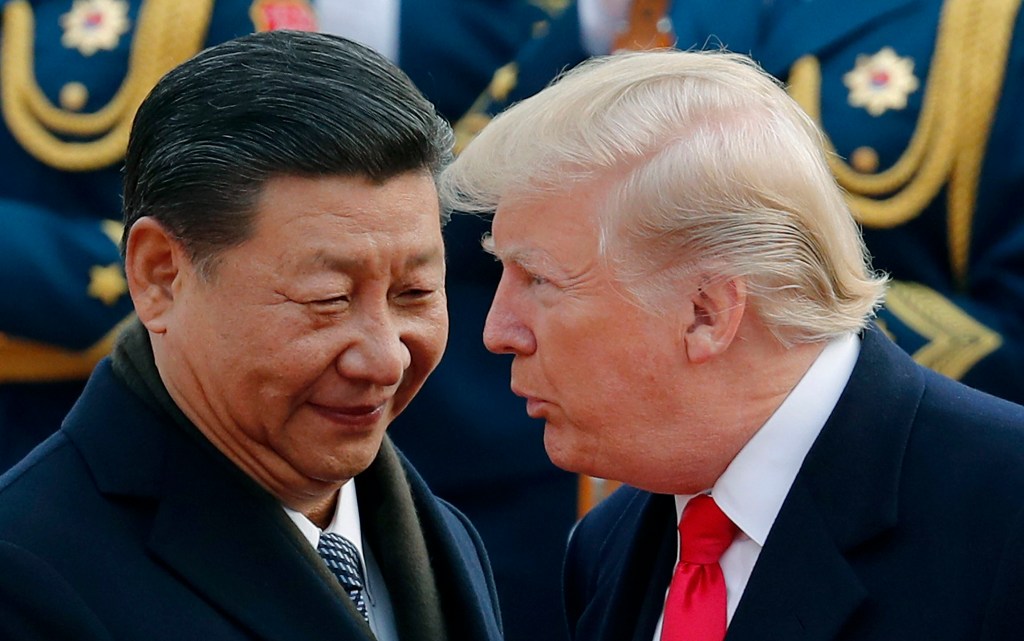
Before anyone could take the first shot in President Trump’s threatened trade war, he and Chinese President Xi Jinping both found a way to save face. The steel tariffs that Trump had earlier announced have been put on hold pending further talks.
The tariffs are designed to protect American steel producers from market competition, so that the U.S. will emerge once again as a steelmaking power. Or so goes the theory goes.
The reality, as we have previously pointed out, is that steel tariffs destroy far more jobs in steel-consuming manufacturing industries (including carmakers) than they could ever preserve in steelmaking. That being the case, the current moment seems like a good time for Trump to look at the history of China, his negotiating adversary, for two important lessons about government, trade, and protectionism.
The first lesson is that openness and trade can make any nation great, even one that has just been ravaged by the human and economic destruction that communism inevitably brings.
In the years following Chairman Mao Zedong’s death in 1976, China’s economy and population were in ruins. The decade-long Cultural Revolution had come on the heels of the worst famine in human history, in which 20 to 50 million Chinese died because of communist mismanagement of the economy.
It was at this moment that China’s Communist Party abandoned the ruinous economic program of full socialism. Deng Xiaoping’s proposal to open China and rapidly increase foreign trade allowed the Chinese to restore, modernize, and enrich their country by doing what all free people do; they made products that other people wanted to buy. It was this, not China’s well-documented (but usually overrated) cheating on trade policy that lifted 800 million Chinese out of dire poverty.
Today, despite continued political repression and government censorship, the same consumer goods and work opportunities available to Americans are increasingly within the reach of a fast-growing Chinese middle class. It may not fit Western preconceptions about China, but Chinese citizens now own more automobiles than Americans do. Their per capita GDP is now on par with that of Mexico and Russia. Starvation is no longer among the daily worries of China’s urban population. Their anxieties focus, rather, on distinctly first-world problems such as interminable traffic jams and the possibility of a housing bubble.
The lesson for Trump is that China became great because it abandoned backward economic ideas about self-sufficiency, and embraced foreign trade. This applies to America, too, even if it is already a far more advanced economy. Were Trump to drop his administration’s nonsense about raising new trade barriers and instead take the opposite path, abandoning job-destroying protectionist measures on products such as steel, sugar, and tires, the president could preside over and get credit for significant economic growth and wealth creation, lower consumer prices, and, yes, more jobs building things such as bridges and cars.
As he approaches these trade talks, Trump should also learn from China’s more distant past just how much harm government can do when it attempts to promote one industry, steel production, in this case, at the expense of others.
During the Great Leap Forward, China’s new revolutionary government made two fateful decisions that were intended to modernize China. They instead created the above-mentioned famine.
Having collectivized agriculture, the first disastrous decision, Mao made things worse by ordering millions of workers away from the fields and other useful enterprises to make steel production, to meet arbitrary government quotas and surpass other countries’ production. Millions of peasants literally started making steel in small batches in their backyards, melting down their agricultural tools and letting their crops rot.
The result? Real economic priorities, especially crop production, fell off a cliff. Tens of millions of rural Chinese starved to death while tons of garbage steel piled up around them.
Trump’s obsession with steel production is not about to cause anything like that in the U.S. But the extreme case from Chinese history demonstrates how government officials make poor decisions about economic production. The choices must be left to the billions of individual market participants, that is, to you and me. That means letting freedom work, not raising barriers in a futile effort to make people behave in a particular way.
If Trump starts a trade war in an effort to boost domestic steel production, that won’t cause a famine. But it will lead to weakness and failure, not greatness, and it will mean jobs won’t be created when they otherwise would have been. If, however, he steers away from trade wars, opens up the U.S., and persuades the Chinese and others to open their markets to American products, he will be learning from history and helping the cause of economic growth and prosperity.