

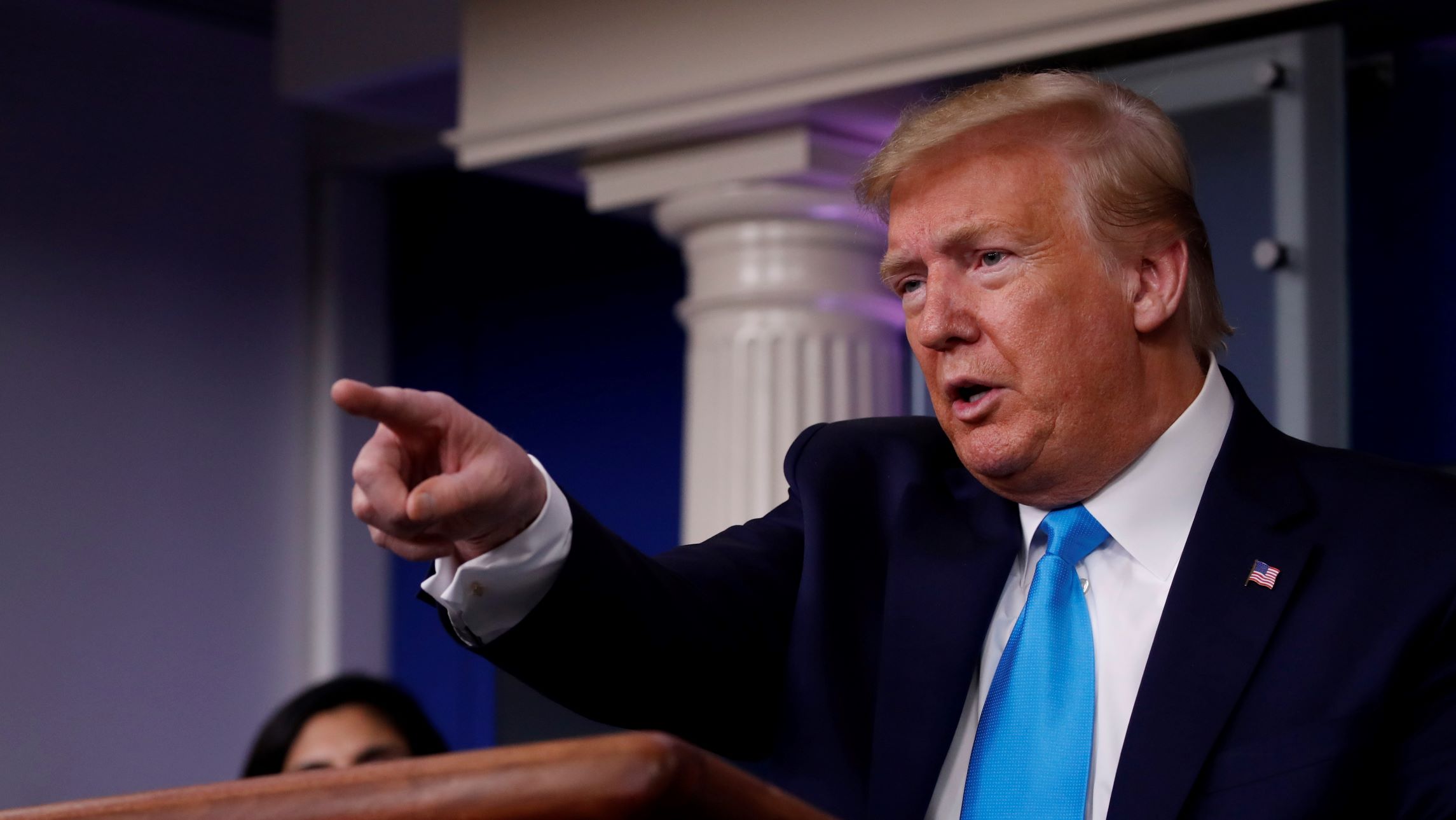
President Trump said he was not aware of memos written in January by a key adviser warning of an unfolding pandemic, but he claimed viewing them would have made no difference to his early response.
For weeks, Trump was accused of playing down the potential threat from the novel coronavirus, saying it would disappear “like a miracle” in February, and of leaving the country unprepared.
Recommended Stories



On Monday, it emerged that in late January, Peter Navarro, a leading China hawk in his administration, circulated memos suggesting that more than half a million Americans might die in a pandemic.
During his regular White House coronavirus briefing on Tuesday, the president said: “I didn’t see them, but I heard he wrote some memos talking about the pandemic. I didn’t see them. I didn’t look for them either.
“But that was about the same time as I felt that we should … that was about the same time that I closed it down.”
Trump was referring to a ban on most travel from China, the origin of COVID-19, that he unveiled on Jan. 31. That was two days after Navarro’s first memo that called for China travel restrictions.
On Feb. 2, a second a memo raised the potential death toll to two million.
Trump, however, played down concerns in public. He frequently compared the coronavirus with flu, and during a coronavirus task force briefing at the end of February, he was confident that the outbreak would soon be contained.
“When you have 15 people, and the 15 within a couple days is going to be down to close to zero, that’s a pretty good job we’ve done,” he said.
Comments like those have been picked over by critics who say many more lives could have been saved if the United States had ramped up production of key equipment, such as masks and respirators, and rolled out tests across the country earlier.
On Tuesday, Trump defended his actions, saying no one could have known how the pandemic would unfold.
“Nobody said it’s going to happen, but you know there is a possibility, there always has been a possibility,” he said.
Closing off travel from China made a decisive difference, he added, taking a shot at the World Health Organization, which says restrictions on movement have limited impact on disease transmission but can trigger disproportionate economic consequences.
“Interestingly, the World Health Organization was not in favor of us closing it down,” he said. “And if we didn’t close it down, we would have lost hundreds of thousands more lives.”
The WHO has become a target for Trump and his loyalists for what they see as a pro-China line. During the briefing, the president said he was considering halting funding for the global health body.
By Tuesday night, more than 12,000 people had died worldwide, according to a tally kept by Johns Hopkins University, and almost 400,000 had tested positive for the virus.
Trump said he believed the U.S. may be getting to the top of the “curve” and repeated his hope that the economy could soon be reopened.
And he defended his early optimistic tone, saying that it went hand in hand with action.
“I’m a cheerleader for this country,” he said. “I don’t want to create havoc and shock and everything else. But ultimately, when I was saying that, I’m also closing it down.”
