

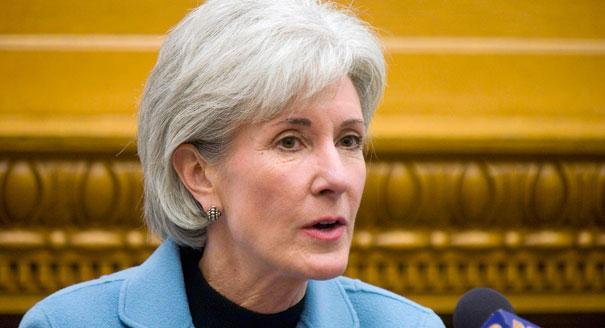
As governor of Kansas, Kathleen Sebelius cited privacy concerns in opposing the release of documents sought during an investigation into criminal wrongdoing at state abortion clinics.
Yet now, as Secretary of Health and Human Services, Sebelius’s department is proposing new rules that could create government databases containing the health records of all Americans.
Recommended Stories


Rep. Tim Huelskamp, R-Kan., sees a double standard.
“On the one hand, (as governor) she spent her time attacking an investigation into some of her biggest political supporters,” Huelskamp told The Washington Examiner. “And here she is in Washington promoting the exact opposite thing, saying, ‘Don’t worry about the confidentiality of private records, your information is safe with us.’”
In 2005, then Kansas Attorney General Phill Kline first requested the records of 90 women and girls who had received late-term abortions. His investigation would look into, among others, the activities of Planned Parenthood and late-term abortionist George Tiller, whose practice was located in Wichita.
Sebelius had reciprocal ties to abortion providers throughout her political career in Kansas. For instance, on May 15, 2007, Sebelius celebrated her birthday at a Planned Parenthood event that raised over $55,000 for the abortion provider. And Tiller donated more than $35,000 to her, according to the Associated Press, though other estimates run much higher than that.
“The entirety of the (Sebelius) administration’s efforts was put behind prohibiting the investigation into George Tiller, Planned Parenthood and other abortion clinics in Kansas, where there was without a doubt, probable cause that these clinics were defying sexual abuse reporting laws,” Huelskamp said.
“This was a cover-up of child rape, sexual abuse, incest, you think of the worst things, this all came out in court documents, “ he said. “Kathleen Sebelius and her administration, to the ‘t,’ said [releasing records] would provide access to sensitive health information.”
He explained, “Under no circumstances did any court ever know that Woman A was Suzie Smith, or whoever it was. Not once. Those were redacted from the records every time. It was a clear misdirection and deception by Planned Parenthood and Kathleen Sebelius, who were clearly working together.”
In addition to supporting abortion providers’ legal arguments, in 2006, Sebelius vetoed a bill requiring doctors to submit information when they perform abortions. “(It) will force women to provide intimate, sensitive health information to the government,” she wrote in her veto message. “Privacy is a fundamental concern to all Kansans.”
Yet last month, in an op-ed that appeared in The Washington Examiner, Huelskamp pointed to a newly proposed rule by Sebelius’s HHS that would direct state governments to harvest Americans’ medical records.
This came about because, under Obamacare, insurance companies must cover patients with pre-existing conditions. Such a system would quickly unravel if some insurers get stuck with the sickest patients, while others cherry-pick the healthier patients with lower medical costs.
To prevent such a scenario, Obamacare calls for the government to engage in what’s called “risk adjustment,” essentially compensating the companies that end up with a disproportionate number of sicker patients.
But here’s the rub – to determine how much compensation companies should receive, the government needs to know everybody’s health status and medical history.
Sebelius’s HHS has proposed having states collect the “raw claims data” of all Americans to determine “individual risk scores,” which can then be used to allocate funds accordingly.
“This database will provide access to raw clinical data, raw medical records, that are private, that are sensitive, and (Americans) don’t want to see in the hands of Washington or in the hands of state-level bureaucrats that work for HHS bureaucrats out of Washington,” Huelskamp said.
Asked about the issue, an HHS spokeswoman cited a blog post by Steve Larsen, director of the Center for Consumer Information and Insurance Oversight, in which he wrote:
But Huelskamp said that this doesn’t address the underlying issue.
“The level of data is the individual level,” he said. “They will say, this is Patient A, this is Patient B, but somebody will have the code.”
He added, “It’s not a one-time data source. It’s, ‘What has been the history of Patient A?’ And what happens to Patient A, when Patient A moves from Kansas, to say, Minnesota? That needs to be with the individual. So there needs to be a history. And it is a pretty significant database, and it would be for every single American as we are understanding Obamacare.”
The Washington Examiner offered HHS the opportunity to respond to the more detailed criticisms of the proposed rule and Sebelius’s past record on privacy, but HHS spokeswoman Erin Shields, after initially offering to answer follow-up questions, declined to respond.
Huelskamp has worked with Rep. Denny Rehberg, R-Mont., chairman of the appropriations subcommittee on Labor, Health and Human Services, and Education to insert a message in the next budget bill due Nov. 18 barring HHS from using any money to create such medical records databases.
And last Friday, news broke that in 2005, the Sebelius administration in Kansas destroyed key records sought by prosecutors in the criminal prosecution of Planned Parenthood.
According to the Kansas City Star, the Kansas Department of Health and Environment is calling it a “routine” destruction of state documents that was not deliberate.
