
Ah, September. The air is turning crisp. Soon leaves will show colors; the holidays are in prospect; everyone looks better in sweaters. Yours truly loves autumn and its September-to-Christmas parade. Each year we live through two days that are not September-to-Christmas to earn the privilege of each one day that is.
And in September, nobody’s NFL team has yet heard the order to abandon ship. Not even the Cleveland Browns! By Halloween, a third of the NFL’s clubs will have no hope of the postseason. By Thanksgiving, half of the NFL will be all but mathematically eliminated. As Santa images and festive lights go up on houses—this may start in commercial districts pretty much any day—much of the NFL’s fan base will already be ignoring games while talking obsessively about the next spring’s draft and free agency.
Recommended Stories
But in September, the inevitable is still in the future. If only it were always this way!
Editor’s Note: This is the first week of the TMQ podcast! Please listen as you enjoy this week’s column.
Sunday, the Bengals were shut out at home. Not to worry: They only need to win 10 of the next 15 to make the playoffs. The 49ers, Giants, and Seahawks failed to record a touchdown in their openers: Don’t fret unless it’s still this way when you’re trying to figure out a Halloween costume. The Indianapolis Colts looked like a team hoping to land the first selection in the 1998 draft. (When they picked Peyton Manning, get it?) But the Colts are far from finished.
Nobody’s at that juncture yet—which will change soon enough. So enjoy September football while it’s still around, while all things are possible for all teams.
And don’t panic! One of TMQ’s immutable laws is: Don’t panic now, there will be plenty of time for that later.
This law applies broadly to many aspects of life—politics, business, romance. Don’t panic now: There will be plenty of time to panic later. There’s always plenty of time for panic, so don’t panic now.
Unless you’re the Houston Texans. “Bill O’Brien is very patient. He does not panic,” CBS announcer Andrew Catalon declared as the Texans were being pummeled at home by the lowly Jaguars. The Texans looked as if they could use a little desperation.
Stats of the Week #1. The last seven consecutive Green Bay-Seattle matchups have been won by the home team.
Stats of the Week #2. Baltimore broke a 0-5 streak at Cincinnati; Philadelphia broke a 0-5 streak versus Washington; Detroit broke a 0-7 streak versus the Cardinals.
Stats of the Week #3. The Browns have lost a league-record 13 consecutive opening day games.
Stats of the Week #4. Stretching back to last season, the R*dsk*ns have lost three straight at home, with Kirk Cousins committing seven turnovers.
Stats of the Week #5. The Seahawks failed to score a touchdown in four of their last 18 games.
Stats of the Week #6. Stretching back to the start of the 2015 season, the Saints have allowed 75 touchdown passes in their last 33 games.
Stats of the Week #7. Quarterbacks Mike Glennon and Josh McCown, who started for the Bears and Jets, are a combined 23-58 in the NFL.
Stats of the Week #8. The New Jersey teams—the Giants and Jets—combined to score one touchdown.
Stats of the Week #9. Ohio-born Ben Roethlisberger, passed over by Cleveland in the 2004 draft, is now 21-2 versus the Browns.
Stats of the Week #10. Stretching back to last season, Kansas City is on an 11-3 run with all losses by less than a field goal.
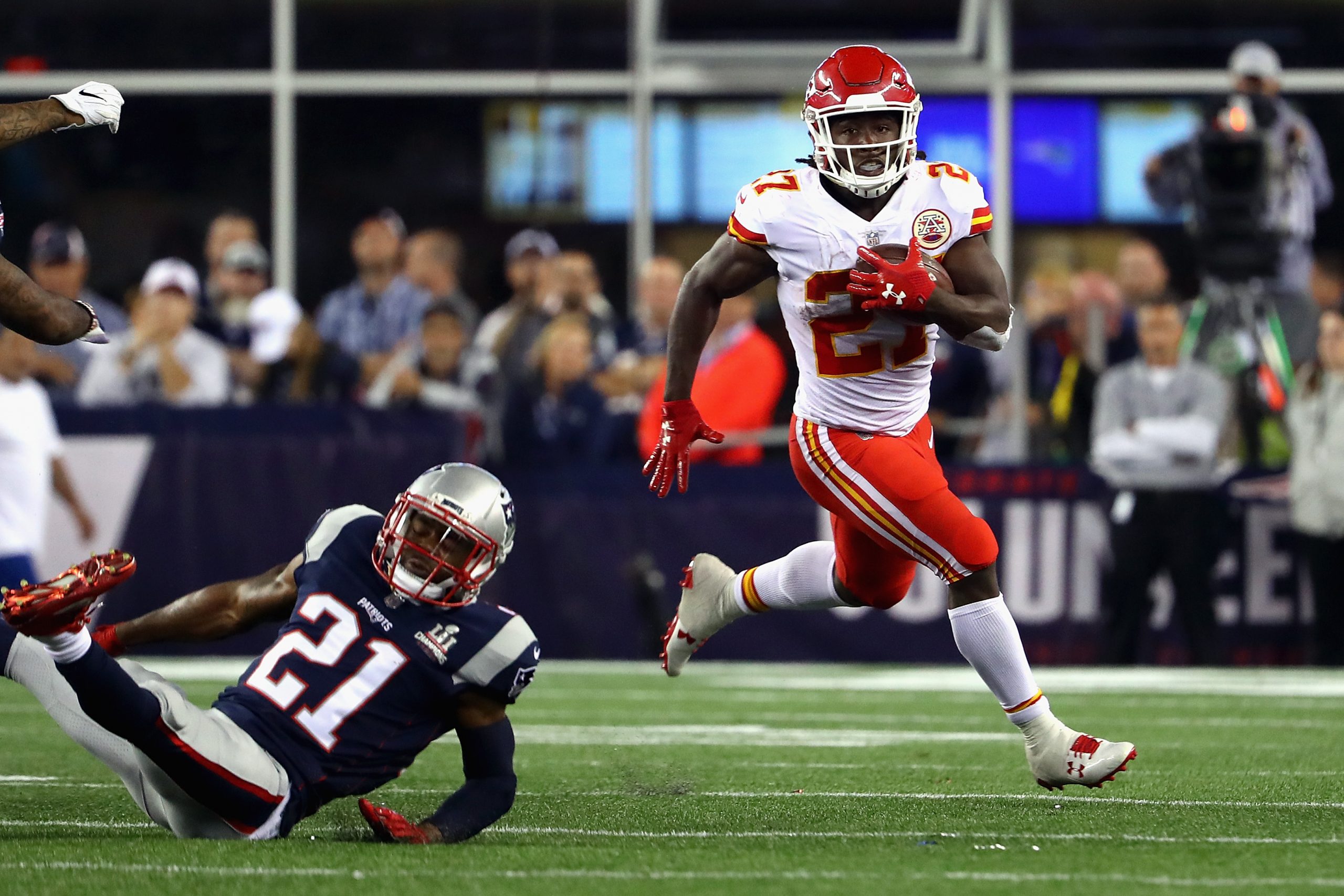
Chiefs running back Kareem Hunt (in white) was sensational in his pro debut Thursday, recording 246 all-purpose yards and three touchdowns in a 42-27 victory over New England. (Adam Glanzman/Getty Images)
Sweet Play of the Week. Trailing the defending champions 17-7, Kansas City faced second-and-goal on the Flying Elvii 3 with 17 seconds before intermission, holding a time-out. At this juncture a touchdown, not a field goal, is essential.
The Chiefs lined up trips left (three wide receivers on that side), with rookie tailback Kareem Hunt in the backfield. The trips guys were tight together, which should have told the New England defense the ball was not going to any of them. At the goal line, there’s so little room that “combo” patterns are asking for trouble, as the Seattle Seahawks learned to their woe on the decisive play of Super Bowl XLIX. Clemson beat Alabama for the big-college football title with a goal-line combo, but offensive pass interference should have been called. Successful goal-line combo routes are as hard to find as people who want to use Equifax to open a Wells Fargo account.
After the snap, all three combo guys “dragged,” running decoy routes to take defenders away from the playside. (On a drag route, you act like you expect the ball to come to you—this draws the defense toward you.) Kansas City left tackle Eric Fisher let his man go up the field as if inviting him to sack Alex Smith. Then Hunt ran a pattern underneath Fisher, to the area that had just been vacated, for a touchdown reception. Sweet.
Sour Play of the Week. With the game on the line, Kirk Cousins lost a fumble that Philadelphia defender Fletcher Cox turned into a scoop-and-score. This was a sour down for the NFL’s new headquarter-based review system, which should have reversed the call to incomplete pass—replays were conclusive. But the down was really sour for Potomac Drainage Basin Indigenous Persons guard Brandon Scherff and tackle Morgan Moses, both of whom barely brushed their men, allowing the jailbreak rush that created the hits on Cousins.
Sweet ‘n’ Sour Play of the Week. The Packers are among teams that call plays at the line of scrimmage to prevent the defense from using situation-substitution. When a defense tries to run substitutes in, Aaron Rodgers is adept at snapping fast to catch the opponent with too many men on the field.
Facing 3rd-and-2 at the Blue Men Group 32 late in the third quarter, Rodgers saw the Seahawks trying to bring in a short- yardage front. He hustled to snap the ball, and a flag flew for 12 men on the field. Jordy Nelson realized the zebras had not stopped the down and shot to the end zone for the touchdown reception that put the hosts in command 12-7. Sweet. Seattle fell asleep on the play—when Nelson took off deep, only middle linebacker Bobby Wagner followed him. Sour.
Stop Me Before I Blitz Again. The Lions faced 3rd-and-10 trailing Arizona 17-15 in the fourth quarter. Surely Matt Stafford expected a big blitz, as the Cardinals often big-blitz in this situation. It’s a double safety blitz, Detroit converts the first down, and scores on the possession to take the lead.
Just Run the Ball! What is it with California teams at the goal line? Four years ago in the Super Bowl, the 49ers, possessing an excellent power rushing attack, had 2nd-and-goal on the Ravens 5 at the endgame and went incompletion, incompletion, incompletion. All three incompletions were even directed at the same receiver.
Now it’s opening day 2017. The Oakland Raiders, possessing the rebooted Marshawn Lynch, reached 1st-and-goal on the Tennessee 2 and went incompletion, incompletion, incompletion, field goal. All three incompletions were even directed at the same receiver.
BOLO of the Week. All units, all units, be on the lookout for the Bengals and Giants offenses, which combined to score three points.
Be on the lookout for the Atlanta Falcons defense, which after losing a 28-3 lead in the Super Bowl, struggled to hold a 20-10 fourth quarter lead against the lower-echelon Bears. Atlanta had to survive two dropped Chicago touchdown passes from the Falcons’ 5 yard line in the closing seconds, else today the sports world would be atwitter over another epic fail by the Epic Fails.
A Cosmic Thought. On Friday, Cassini will crash into the atmosphere of Saturn. This probe has orbited the giant planet since 2004, and previously dispatched a small lander to Saturn’s moon Titan, where it returned data for around 90 minutes. On Titan, the lander did not encounter Martian soldiers chanting rented-a-tent, rented-a-tent while preparing a weapon to attack Earth, as happens in the Kurt Vonnegut novel The Sirens of Titan. At least, that’s what NASA wants us to believe. Somewhere in a guarded government vault may be audio of a strange chant of rented-a-tent moments before telemetry suddenly ceased.
When Cassini hits the saturnine atmosphere, presumably this will not cause a distant super-advanced civilization to destroy Earth. In Arthur Clarke’s 1982 book Odyssey Two, sequel to the better-known volume on which Stanley Kubrick’s 1968 movie A Space Odyssey was based, a second planetary expedition—the first did not go so well, if you recall the movie—triggers an ancient device that turns the planet Jupiter into a small star so that it can warm the Jovian moon Europa, where life will develop. Humanity is warned not to interfere, and never to send any technology to Europa.
In the original novel, Saturn, not Jupiter, is the destination, and Titan, not Europa, is the moon declared off-limits. Kubrick changed the destination to Jupiter because special-effects versions of Saturn’s rings looked way too cheesy. So Arthur Clarke was trying to warn humanity to steer clear of Saturn, and on Friday, into the planet’s atmosphere goes a probe with MADE IN THE USA stamped on the side. It’s just a novel! Aliens won’t attack on Friday!
Then next Monday, a lunar occultation will block Earth’s view toward Venus from much of the South Pacific. Perfect opportunity for an alien star cruiser to sneak up and exact vengeance for us dropping burned-out technology onto Saturn.

Nice going, space metal. (NASA Illustration)
The full title of Kubrick’s famous flick was 2001: A Space Odyssey. In that year—33 years into the future to Kubrick—there are colonies on the moon, an expedition en route to Jupiter, and a really far-out sci-fi concept: Pan American Airways still exists. The sequel was set in 2010, and depicted a world in which the United States, Russia, and China all launch gigantic manned spaceships to Jupiter.
Now it’s 2017 and nothing remotely like this is in prospect. There will be no expeditions to the outer planets, to say nothing of a manned landing on Mars, absent a propulsion breakthrough. I’d be happy if Elon Musk’s Falcon Heavy simply works, which would return space access back to where it was 50 years ago, when the big rockets of the Apollo program were flying.
Merely putting expendable rockets into the sky—something done routinely and flawlessly a half-century ago—has become an impossible goal for today’s process-and-delay obsessed government. NASA started a heavy rocket project in 2011. Currently the first flight is 2019—longer to stage a test flight than the Apollo program from go-ahead to walking on the Moon, which was accomplished when far less was known about rocketry.
Three years ago, Congress told the Air Force to stop using the Russian-built RD180 engine that for more than a decade has powered most rockets that place spy satellites in orbit. Last week the Wall Street Journal reported the replacement-engine project is so fouled up, U.S.-built engines equivalent to the RD180 won’t fly till at least 2022, and maybe not till 2025. Eleven years is the span between the Vanguard rocket blowing up on the pad in 1957, and the crew of Apollo 8 reading the Genesis story from lunar orbit on Christmas Eve 1968. Yet that’s how long the ultra-subsidized U.S. aerospace establishment says it now takes to produce a rocket engine similar to long-existing engines. Please join me in rooting for Elon Musk to disrupt this business.
Browns Already in Midseason Form. Cleveland’s first possession of the new season ended in a blocked punt recovered for a touchdown by Pittsburgh.
Why Isn’t Free Speech in the U.S. News Colleges Ranking? Due Tuesday is the next edition of the U.S. News & World Report college rankings, and whether you like college rankings or not, the publication is influential in the marketing of what has become a major sector of the American economy. U.S. News, which has moved from the mailbox to nearly all digital, has tried to behave responsibly with its rankings, regularly tweaking them to reduce the role of prestige while adding objective metrics. But at heart the reason Princeton is higher-ranked than Columbia, or Columbia higher-ranked than Johns Hopkins, or RPI higher-ranked than Lehigh or any other pairing you’d please, is status. Status is a huge aspect of colleges and universities. TMQ believes that a hard-working student at Kansas State will learn more than a slacker at Cornell, and there is research to back this contention. But there’s no getting around that status is part of what colleges are selling, and U.S. News is the Social Register of college status.
Given disturbing trends in free speech at elite campuses, U.S. News should add a weight for freedom of expression. Middlebury and Berkeley would tumble down the rankings if free speech were a criterion. Middlebury students who attacked the car in which Charles Murray and Allison Stanger were riding barely so much as received a wrist slap. According to Middlebury, an undisclosed number of students got “official college discipline, which places a permanent record in the student’s file. Some graduate schools and employers require individuals to disclose official college discipline in their applications.” Take that! If U.S. News took free speech into account, Claremont McKenna would rise in the rankings. Unlike Middlebury and Berkeley, Claremont McKenna did not coddle students engaged in P.C. intimidation.
Of course it’s not new for those attending college to behave foolishly, and surely most Middlebury and Berkeley students and faculty were disgusted by acts of intolerance. But imagine everything about the Middlebury situation was exactly the same except a left-wing speaker had been appearing at a conservative educational institution—say, Arundhati Roy had been speaking at Wheaton College of Illinois, where students shouted her down and then attacked the car she was riding in. The mainstream media would be ultra-outraged, while the academic left would demand not just a nebulous reprimand hidden in a sealed file, but prosecution and jail time. Let’s hope Alice Lloyd is right about the larger trend.
In Praise of Berea College. A wonderful alternative to the U.S. News status-focused worldview is the invaluable college guide published in recent years by the Washington Monthly. This guide gives significant weight to affordability, contribution to public service, and impact in helping the disadvantaged move into the middle class. Under national universities, the Washington Monthly’s new guide ranks Texas A&M fourth, ahead of most Ivies, owing to a much better record of public service.
In liberal arts institutions, Berea College finishes first, ahead of all NESCAC schools (Williams, Bowdoin, etc.), ahead of Swarthmore and Pomona, because of Berea’s amazing social-justice stats. At Berea, founded to serve the Appalachian poor, 83 percent of students receive Pell Grants (at Wellesley, 11 percent do); 43 percent of students are the first in their families to attend college (at Vassar, that share is 14 percent); and the net price of attendance for working-class families that is less than half of other private colleges.
Calling Jerry Maguire. In sports-agent news, the agent for Kirk Cousins, who’s looked terrible in his last three home starts, may be ruing—really ruing!—not trying harder in the offseason to land his client a long-term deal. But the agent for Texans left tackle Duane Brown, the league’s lone holdout, may be ordering champagne. The Texans were smacked around at home by the lowly Jaguars, surrendering 10 sacks in the process. Getting Brown back into the lineup immediately may become the priority in Houston.
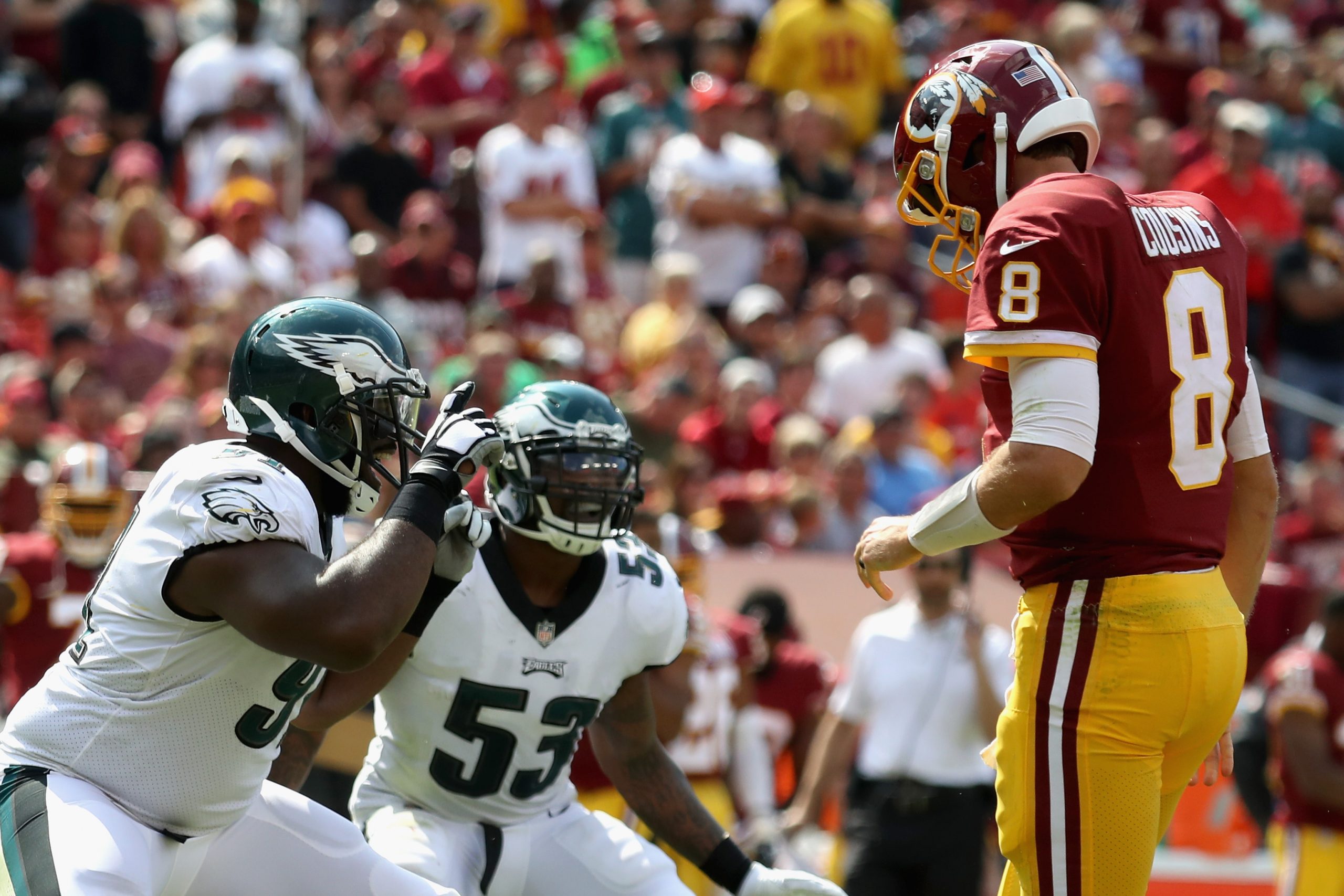
You can imagine what Eagles defenders Fletcher Cox (L) and Nigel Bradham (R) are telling Kirk Cousins here: You should’ve taken the money. (Photo by Rob Carr/Getty Images)
Disclaimer of the Week. “Professional driver on closed course.” This tiny- type disclaimer appeared below Kia ads that ran during NFL games on opening weekend. The ads show a hamster behind the wheel of a Kia. The hamster is a professional driver?
Quote of the Offseason. “I don’t pay too much attention to what’s on Instant Chat” – Bill Belichick. This is the case against social media, boiled down to a sentence. Unfortunately social media is winning: See the fine new book iGen by Jean Twenge, also excerpted in the current Atlantic.
Before Thursday’s opener between Belichick’s Patriots and the Chiefs, NBC showed the coach of the defending champions speaking to kids at his old high school. Was that . . . a smile on Bill Belichick’s face?!? As Skipper of the Madagascar penguins would say, “What have you done with the real Belichick?” If Belichick for whatever reason has decided to start enjoying life, the Patriots are finished.

We’re waiting, coach. (DreamWorks Animation/Vimeo screengrab)
The Football Gods Chortled. Matt Stafford and Scott Tolzien threw pick-sixes on their first attempts of the season.
One-Back Takes Over the NFL. Anyone interested in sports analytics simply must have the Football Outsiders Almanac, run by the estimable Aaron Schatz. A few insights gleaned from the 2017 edition:
- In 2016, NFL offenses went one-back on 78 percent of snaps.
- Last season 64 percent of NFL snaps were from shotgun formation. Sixty-six percent of snaps involved at least three wide receivers.
- Just five seasons ago, most of the league was in a two-back set at least 50 percent of the time. By the 2016 season, only Buffalo and New England used the traditional two-back set more often than one-back or empty sets.
- Eighteen percent of 2016 offensive downs were play-fake, and five percent involved more than five offensive linemen.
- Defining a blitz as more than four pass rushers, 27 percent of 2016 defensive downs were blitzes. The “house” blitz—six or more rushing the passer—happened on six percent of defensive downs.
- New England had the NFL’s best defense in 2016: The Patriots blitzed a below-average 21 percent of the time, and employed the “house” blitz a below-average 3 percent of the time.
- The Jets and Saints had the highest NFL percentage of big-blitzing, bringing the house 13 percent of the time. The result was the Jets were 28th in defense and the Saints were 31st.
- Only 54 percent of sacks were by defensive linemen, the balance by linebackers or defensive backs.
- Nickel and dime defenses—at least five defensive backs—were fielded on 68 percent of snaps, a conventional four-defensive back alignment employed only 32 percent of the time. This means the “base” defense on depth charts and announced to fans pregame, which almost always involves four defensive backs, is not in fact the base defense: The nickel is now the NFL’s base defense.
- Despite TV announcers promoting the notion of mano a mano duels between elite wide receivers and top cornerbacks, on 76 percent of NFL downs, the corners line up on the same side of the field regardless of where the other side’s best receivers go.

The unofficial drink of your New England Patriots. (Photo credit: Jeff Wilcox)
New England Turns Back into a Pumpkin Spice Latte. From the juncture at which they fell behind 28-3 in the Super Bowl till the second quarter of the NFL opener, the Patriots outscored opponents 48-7. Then New England turned back into a pumpkin, outscored by Kansas City 35-10 on the Flying Elvii’s own field.
The deciding play came early in the fourth quarter when the defending champions, trailing 28-27 and knowing the fourth quarter generally favors the home team, went for it on 4th-and-1 in Kansas City territory and were stuffed. TMQ’s Law of Short Yardage holds: Do a little dance if you want to gain that yard. Misdirection is essential on short yardage downs; in this instance, the Patriots just lunged straight ahead from a power set, and failed.
The Chiefs defense opened in a standing-front look, which meant they expected New England to pass constantly, but also meant only three, or even just two, rushing Tom Brady. For the second half Kansas City shifted to a conventional front with a four-man rush, and was putting pressure on Brady, especially a sack at 5:14 remaining. Usually Bill Belichick gets the better of other coaches on tactical judgments, but this time Andy Reid got the better of him.
The 42 points and 537 yards surrendered by Matt Patricia’s defense—a fluke or an omen? New England was first against points in 2016, and mostly controlled the Atlanta offense in the Super Bowl; through 19 games last season, Patricia’s charges allowed only six plays of more than 40 yards, including no such plats interception e Super Bowl. On one night in Foxboro, Kansas City had offensive snaps of 78, 75, and 58 yards.
During the offseason, Belichick, who rarely opens Robert Kraft’s wallet, invested megabucks in free-agent corner Stephon Gilmore—despite Tom Brady having burned Gilmore badly when the Patriots faced him last season. Highly sophisticated observers (me) thought placing a decal of an airborne Elvis on Gilmore’s head instantly would make him a better player. But he was terrible in the opener, allowing the 75-yard touchdown to Tyreek Hill: a down on which Gilmore let Hill blow past, then barely bothered to jog after him. The Chiefs had two receivers wide on each side, and the Patriots were in Cover 1 (single safety high) with Gilmore and Devin McCourty on the playside. Hill ran an out-and-up. Gilmore made the same mistake he did in 2016, when Brady turned him into burnt toast on a similar action: “Looking into the backfield” trying to guess the play, rather than sticking with his man. Maybe Kansas City noticed from film study that Gilmore made that mistake in 2016. Belichick and Patricia hadn’t coached him up about not looking in the backfield: very un-Patriot-like.
Last spring in the draft, Kansas City general manager John Dorsey conducted a king’s ransom trade for quarterback Patrick Mahomes. The deal displeased Reid, who campaigned, successfully, to get Chiefs management to jettison Dorsey. But in that same draft, Dorsey found Kareem Hunt with the 86th selection. If Hunt turns out to be a poor-man’s Christian McCaffrey, there may be a comic-book-style retconning in which Dorsey is seen as having done a great job with his final draft.
Adventures in Officiating. Last week TMQ wrote, “Good luck to zebras with the league front office directive to ‘strictly enforce’ penalties involving ‘low hits on the passer rules designed to protect quarterbacks in the pocket from forcible contact to the knee area or below.’”
It didn’t take long for the first controversy. In the second quarter of the Monday Night Football opener at Minnesota, the Vikings sacked Drew Brees on third down—a clean-looking play that would have been kosher anytime in the century from the legalization of the forward pass until this week. But roughing the passer was called, because a Viking hit Brees low. If he’d hit Brees high, that would have been a penalty, too. The automatic first down sustained a New Orleans drive that resulted in a field goal.
Under the new rule, it’s going to prove hard to tackle a quarterback in a passer stance in a legal manner. I am not being sardonic when I say: Put flags on the quarterback, and tell defenders to pull the flag. That would be a clear standard that would allow sacks without the dubious roughing-the-passer calls likely to be in store for this season.
Buck-Buck-Brawckkkkkkk. Trailing 27-3 in the third quarter at LA/A, the Colts faced fourth-and-6 on the Rams’ 20. If the visitors are to come back, a touchdown here is essential—all a field goal would accomplish is reducing the margin of defeat. Outraged, the football gods caused Adam Vinatieri’s kick to hit the uprights. Moments later, Indianapolis trailed 37-3.
Trailing 23-0 in the third quarter at Santa Clara, the 49ers faced 4th-and-6 on the Panthers’ 26. If the hosts are to come back, a touchdown here is essential—all a field goal would accomplish is reducing the margin of defeat. In this case, Kyle Shanahan ordered the placekicker in to avoid having to listen to the sentence, “You got shut out in your head coaching debut.”
Reader Animadversion. Last week’s column obsessed about junk-science predictions, such as claiming to know, to the tenth of a percentage point, how the presidential election will play out. Readers including Julia Connor of Boulder, Colorado, write that another form of predictive junk-science is forecasting results that cannot occur. She points out that an ESPN prediction of NFL 2017 team-by-team finishes adds up to 283 victories. “The maximum number of victories in an NFL regular season is 256,” Connor notes. Everybody’s above average! ESPN forecasts 24 NFL teams to finish the season with winning records: In 2016, there were 15 winning NFL teams.
Reader Barbara Grunwald of Clovis, California, reminds that this column once called the 49ers the Squared Sevens—the square of seven is 49. I guess this means the team’s official cognomen must now be Santa Clara Squared Sevens.
Reader Paul Gillings of Wakefield, West Yorkshire, singles out a glaring error in last week’s column. I said the Patriots were the most recent team to make back-to-back Super Bowl appearances. As Gillings notes, the Seahawks, in 2014 versus Denver, then in 2015 versus the selfsame Flying Elvii, is correct. The error was by me, not by a WEEKLY STANDARD editor. Though, I reserve the right to blame editors for future errors.
Will Sheldon Richardson Become Gruntled at Seattle? The season-eve trade that sent Sheldon Richardson to Seattle for Jermaine Kearse and a second-round draft choice—since the transaction moved the latter player to Jersey/B, you are unlikely to hear the name Jermaine Kearse again this season—included, in the fine print, that the Seahawks and Jets flip-flop seventh-round selections in the next draft. Best-case, this will let Seattle choose a tad higher in the least important round. It’s a gratuity: “Here you are my good man, here’s your disgruntled defensive tackle, and I’ve thrown in a little something for your effort.”
SI Curse Lives. The Sports Illustrated NFL-preview edition featured a prediction that the Patriots would win the Super Bowl, and Tom Brady as cover boy. Needless to say, New England was thumped in its opener.
The Financing of Big-College NCAA Football Makes Enron Look Honest. After Notre Dame lost a close game to Georgia on primetime national TV, Irish coach Brian Kelly acted as if the world had just ended. Is that what colleges should teach? During last January’s Alabama-Clemson title game, when a Crimson Tide player was flagged for illegal motion, Nick Saban—who’s paid about $11 million a year, plus lavish perks that are propped up by tax deductions—screamed at THE guilty party on national television, berating the “college student.”
It’s not news that coaches of big-college football programs don’t even pretend to be involved in education, or to stand for anything other than their own paychecks. But the situation seems to be getting even worse—players are taken advantage of, neither receiving diplomas (first choice) nor pay (second choice), while coaches roll in money. Marc Tracy of the New York Times provides disturbing new details on the latter. It’s long been clear the NCAA, and the big-money football conferences, have no shame. Why does Congress continue to allow donations to this swindle to be tax-deductible?
Obscure College Score. Every autumn at colleges all across our great nation, leaves fall and ill-tempered plastic-clad gentlemen slam into each other. The collegiate ritual of football, bands, drinking, dates, and hooting-and-hollering may no longer include pleated skirts for women and coat-and-tie for men, but the essence is the same as it was at the Harvard-Yale game a century ago. Tuesday Morning Quarterback recommends attending college football at the Division 1AA, Division II, Division III, and NAIA levels—the quality of play may be surprisingly good, events are human-scale, parking isn’t expensive, and burgers and dogs cooked by a mom’s booster club always taste best.
Each week Obscure College Score will highlight a contest that was not reported on ESPN or Fox Sports. This week’s is Lawrence 27, Finlandia 22. Trailing 25-22 with 1:27 remaining, Finlandia took over on its 1 yard line and immediately committed two major penalties, resulting in a safety that iced the contest for Lawrence. Located in Hancock, Michigan, Finlandia University “is the only institution of higher learning in North America founded by Finns.”
The 500 Club. Versus Tennessee on the collegiate Monday-night opener, Georgia Tech rushed for 535 yards, and lost. Versus Tulsa this weekend, Louisiana Lafayette gained 596 yards on offense, and lost—barely missing admission to the even more prestigious 600 Club. Visiting Samford, West Alabama gained 522 yards on offense, and lost. If you know of a high school team that gained a huge amount of yards, or scored more than 50 points, and still lost, tweet it to me @EasterbrookG—I’ll need a URL or newspaper box score as verification.

A parliament of owls. A flamboyance of flamingoes. A conference of cupcakes.
March of the Cupcakes. Fresno State opened its season by hosting Incarnate Word, a lower-division cupcake that had been hired to fly to California and lose: The Cardinals kept their end of the bargain, losing 66-0. But as the good book says, “The measure you give will be the measure you get.” This weekend it was Fresno State’s turn to be the hired cupcake, flying to Alabama to lose 41-10 to the Crimson Tide. Fresno State’s boosters are celebrating, as the Bulldogs covered the 43.5-point spread, triggering a payout for anyone who put action on Fresno State.
Next Week. Assuming aliens don’t destroy the Earth as vengeance for the desecration of Saturn, by next week I should have some tormented, backtracking explanation of why I picked the Texans for the Super Bowl, who then lost at home to the Jaguars.