
CHARLESTON, S.C. – The South Carolina Republican primary campaign has taken some sharp turns in the last few days, with the withdrawals of Rick Perry and Jon Huntsman from the race; with the fallout from the news that Rick Santorum, and not Mitt Romney, had more votes in the Iowa caucuses, where missing ballots made a certified result impossible; and with the resurgence of Newt Gingrich after a near-death experience in New Hampshire.
On top of that, there will be the aftereffects of Thursday night’s debate before South Carolinians go to the polls on Saturday, plus the voters’ reaction — extremely difficult to predict — to Marianne Gingrich’s decision to publicly attack her former husband.
But if you dig beneath all of that, this race is also being driven by a simple contrast in the styles of Mitt Romney and Newt Gingrich. Behind the debates and the ads and the surrogates are two candidates who approach voters in different ways.
More and more, Romney’s campaign events have taken on the characteristics of a general-election campaign. There are big stages, good lighting, powerful sound systems, lots of advance staff, and security people talking into their cufflinks. Voters who attend a Romney rally see a well-produced show.
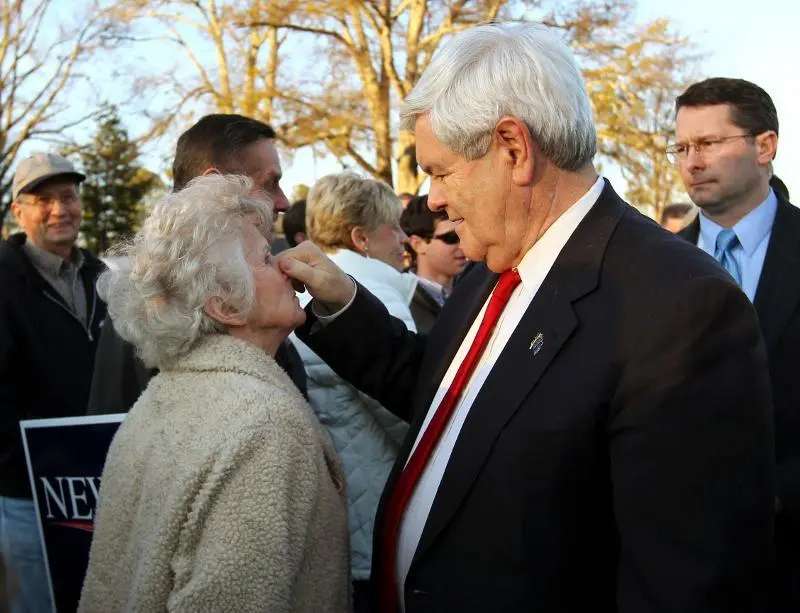
Gingrich, not so much. Still operating on a tight budget, the former speaker’s events are less buttoned-down and produced. There might be a stage, there might not. There might be music, there might not. It all depends. But the big difference is how the candidates engage the voters who come to see them.
Neither man comes across in public as warm. No matter how relaxed and comfortable they might be in intimate settings with family and friends, at big public events neither Romney nor Gingrich seems particularly approachable. Romney gives his audiences speeches that can feel canned, filled with bland phrases like “Believe in America,” which can leave audiences with the sense that they’ve just heard a shorthand version of the case for Romney’s candidacy.
Gingrich, on the other hand, just talks to voters — and he speaks to them as equals who are just as interested in the substance of things as he is. Although Gingrich, like all other candidates, uses some lines over and over again, a speech at one of his events is more than anything a discussion of what Gingrich is thinking about at the moment he walked to the microphone. The effect is more casual and more human than Romney’s.
Take how each man discusses the nation’s founding. In this time of intense interest in the Declaration of Independence and the Constitution, candidates often cite the Founders, and at recent appearances, both Romney and Gingrich discussed the meaning of unalienable rights and the pursuit of happiness.
It is “the right of Americans to pursue their dreams, as they choose,” Romney told an audience in Rock Hill, S.C., on Wednesday. “We’re not bound by the circumstances of our birth, we’re not told by government what we can and cannot do. We pursue happiness as we choose. We are a merit society — an opportunity society where people can achieve success and achieve their dreams based upon their education, if they can get some, their willingness to work hard, their willingness to take risks, maybe have a little good luck. … This merit society, interestingly, does not make us poorer when [people] are successful. Instead, it makes us better off.”
It was a perfectly workmanlike recitation, ending with what was perhaps a little defense of Romney’s success in the face of attacks from Gingrich and others. But it did not seem to actually connect with the audience.
For Gingrich, the Founders present a chance for a long discussion of first principles, usually in far more detail than Romney. But judging from audience reactions, Gingrich is able to make his subject more interesting, and more accessible.
“In the 18th century, happiness meant wisdom and virtue, not hedonism and acquisition,” Gingrich told an audience in Myrtle Beach on Monday. “Notice it’s the right to pursue happiness — not a guarantee of happiness. There’s no provision in the thinking of the Founding Fathers for happiness stamps for the under-happy. There’s no suggestion we need a Federal Department of Happiness to monitor whether or not we’re achieving it. And if you had said to the Founding Fathers, imagine a politician coming into the room to say, I’m now going to take from the over-happy to redistribute to the under-happy — they would have thought that was crazy. They would have said by what right does a politician reshape the entire society based on his or her whim?”
Audiences seem to leave Gingrich events feeling a little more connected to their candidate than Romney’s crowds do — and that could be a factor on Saturday.
Byron York, The Examiner’s chief political correspondent, can be contacted at [email protected]. His column appears on Tuesday and Friday, and his stories and blogposts appear on washingtonexaminer.com.
