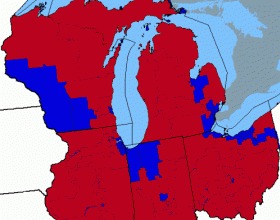
Today’s entry is the last in our series reviewing the 2010 midterm electoral results. Our final chapter covers the Midwest. This region has been swinging electoral outcomes in the United States for more than 200 years. It was a key element in the Jeffersonian majority from 1800 to 1824, then it was also a vital element in the Jacksonian coalition from 1828 to 1860. Lincoln and the Republicans realigned it in 1860, but the Democratic revival in Indiana and Ohio made for a competitive party system from about the Panic of 1873 to the Panic of 1893. After that, McKinley and the Republicans won it back, and it stayed Republican until the Great Depression. For the last 60 years, both parties have traded leads in this important region, which has facilitated the regular changeover in party power since the death of Franklin Roosevelt.
The reason for this is the diversity of the region. Consider, for instance, Ohio in the 19th century. Southern Ohio was full of migrants from the South, and thus was tilted to the Democrats. Northern Ohio was full of Yankee migrants from New England, and thus tilted Republican. But it also had a mix of farming as well as industry, giving the two parties economic bases of support. (This is why so many “no name” Republican presidents from the 19th century were from Ohio. It was an easy way to capture the Buckeye State’s crucial electoral votes!) While our understanding of the phrase “political diversity” is very different in the 21st century, it remains true that states like Ohio are stil very diverse, and very well balanced. Both parties have solid bases of support that rarely fall below 45 percent, making the small share of Ohio voters swing voters very important.