
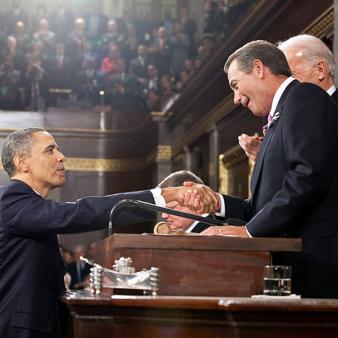
A funny thing happened to our dysfunctional government. It functioned, unwittingly perhaps, but function it did. President Obama forced Republicans, unwilling to risk the political consequences of taking America over the fiscal cliff, to accept a $180 billion tax increase. Republicans returned the favor by forcing the president to live with an across-the-board spending cut—the sequester—that he had long-ago proposed, confident that Congress would never implement it. He guessed wrong. As a result of these tax increases and spending cuts, our government’s deficit is headed down. It was $1.1 trillion in fiscal 2012, will be about $845 billion this year, and fall to $615 billion in fiscal 2014, almost half the amount of red ink spilled in 2012. The deficit-to-GDP ratio is also falling, from 7 percent in 2012 to 5 percent this fiscal year, and to a reasonably acceptable 3.7 percent in 2014. The Treasury actually will be paying down debt in this quarter. Yes, April is typically a month of high tax collections, and the Treasury will resume borrowing in the next quarter. Still, this is the first quarter since 2007 in which the Treasury will pay off at least a few of our IOUs.
Republicans are unhappy that this touch of fiscal sanity has been purchased at the price of substantial tax increases, Democrats that it has been bought by cutting some of their precious spending programs, voters that the President has ordered his bureaucrats to maximize the pain of spending cuts and that their pay checks have shriveled as a result of the increase in payroll taxes.
Real journalism.Trusted by millions.
Unlimited access to in-depth reporting, expert analysis, and the stories that shape our country.
Already a member? Log in