

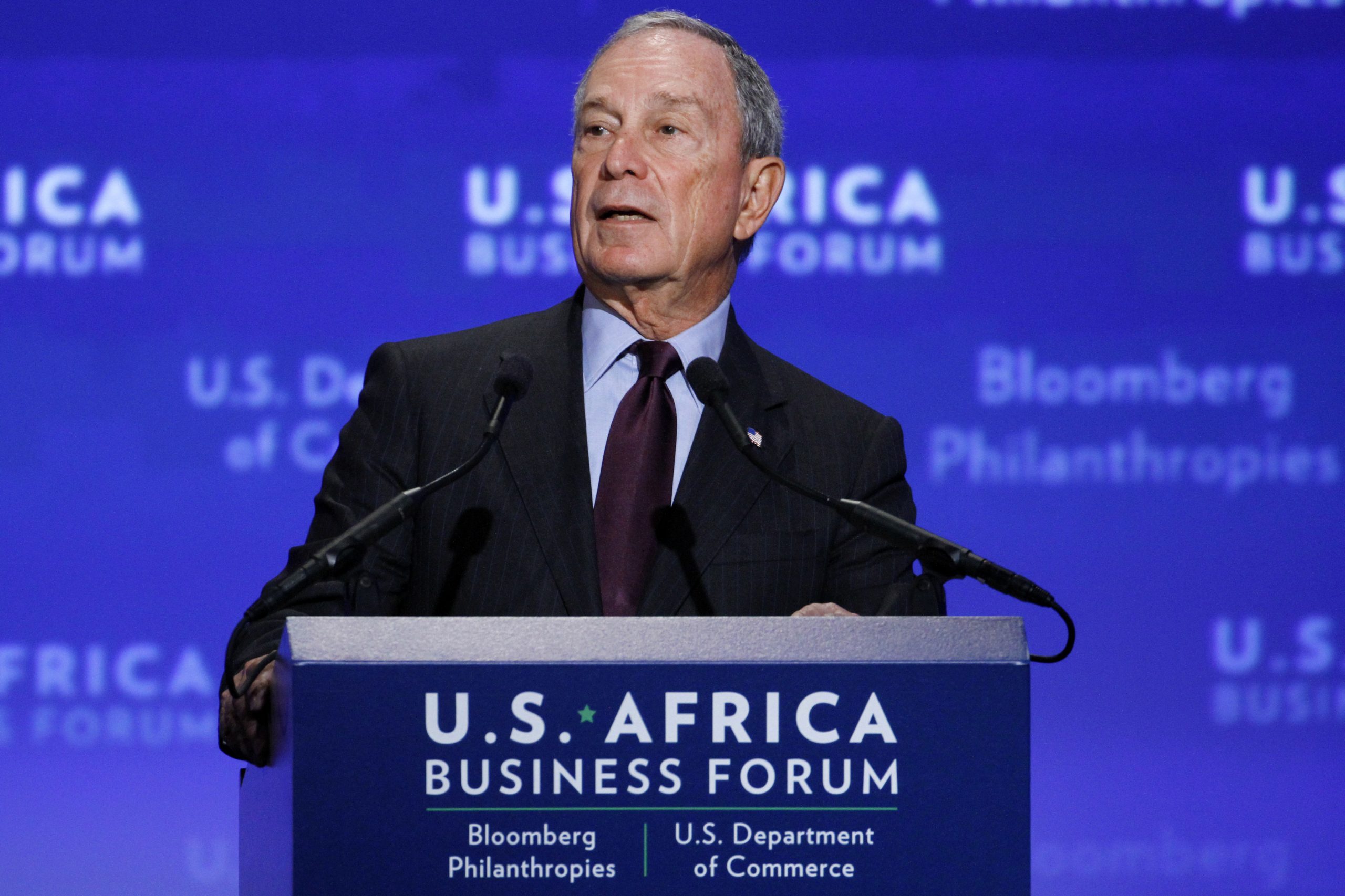
MADRID — Billionaire and 2020 presidential candidate Michael Bloomberg said he came to the United Nations climate talks in Madrid because President Trump wouldn’t.
Bloomberg had a whirlwind tour Tuesday of the United Nations Conference of the Parties meeting, where countries are hammering out the last few aspects of the rules to implement the Paris climate agreement.
Recommended Stories


The global climate talks come just a month after Trump submitted formal documentation for the United States to withdraw from the global climate pact. The White House sent no political officials — only a small team of career negotiators from the State Department, the Environmental Protection Agency, the Department of Agriculture, and other agencies who are keeping a low profile outside the negotiating room.
Bloomberg, who just wrapped a term as the U.N. secretary general’s special envoy on climate change, spoke at an event on sustainable finance, gave remarks at a panel focused on local-level climate efforts, and presented a new report from his initiative, America’s Pledge, that details how states, cities, companies, and other groups in the U.S. are addressing greenhouse gas emissions in the absence of federal policy.
His candidacy, though, has generally been met with mixed reactions from environmentalists, given the already-crowded 2020 field and Bloomberg’s initial commitment to climate change advocacy investments in lieu of a run.
At the climate talks, Bloomberg revealed a little of what he would focus on as president related to climate change.
His visit to Madrid was also coupled with his campaign’s release of international climate priorities. Those include swiftly rejoining the Paris Agreement, applying a border adjustment fee on carbon-intensive goods from other countries, and crafting a roadmap with cities, states, and tribes to reach a new 2030 emissions target. Bloomberg’s priorities say he would hold “immediate talks” with the top 20 global emitters to bring them on board with that new 2030 target, as well.
The next U.S. president “should end all subsidies for fossil fuel companies and fossil fuel extraction, and that includes tax breaks and other special treatment,” Bloomberg said early Tuesday at the sustainable finance event.
And when presenting America’s Pledge report, he suggested it could provide a roadmap for federal action over the next decade.
The report, released in Madrid on Monday, finds that scaling up efforts by U.S. states, cities, and businesses could lead to a 37% emissions cut below 2005 levels by 2030. Add in the equally aggressive federal action, the report says, and the U.S. could slash emissions by 49% by 2030.
“This is Americans’ answer for filling in what the U.S. government did not want to do,” Bloomberg said, presenting the report to Patricia Espinosa, the executive secretary of the U.N. Framework Convention on Climate Change. “We’re all in, and we’re going to continue what we’re doing.”
He added he is “looking forward to this November’s election and a new president in 2020.”
