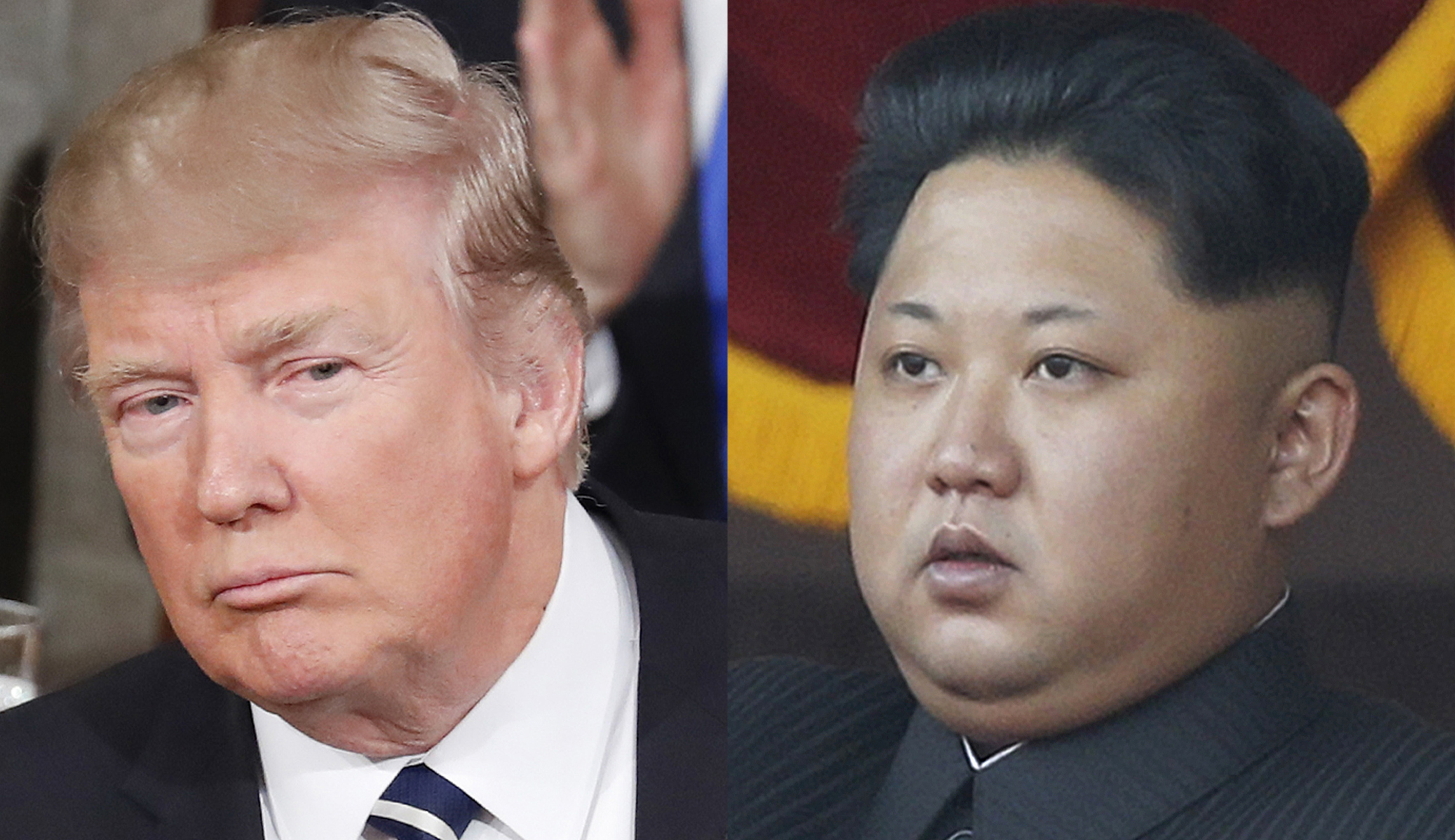
As tensions grow on the Korean Peninsula, President Trump is preparing for possible military action.
He is right to do so.
Yes, the use of force against North Korea’s ballistic missile program would be a dramatic and risky venture. Still, as I’ve explained, a North Korea that puts nuclear warheads on intercontinental ballistic missiles cannot be deterred. The military option must thus be held in reserve.
In addition, if China is to pressure Kim Jong Un to negotiate with the U.S. seriously, Chinese leaders must believe that Trump will use force if they do not.
That said, the absolute best outcome to this crisis is a diplomatic arrangement that addresses both U.S. and North Korean concerns. What would such a deal look like?
I think it would have four key characteristics:
1) The U.S. would accept that Kim Jong Un won’t surrender his nuclear weapons program. This is a hard thing to admit, but it is almost certainly a prerequisite of any deal. The North Korean government has come to believe that its nuclear weapons are the surest way of ensuring their regime’s survival. Imbued with their “Juche” ideology of self-reliance, they believe nuclear weapons are the ultimate insurance policy against U.S. invasion.
But from the U.S. perspective, those nuclear weapons are not, by themselves, a critical threat to U.S. national security. What makes them a critical threat is their emplacement on intercontinental ballistic missiles. And addressing that capability must be the absolute priority of any diplomacy.
2) In turn, the second component of any deal should be the verified suspension and dismantling of North Korea’s ICBM program. In contrast to the Iran deal, the verifications process in North Korea would have to be watertight. That would mean a significant International Atomic Energy Agency presence and the full cooperation of Kim’s regime. The U.S. would have to make clear to China that if North Korea obstructed these efforts, the deal would die, and military action would swiftly follow.
3) In return for North Korea’s acceptance of ICBM disarmament, the U.S. should be willing to provide Kim’s regime with security assurances. This might include a written peace treaty to officially end the Korean War. Commensurate with North Korean redeployments, it might also entail a withdrawal of U.S. armed forces from the Korean demilitarized zone. Finally, South Korea would engage new economic investment programs in North Korea.
These investments would show Kim that he has gained from the deal, but also consolidate his domestic position with the elites. As proved by Kim’s occasional purges, “the Marshal” is hyper-paranoid about conspiracies against his rule. As such any deal that affords Kim the means to reward patrons, would offer significant appeal.
4) The deal would have to ensure North Korea does not use other nations as intermediaries (cutouts) for continued ballistic missile testing. Iran and Russia are of particular concern here. As I’ve explained, Iran is determined to achieve an intercontinental ballistic missile capability. Russia, of course, is happy to trade technology and human expertize for hard cash. Again, it would be crucial that China be made aware that any North Korean efforts to sidestep the deal would mean military action.
Ultimately, any deal would have to balance the carrot and the stick. North Korea would have to be offered compromises it could accept alongside rewards it would appreciate. Simultaneously, North Korea and its Chinese patron would have to know that cheating would mean American security imposed by the coercive instruments of U.S. military power. If North Korea and China believe the U.S. won’t use force to resolve the crisis, they won’t do what is necessary to resolve it peacefully.
As the Mongols learned, peace on the Korean Peninsula has never been a simple venture. Nevertheless, it is a worthy pursuit.
Trump can render positive recording in history if he gets a deal. And as Matthew 5:9 reminds us, blessed are the peacemakers, for they shall be called the children of God.
