

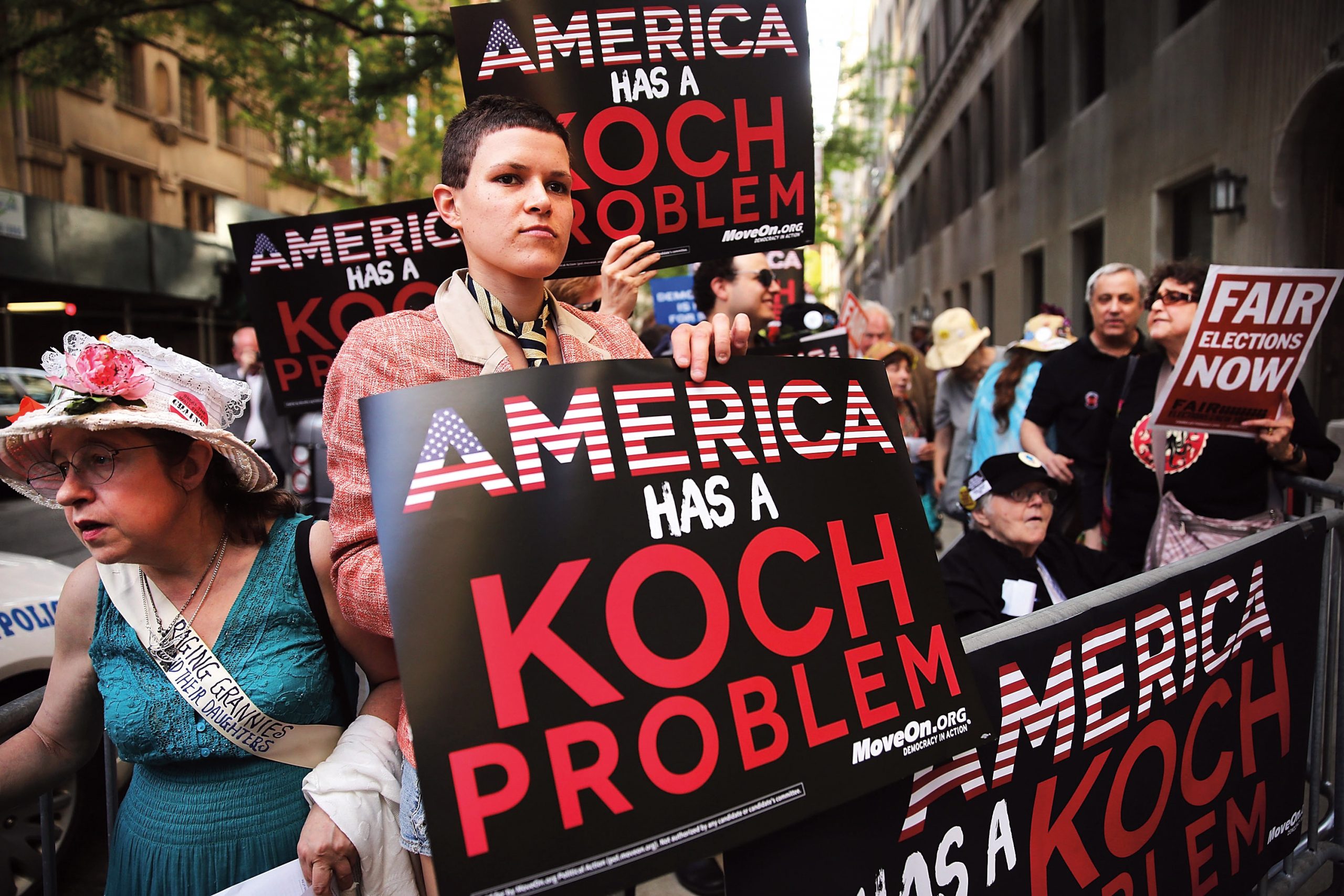
It has been six months since Majority Leader Harry Reid strode onto the Senate floor on a mission to save his job.
His defense took the form of offense — a verbal assault on two Republican billionaires few Americans had heard of.
Recommended Stories


To some observers the attack on Charles and David Koch appeared questionable both in terms of decency and effectiveness. But Reid has been pounding away at them ever since.
The Kochs are behind several GOP groups, including Americans for Prosperity, that by March had already spent millions of dollars attacking Democratic lawmakers who seemed most vulnerable. Control of the Senate, which had been in Reid’s tight grip since the 2006 election, was at stake.
Reid set the tone for how Democrats would fight back. He made it personal, playing on pronunciation of the brothers’ last name (as in “Coke”) to accuse the GOP of being “addicted to Koch.”
Reid’s wife cooked up the catchphrase, catnip to the middle-school sense of humor of Washington’s political class, and the Democratic Senatorial Campaign Committee gleefully echoed the refrain.
Still, there was a hitch in the plan: Few people were familiar with the Koch brothers. In mid-March, a George Washington University Battleground Poll showed that fewer than half of Americans had ever heard of them.
Now, however, thanks largely to Reid and the Senate Majority PAC with ties to him, many more voters know of the Koch brothers, at least in places where it matters most for Democrats.
In states such as Iowa, New Hampshire, and Colorado, Democratic efforts to disparage the Kochs and tie them to Republican Senate candidates have been particularly aggressive, and the brothers’ name recognition has risen.
Justin Barasky, a DSCC spokesman, explained it this way: “It’s never been about raising their name ID as much as it’s been about forcing Republican Senate candidates to own the numerous positions they’ve taken that are good for billionaires like the Kochs and bad for middle-class families.”
That strategy manifested itself in a tape leaked from a conference the Kochs held earlier this year at which Republican candidates, including Iowa’s Joni Ernst, praised the brothers’ work. The recording was prime fodder for Democrats.
Democratic attacks on the brothers have resonated in states where the party has linked the Kochs to local issues, especially through subsidiaries of Koch Industries. The strategy mimics Democratic attacks in 2012 on Bain Capital, the investment firm founded by Republican Mitt Romney.
In Alaska, where Sen. Mark Begich is in a tough fight for re-election, Democrats have zeroed in on a Koch-owned oil refinery that laid off 80 workers.
“Those jobs mean everything for a lot of folks around here, but for those Lower 48 billionaires that are shutting it down, those jobs are just numbers on the spreadsheet,” says one pro-Begich ad as the Koch name and photos of Charles and David Koch flash across the screen.
One Democratic strategist estimated that at least 25 ads have attacked the Koch brothers in this election cycle.
“I tend to gloss over when the Koch brothers are mentioned,” National Republican Senatorial Committee spokesman Brad Dayspring told the Alaska Dispatch News in response to one ad. “Every Democratic candidate mentions it.”
As one Democratic strategist reasoned, “We wouldn’t be doing it if it wasn’t effective.”
In the Michigan Senate race, Democratic Rep. Gary Peters can’t stop talking about the Kochs.
“I feel like I’m not really running against [Republican] Terri Land, I feel like I’m running against the Koch brothers,” Peters said at a campaign event in July.
Democrats say invoking the Kochs has helped Peters maintain a slim lead over Land in most polls, but it has taken months of raising their profile to pay dividends.
Michigan Democrats have found that focusing on the alleged environmental impact of Koch subsidiaries is more persuasive than ads about layoffs.
“The Koch brothers and Koch Industries have such a wide reach, in almost every state you can find something they’re involved in,” said one Democratic strategist with ties to Michigan. “Making the Koch brothers seem like an opponent of Michigan, that was really important here.”
In May, nearly half of Michiganders recognized the name “Koch.” By July, the number had jumped more than 10 points to 60 percent — just short of Peters’ name recognition in the state. Democrats estimate the Kochs’ name ID in Michigan is even higher now.
It remains to be seen whether attacking rich men will be enough to help Democrats keep their majority in the Senate and vindicate Reid, who pushed the idea in the first place. But in a year with few bright spots for Democrats, the party is hopeful.
“Everyone made fun of [Reid] for six months for kicking the crap out of the Kochs, but he was right,” said the Michigan Democratic strategist. “When we keep the majority by one seat, people will come back and say the damage we did to the Koch brothers made the difference.”
