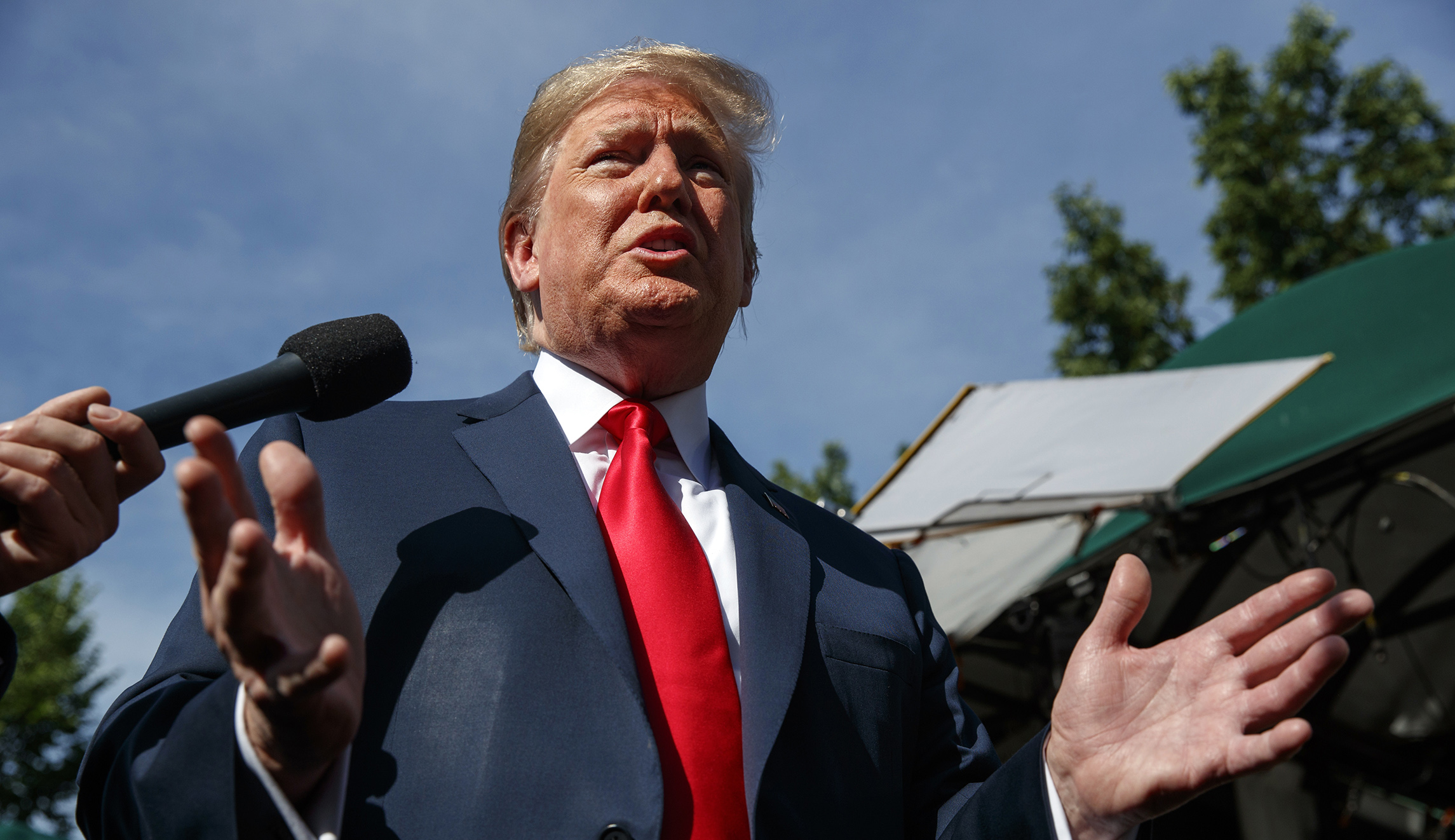
President Trump generated another controversy this morning when he said of North Korean dictator Kim Jong Un, “he’s the head of a country, and I mean he is the strong head. Don’t let anyone think anything different. He speaks, and his people sit up at attention. I want my people to do the same.”
Even if we’re charitable and take Trump at his word that he was merely joking rather than literally desiring being treated as a dictator, the casualness with which he speaks of the North Korean regime is still unsettling. It comes after a week of Trump offering public admiration of the strength and toughness and popularity of Kim, and is part of a decadeslong pattern of Trump associating authoritarianism with strength and freedom with weakness.
Recommended Stories
In the wake of China’s brutal crackdown of protesters at Tiananmen Square, most Americans were inspired by the image of the Chinese man who stood in front of the tank. But in 1990, Trump told Playboy, “When the students poured into Tiananmen Square, the Chinese government almost blew it. Then they were vicious, they were horrible, but they put it down with strength. That shows you the power of strength. Our country is right now perceived as weak.”
Asked about this in 2016 in a CNN Republican primary debate, Trump insisted he was not endorsing the behavior, yet added, “I said that is a strong, powerful government that put it down with strength. And then they kept down the riot. It was a horrible thing. It doesn’t mean at all I was endorsing it.”
In the same debate, he went on to defend positive statements he had made in speaking about Russian President Vladimir Putin, “As far as Putin is concerned, I think Putin has been a very strong leader for Russia. I think he has been a lot stronger than our leader, that I can tell you. I mean, for Russia, that doesn’t mean I’m endorsing Putin.”
Yet throughout the campaign, Trump went further than merely saying that Putin was strong, he crossed over into moral relativism, suggesting that the evil actions Putin was taking weren’t much different from America’s actions. Comparing U.S. actions with that of totalitarian regimes is a line of argument that has historically enraged conservatives when expressed by the far left.
“He’s running his country and at least he’s a leader, unlike what we have in this country,” he told MSNBC’s “Morning Joe” in Dec. 2015, adding, “I think our country does plenty of killing also, Joe, so you know. There’s a lot of stupidity going on in the world right now, a lot of killing going on, a lot of stupidity.”
In Sept. 2016, asked by Matt Lauer about Putin’s malicious actions, he responded, “do you want me to start naming some of the things that President [Barack] Obama does at the same time?” Interestingly, in the same interview, he praised Putin’s high approval rating. That’s a theme he would come back to this week when describing, inaccurately, the popular support and “fervor” that the North Korean people have for Kim.
As president in Feb. 2017, Trump would later infamously respond to Bill O’Reilly’s comment that Putin was a killer by saying, “There are a lot of killers. You think our country’s so innocent?”
Looking at Trump’s history of statements actually runs counter to the conspiracy theory that Trump’s complimentary words for Vladimir Putin must mean that Russia has dirt on him. Trump’s description of totalitarian rulers has been pretty consistent over the years and is not specific to Putin. Just this week, he said of Kim’s bad actions, “so have a lot of other people done some really bad things. I mean I can go through a lot of nations where a lot of bad things were done.”
It seems that what’s at the heart of Trump’s comments is a “strong man” view of the world. Rulers like Kim and Putin do what they need to do to advance the interests of their country and are respected for it.
The flip side of this is this is the way Trump contrasts these sort of rulers with wuss American presidents who won’t do what’s necessary. This is part of his rhetoric on diplomacy, on domestic law and order issues, and on trade, where America is constantly getting ripped off because we’re weak when every other country is strong.
We see it also in his talk of revoking press credentials and revisiting libel laws or, if you trust former FBI Director James Comey, joking about jailing reporters; in the way he called Sen. Ted Cruz a “pussy” for equivocating over the use of torture; or boasted about how he’d give the death penalty to any cop killers; or even how he talked about confiscating guns from potential threats without due process.
Despite all the fears going into his presidency, U.S. institutions have generally held Trump in check and there’s little evidence that he in reality wants to establish some sort of dictatorship. Yet it’s impossible to look at the breadth of his statements without acknowledging that they show somebody who is often frustrated with the roadblocks that exist to getting things done in America while admiring the efficiency of a totalitarian state where rulers can do what they need to do.
What’s sad about this is that in the past, U.S. presidents have viewed the freedoms that exist in America as the source of our strength, rather than weakness. This was central to Ronald Reagan’s conviction, in the face of all naysayers, that the U.S. would prevail over the Soviet Union. “What I am describing now is a plan and a hope for the long term — the march of freedom and democracy which will leave Marxism-Leninism on the ash-heap of history as it has left other tyrannies which stifle the freedom and muzzle the self-expression of the people,” he said in a 1982 speech to members of the British parliament.
There’s a reason why the U.S. has persisted with a stable government for well over two centuries as many dictatorial regimes have risen and fallen — if only Trump would learn it.
