
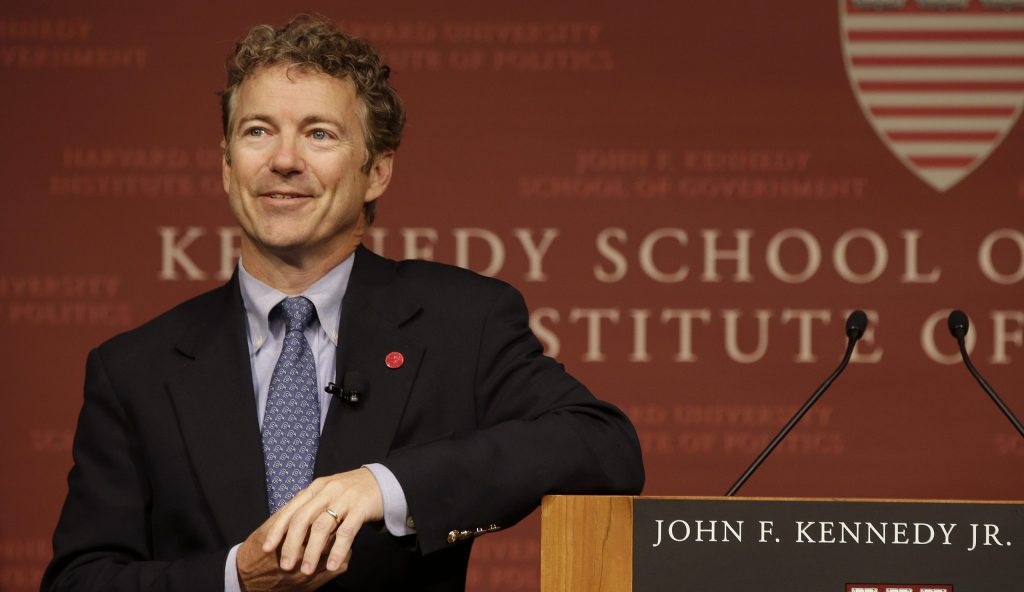
Rand Paul gets something about Russia that other senators don’t

The Senate can be an incredibly clubby institution. Senators will often commiserate over a steak dinner or huddle together in the Dirksen Senate Office Building, nurturing the types of personal relationships that are critical to pushing bipartisan legislation to the floor. Unlike the more populist and partisan House of Representatives, the Senate prides itself in being more level-headed, sober, and civil. Watch the senatorial proceedings on C-SPAN long enough, and you will often see senators on the floor laughing with each other and patting one another on the back as if they were old pals.

Sen. Rand Paul, R-Ky., is technically a part of the club. But compared to many of his colleagues on both sides of the aisle, he is a bit of a loner and a proud contrarian. He pushes the envelope when others in the chamber would much rather have smooth, painless proceedings so they can go home for a weekend of fundraising or constituent meetings. Earlier this year, Paul single-handedly shut down the federal government for several hours by delaying a series of votes on a massive funding bill that would have kept the lights on. To those on both sides of the political aisle, it was another stunt orchestrated by Paul to burnish his credentials as an independent voter. To Paul, however, it was about the principle of protesting an omnibus bill that made an already big deficit problem bigger.

The Kentucky senator is irritating his colleagues yet again, this time over the subject of U.S.-Russia relations. At a time when Democrat and Republican lawmakers alike are competing with one another over who can introduce the most anti-Russia sanctions bill, Paul is flying to Moscow to meet with Russian officials and lobbying President Trump to lift some travel restrictions on Russian parliamentarians so they can come to Washington for meetings. The vast majority of Capitol Hill is hell-bent on punishing Russian President Vladimir Putin for a laundry list of offenses, from continued cybermeddling in America’s political system to the Kremlin’s unwillingness to withdraw its troops and intelligence operatives from Eastern Ukraine. Rand Paul, as he usually is, is the man on the outside looking in and wondering why his fellow legislators are so ideologically and politically adverse to talking with the Russians.

Paul has a point. As has been stated many times over, the U.S.-Russia relationship is in the doldrums. In fact, the old Russia hands in the Beltway are fond of telling anybody who will listen that the last time ties between Washington and Moscow were this bad, Ronald Reagan was in the Oval Office and Mikhail Gorbachev was just a member of the Soviet Politburo. While the U.S. and Russia may not be lobbing threats of nuclear annihilation at each another like in the old days, U.S. and Russian forces have come dangerously close to colliding in Syrian airspace and are essentially engaged in a proxy conflict in Ukraine’s Donbas. U.S. pilots have actually killed hundreds of Russian mercenaries in Eastern Syria. And with Putin marketing new weapons systems and presenting graphics of Russian missiles impacting targets in the great state of Florida, Baby Boomers can be forgiven for experiencing a little deja-vu.

So what is the problem with Paul meeting with Russian officials or attempting to spark a civil, substantive discussion between U.S. politicians in the Congress and Russian politicians in the Duma? Notwithstanding the knee-jerk opposition to his trip and the lazy, ad-hominem attacks levied against him as Putin’s favorite advocate in Washington, I have yet to come across a convincing explanation for why Paul shouldn’t be doing what he’s doing. Some may not like the optics of a senator shaking hands with Russians on their home turf or recoil from a discussion about lifting symbolic travel restrictions on top Russian lawmakers, but this is a small price to pay for the possibility of a better understanding between representatives of the world’s two largest nuclear weapons powers. Promoting dialogue should be welcomed, not vilified.

No one is anticipating a magical transformation to a loving marriage between the U.S. and Russia. As long as Vladimir Putin is in the Kremlin, it will be very difficult, if not impossible, for the Trump administration (or any administration for that matter) to turn bilateral relations around. Russia will continue to be an adversarial power; to hope for anything better than that is probably an exercise in futility.

Fortunately, the U.S. doesn’t need to have an intimate relationship with Russia to defend its national interests and prevent the kinds of miscalculations and misunderstandings that can lead to disaster. Washington does, however, need some kind of constructive working arrangement if it hopes to get anything done at the United Nations Security Council (where Russia holds veto power) or maintain a degree of predictability and stability on arms control. Rand Paul gets it. The only question is how long it will take the rest of his colleagues to get with the program.

Daniel DePetris (@DanDePetris) is a contributor to the Washington Examiner’s Beltway Confidential blog. His opinions are his own.

Related Content