Scalia, a great jurist, sharpens focus one last time

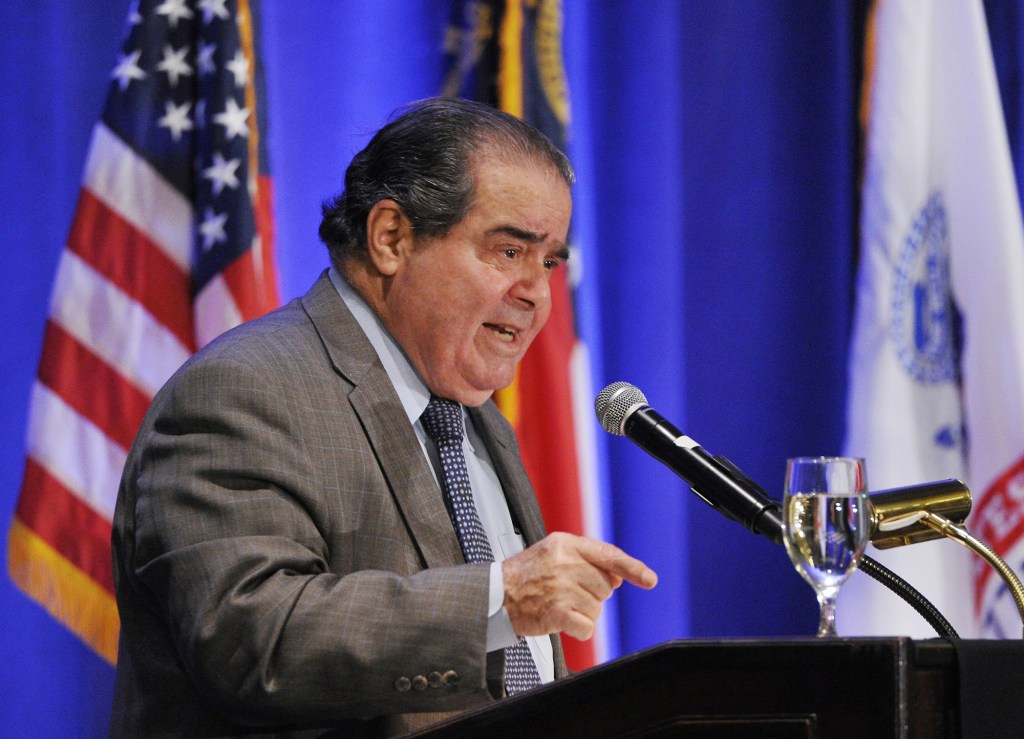
Justice Antonin Scalia, who died Saturday, was not just a conservative icon. He was also a great public servant and one of America’s clearest legal thinkers. His opinions, dissents and questions in open court were full of his sharp wit and colorful expression. He was a great jurist and will be sorely missed.

His death is not only a blow to the republic, but also a reminder of how deathly serious the 2016 election really is.

Perhaps in spite of himself, Scalia became something of a popular icon. It is hard to imagine other justices getting the sort of reaction he did during oral argument in 2012, when he wondered aloud whether Obamacare’s individual health insurance mandate might be similar to a government requirement to buy broccoli. He helped make such phrases as “argle bargle,” “pure applesauce” and “jiggery-pokery” famous in his opinions.

When dissenting — and he was very prolific with dissenting opinions, being often the clarion voice of constitutional textualism in an epoch of dirigiste liberalism — Scalia at times would openly mock his colleagues, as in one opinion where the majority (in his opinion erroneously) ruled on what constituted a “fundamental” part of the game of golf.

Scalia enjoyed speaking in public, and more than once his appearances outside the courtroom raised eyebrows. Of the Citizens United decision, which weakened campaign finance laws and upheld the right to spend money on political speech, he excoriated those who would blame the court for any resulting problems. “I don’t care who is doing the speech,” Scalia said in a forum with Justice Stephen Breyer. “The more the merrier. People are not stupid. If they don’t like it, they’ll shut it off.”

Scalia had a clear philosophy of the judiciary that was based on interpreting laws as they were written and passed. He was critical of judges’ eagerness to divine legislative intent through other means, an issue that came up in the recent King v. Burwell decision, also related to Obamacare. In one famous 1987 dissent, he listed more than a dozen potential reasons why a legislator might have proposed or voted for something, including a desire to mend fences (or burn bridges) with other legislators, drunkenness at the time of the vote, or anger at his own wife. It was not the court’s place, he said, to judge laws based on such considerations.

Scalia’s pet peeve was the modern tendency to frame every perceived wrong as something that had to be unconstitutional. He believed that in constantly ascribing new and hidden rights to a document that did not contain them, justices were turning the Supreme Court into a super-legislature that dictated cultural norms, rather than a true judicial panel.

He took this position most famously in Lawrence v. Texas, which in 2003 struck down state laws against homosexuality. His position was that if people wanted those laws repealed, they should go to their elected state legislatures for a remedy.

As he put it in a later interview, referring to the issue of equal rights for women: “If the current society wants to outlaw discrimination by sex, hey, we have things called legislatures, and they enact things called laws,” he told the magazine California Lawyer five years later. “You don’t need a constitution to keep things up-to-date. All you need is a legislature and a ballot box. … Persuade your fellow citizens it’s a good idea and pass a law. That’s what democracy is all about. It’s not about nine superannuated judges who have been there too long, imposing these demands on society.”

In 1992, he had similarly written of abortion, “The permissibility of abortion, and the limitations upon it, are to be resolved like most important questions in our democracy: by citizens trying to persuade one another and then voting.”

The idea of a “living” or “evolving” Constitution repelled Scalia. In his view, it represented a backdoor way of letting unelected judges substitute their own values for those of the people who made the decisions to vote and ratify the Constitution and its amendments. “The risk of assessing evolving standards,” he wrote in one dissent, “is that it is all too easy to believe that evolution has culminated in one’s own views.”

There is only space here for the smallest sampling of Scalia’s thinking. But his death underscores the seriousness of the election now underway.

Presidents appoint Supreme Court justices, albeit with the consent of the U.S. Senate. With Senate Majority Leader Mitch McConnell, R-Ky., signaling that there will be no confirmation this year, the task will likely fall to the next president. If Republicans choose an unelectable nominee, Hillary Clinton will likely appoint two or even three justices. This would create a left-wing court that will, as Scalia would have hated, shape cultural norms for another generation.

Republican primary voters should have this fact at the front of their minds when they make their choice.

Related Content