

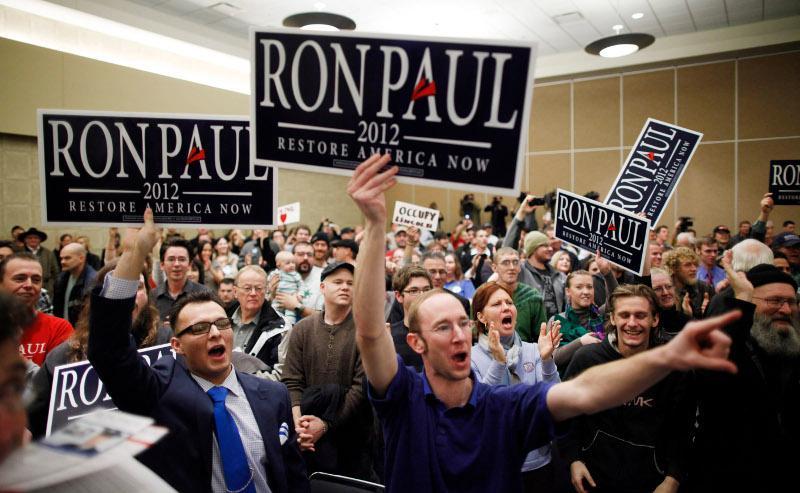
DES MOINES, Iowa – To his passionate fan base, it’s no surprise that Rep. Ron Paul, R-Tex., is within striking distance of winning the Iowa caucuses, with just three days to go. But for many Republicans who consider him to be a wacky libertarian with troubling foreign policy views, it’s a bit of a mystery how that has a chance of winning – and this sense of puzzlement extends to Iowans who are supporting other candidates. But after several days of speaking to voters and attending several Paul campaign events, I’ve found a number of reasons why he’s been able to move beyond being a fringe candidate to actually being a threat to win the state.
From the outset, it’s worth remembering that Paul began the 2012 campaign with a preexisting fan base here in the Hawkeye state. He received 9.9 percent of the vote in the 2008 caucuses, which was just over 4,000 votes shy of a third place finish. In many senses, his campaign never really left the state in the intervening years, building a strong grassroots organization that could be the difference on Tuesday when everything will depend on turnout.
Recommended Stories


On top of the head start he had over other candidates, a number of events have helped him expand that base – the most important being the collapse of the economy and explosion of our nation’s debt. While it’s now popular for Republicans to criticize the Federal Reserve Board in the wake of the bank bailouts and deficits under President Obama, Paul has been doing so for decades, and he has a consistent voting record when it comes to limiting government. He voted against the big government Bush era initiatives that most Republicans embraced, such as the Medicare prescription drug bill. When I spoke to voters who said they planned to support Paul or are leaning toward him, a big factor was that they trusted him most when it came to budgetary matters, something that’s borne out by the Des Moines Register poll released last night. According to the survey, 42 percent of likely caucus-goers said Paul is the “most concerned about reducing government debt”; 35 percent described him as the “most consistent”; and 44 percent said he was the “most dedicated to limiting the influence of government.” On all three questions, he was the leading candidate by a roughly 20-30 point margin. Not a bad place to be in the Tea Party era of GOP politics.
The shift in focus in issues also helped him mitigate problems many Republicans have with his foreign policy. In 2008, national security was a much greater concern for Republicans as America was still in the midst of the Iraqi surge strategy and we were closer to the Sept. 11 attacks. Now, some people who may not share his non-interventionist foreign policy views are more inclined to overlook their differences, because other concerns have taken over. Also, it’s been historically true that during tough economic times, there’s a more sympathetic audience to the argument that we can’t be worrying about the rest of the world, because we’ve got enough problems to deal with here. During his speeches, Paul frames his non-interventionist foreign policy arguments as a budgetary concern – that we simply can’t afford to be spending trillions of dollars overseas. It’s a message that’s winning converts. When I visited a Paul town hall meeting in Sioux City, Iowa, I spoke to Dan Mulder of nearby Orange City, who was considering supporting Paul primarily because of his interest in seeing deep spending cuts, but he had concerns when it came to foreign policy. After Paul spoke, Mulder told me he felt more comfortable getting behind the candidate. “I feel more open to his philosophy on it right now,” Mulder said, which he no longer feared as a total disregard for defending the nation from attack. “I like his stance (that we need to) take care of ourselves first.”
Another factor is that his campaign has gotten savvier about pandering – something that doesn’t come naturally to Paul. As I’ve already reported, Paul is making an explicit appeal to social conservatives, not just on abortion, but also on protecting traditional marriage. He wouldn’t be able to win here as a libertarian purist. At the same time, as the Weekly Standard’s John McCormack has written about in greater detail, despite his vow to cut spending by $1 trillion in his first year in office, Paul doesn’t touch Social Security and Medicare – the primary drivers of our nation’s debt. And he points this out during his campaign appearances. This appeals to people who would like to believe the source of our budgetary problems is that we’re squandering too much money on foreign aid and bank bailouts, rather than programs from which they benefit. At a Paul event in Sioux City, Iowa Friday night, Dan Wurth who is still undecided, but considering Paul, told me restraining entitlements was one of his most important issues, but he added “not Social Security and Medicare.” When I asked him why he didn’t consider Social Security an entitlement, he said, “because I’m on Social Security” and paid into it. He said he was sympathetic to Paul’s views about not sending so much money overseas.
Another factor working in Paul’s favor has been that nobody but his most dedicated supporters thinks the 76 year-old is likely to actually become president, so he’s escaped a lot of the scrutiny that other candidates have endured, and until very recently, it wasn’t in any of his rivals interests to attack him. So as they focused on attacking each other, Paul went through debate after debate without being challenged on racist material that appeared in newsletters under his name. There wasn’t a spate of negative ads blasting Paul for supporting drug legalization, the right of states to allow gay marriage, or any of the other issues that would alienate voters here. This weekend, while other candidates are whizzing around the state, Paul decided to take two days off and go back to Texas. Were he considered a real threat to win the presidency, the media would have seized on that as an indication that he may be too old to be president. But why bother pursuing that story when he’s not likely to get to the White House anyway? I ran a man at a Newt Gingrich rally in Atlantic, Iowa, and he told me he was voting for Paul to send a message even though he knew he wasn’t electable (he blamed the media for this).
Take all of this together, and you have a confluence of factors that are helping propel Paul at or near the top of the polls in Iowa.
