

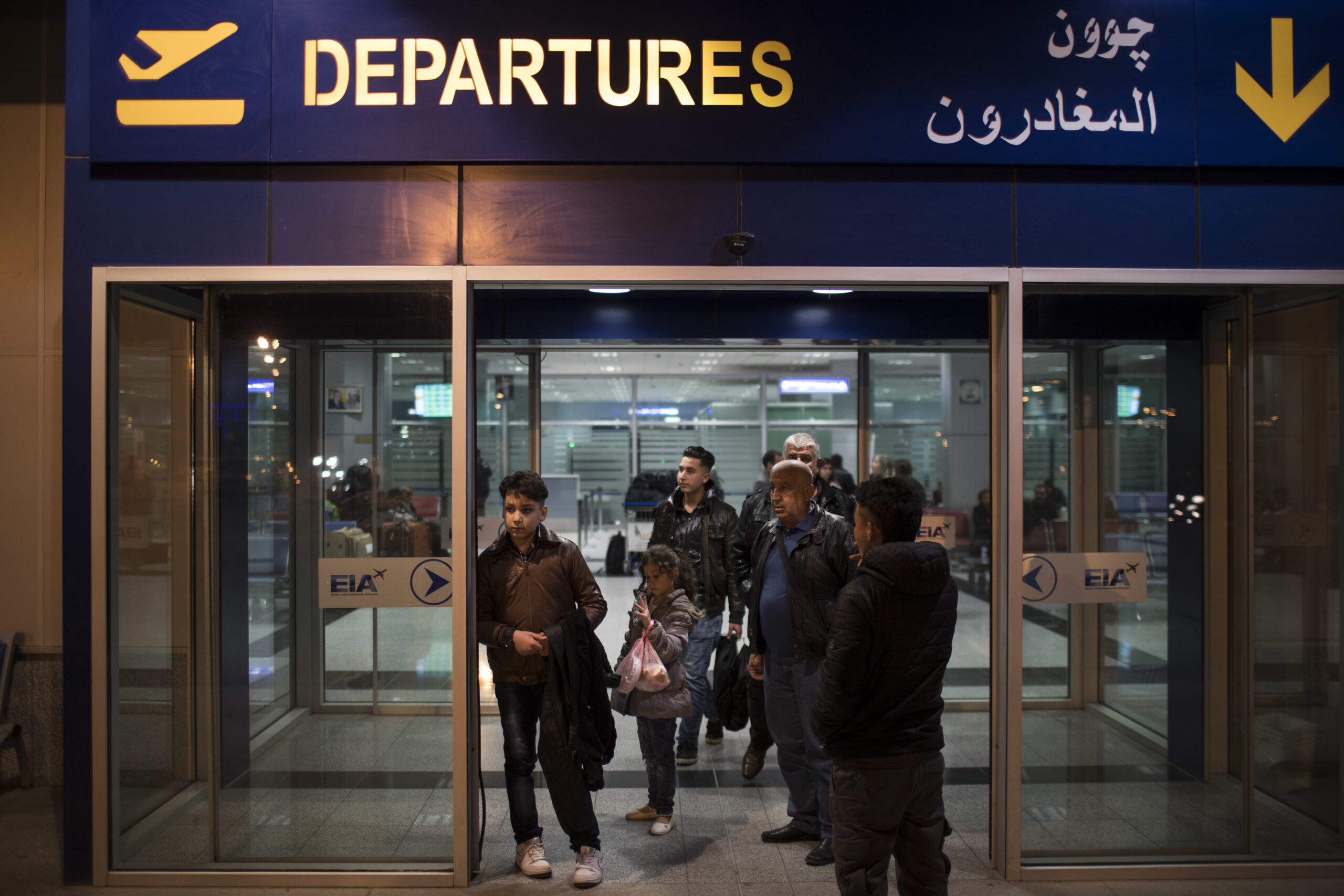
After months of court delays, President Trump’s executive order on immigration will take effect, in part, on Thursday night at 8 p.m. Eastern time after a Supreme Court ruling earlier this week reversed two lower court rulings that had completely blocked its implementation.
Recommended Stories


The Department of Homeland Security announced official details of how it will be implemented about two hours before it’s due to take effect.
“The department expects business as usual at our ports of entry upon implementation of the EO today. U.S. Customs and Border Protection officers are trained and prepared to professionally process in accordance with the laws of the United States persons with valid visas who present themselves for entry. We expect no disruptions to service,” DHS said in a press release.
The onus will now be on individuals from Libya, Syria, Iran, Somalia, Yemen and Sudan to produce a “credible claim of bonafide relationship” with either an entity such as a workplace or university, or a person living in the United States.
If no close relationship exists, then the person is banned from coming to the country for 90 days. That reflects the Supreme Court decision, which said the order could take effect only for those immigrants with no close ties to America.
For example, certain close family members — a parent, spouse, child, adult son or daughter, son-in-law, daughter-in-law or sibling — will not be affected by the ban. Others — including fiancees, grandparents, grandchildren, aunts, uncles, nieces, nephews, cousins, brothers-in-law, sisters-in-law and any other “extended” family members — will not be allowed entry.
All refugees from any country are also banned for 120 days from coming to the U.S. without evidence of a close relationship.
“The suspension of entry in the E.O. does not apply to individuals who are inside the United States on June 29, 2017, who have a valid visa on June 29, 2017, or who had a valid visa at 8:00 p.m. EDT January 29, 2017, even after their visas expire or they leave the United States,” read State Department guidance sent to all U.S. embassies and consulates on Wednesday evening.
Any relationship “must be formal, documented, and formed in the ordinary course, rather than for the purpose of evading” the executive order, it said.
Refugees traveling to the U.S. through July 6 will be allowed entry. There is a cap of 50,000 refugees allowed to resettle in the country in this fiscal year. As of Wednesday night, the limit had almost been reached at just more than 49,000.
Civil rights and immigration groups have already said they will send monitors to Los Angeles, New York and Washington to make sure no one is wrongly denied entry into the country. But others remained opposed to the policy.
“Separating families based on these definitions is simply heartless,” said Naureen Shah, director of campaigns for Amnesty International USA, in a statement. “It further proves the callous and discriminatory nature of Trump’s Muslim ban.”
Trump issued a revised executive order in March, excluding Iraq from the country list. The original order signed Jan. 27 was halted in February by a federal judge in Seattle on Feb. 3 and then the 9th U.S. Circuit Court of Appeals six days later. The administration then petitioned the Supreme Court to review his second order.
The Supreme Court on Monday lifted most of the lower-court injunctions against the order and announced it will hear oral arguments on the case in its October term.
