
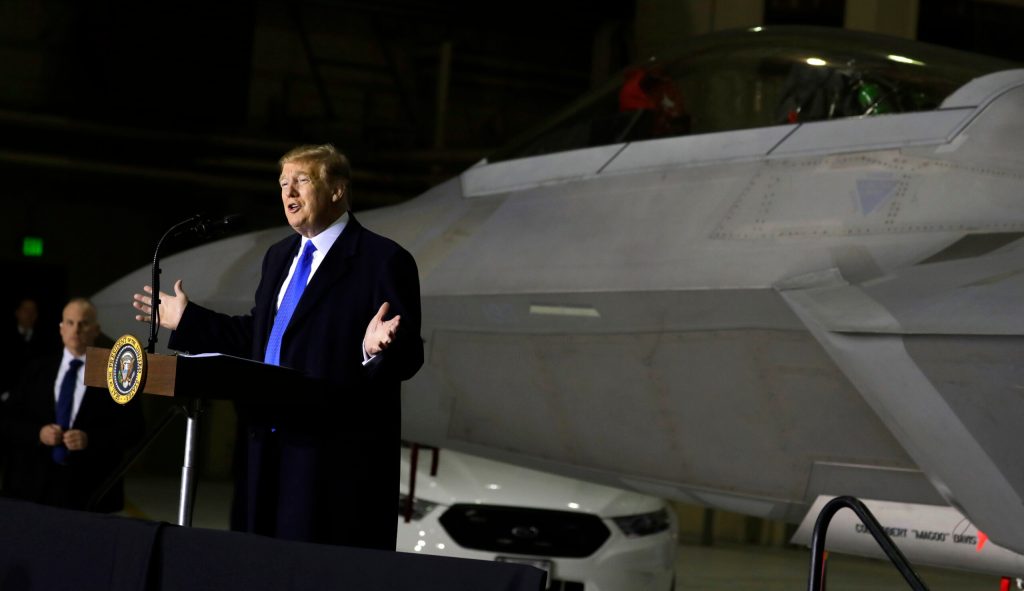
While President Trump is boldly proclaiming to the public that “great nations do not fight endless wars,” his own national security advisers appear to be preparing a legal rationale for a new one.
Senior Trump administration officials are discussing options for possible U.S. military strikes on Iran in retaliation for hosting of al Qaeda militants on its soil, the Washington Times reported this month. If such an operation were to commence, at least some of those officials believe the White House could go to war without explicit congressional approval under the 18-year-old 2001 Authorization for the Use of Military Force.
That 60-word AUMF provides the president with the power to “use all necessary and appropriate force” against al Qaeda and the Taliban in response to the Sept. 11 attacks. It has already been stretched to the breaking point to justify airstrikes on al Qaeda affiliates and sympathizers from Pakistan to Somalia who have little to no real connection to the Sept. 11 attacks, and, in some cases, did not form until after 2001. To claim the AUMF could include Iran, a country that had no connection to the Sept. 11 attacks, and a Shia power whose interactions with al Qaeda are at best transactional and laden with mistrust, would be a gross violation of the power Congress afforded the president nearly two decades ago.
Since the 2001 AUMF was enacted, the executive branch has cited the law 37 times to justify a policy decision relevant to counterterrorism. While some of those decisions were appropriate, such as using military force against known al Qaeda operatives who planned specific terrorist attacks against the United States, others have been far beyond the law’s original scope.
The Obama administration, for example, explained its bombing campaign against the Islamic State in Iraq and Syria as compatible with the 2001 authorization — even though ISIS and al Qaeda viewed one another as mortal enemies at the time and were competing for land, money, and recruits. The statute has been used to send U.S. military trainers and advisers in dozens of countries around the world, from the Philippines and Kenya to Nigeria, Cameroon, Chad, and Niger.
The pace of U.S. deployments under the 2001 authorization has so accelerated that senior lawmakers are often unaware of where American soldiers are operating at any given time. When four U.S. soldiers were killed in an ambush near the Mali-Niger border, several members of Congress were shocked to learn Americans were on Nigerien soil to begin with.
For administration officials to even debate the question of whether this AUMF permits the United States to hypothetically bomb Iran suggests that interventionists within the administration are willing to deliberately misread the law in order to pursue their agenda.
Dangerously, legislators have avoided the accountability that comes with difficult decisions about war and peace. Congress’ war powers have essentially been surrendered to the executive branch, a development rank-and-file lawmakers are just now beginning to recognize as a problem that has rendered the legislative branch’s power increasingly toothless.
Going beyond legal concerns, there is also a strategic reason why using force against Iran is a downright crazy proposal: Iran is a menace to the region, not a threat to dominate it, and it is certainly not a direct national security threat to the U.S.
The Iranian government has funded, employed, and leveraged proxies — a sign of weakness, not strength — to thwart regional rivals and pursue its own foreign policy goals, seeking advantage where it can find it. Iran is a master of exploiting its adversaries’ mistakes, whether it’s Saudi Arabia’s intervention in Yemen or U.S. regime change in Iraq. But, while Tehran uses illicit means in order to defend and promote its regional strategy and national interests, it is doing nothing its adversaries, chiefly Saudi Arabia and the United Arab Emirates, haven’t done in the past or, indeed, continue to do.
More important, Iran doesn’t come remotely close to being a peer competitor to the United States. With a $454 billion GDP hemmed in by international sanctions, Iran’s economy is approximately one-third the size of Spain’s. Despite the inflated rhetoric one often hears, Tehran does not possess the hard power, economic might, or diplomatic resources to be a hegemon in the region. It also has far more adversaries than allies. Its main partner in the region is Russia, a nation struggling with lackluster economic growth and led by a highly pragmatic man in Vladimir Putin who would be more than happy to downgrade the relationship if it served Moscow’s interest.
War is never as easy as it seems. Remember Iraq? While weak by any standard, a war in Iran would come at great cost in financial and human lives. It would make Washington’s last 17 years of “endless war” look like a cakewalk in comparison.
Iran, simply put, is one of several undesirable actors in the region, but one that can be easily balanced by our regional partners and allies.
While some elites in Washington talk among themselves about a reckless confrontation with Iran, the American public is encouraging more restraint and common sense. In a comprehensive survey conducted by the Eurasia Group Foundation, Americans were five times more likely to favor diplomatic solutions with Iran than preventive military action.
The public wants more restraint from their political leaders and less entanglement in conflicts that, once initiated, never seem to end. A war with Iran would be one of them.
If President Trump truly hopes to end America’s “endless wars” and reshape U.S. foreign policy for an era of emerging, great power competition, he should reject the advice of his interventionist advisors who are so eager to start another one.
Daniel DePetris (@DanDePetris) is a contributor to the Washington Examiner’s Beltway Confidential blog. He is a fellow at Defense Priorities.
