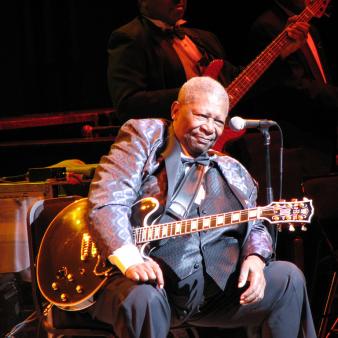
B.B. King, born Riley B. King and also called the Beale Street Blues Boy and the King of the Blues, has died at the age of 89. Earlier this month, he announced he was in hospice care due to complications from diabetes. (Nearly 15 years ago, B.B. had become a paid spokesman for a blood glucose test device OneTouch. “OneTouch gave me everything,” he crooned in the TV ad.) Even at his advanced age, his death comes as a shock, since the blues legend toured well into his eighties. It was a bad omen, however, when B.B. collapsed during a performance and cancelled the remaining shows on what would be his final tour last year.
In losing B.B., we lose our connection to the original generation of rhythm and blues musicians, those black artists who took the rough acoustic sounds of the Mississippi Delta, stripped away the polished jazz elements that had come in Chicago, and created a new sound that combined syncopated rhythms and the 12-bar blues. B.B.’s contributions to the genre are many, but most important was that he gave R&B its first and most prolific guitar god.
Blues guitar playing might as well be divided into two eras: B.B.B. (before B.B.) and A.B.B. (after B.B.). The guitar had shifting roles within blues music, first as the lone, often out-of-tune accompaniment to the guttural singing of Robert Johnson or Son House. The guitar took a backseat once the blues went urban, providing a rhythmic backing to the louder horn arrangements. The advent of the electric guitar meant the instrument could again be heard, but still blues music didn’t quite know what to do with it. B.B. King didn’t invent the blues guitar solo, but he helped develop it into a new kind of art form. More virtuosic blues guitarists like Buddy Guy, Eric Clapton, Stevie Ray Vaughan, Joe Bonamassa, and countless others are indebted to B.B. King’s innovations and particular style of play.
B.B. employed string bends and vibrato to emotional effect, alternating between fast runs through several notes to holding out the long ones even longer than you expected. The opening solo on his biggest hit, “The Thrill Is Gone,” is a perfect example of his technique. A great blues singer in his own right, B.B.’s guitar playing was like having a second vocal part, gliding naturally between notes that evoked a singing voice. His guitar had a name, Lucille, and her role was so critical that B.B. King was really a duet act.
In verses, B.B. would respond to his own vocals with short parallel licks in the pauses, a call-and-response between himself and his Lucille. Rarely did they talk over one another. Listen closely enough, and you’d start to hear Lucille talking back to B.B.
“Every day,” he would sing. “Yeah?” Lucille would seem to respond in the second of space before the next line. “Every day I have the blues,” he’d continue. “Tell me more about it, Blues Boy,” she’d shoot back. “When you see me worried baby, ‘cause it’s you I hate to lose,” he’d finish. “You’d know I’d never leave you, B.B,” Lucille would reassure him.
After a couple verses and choruses, it was Lucille’s time to shine. There was an open secret to how he created the B.B. King sound on his guitar solos. In a typical 12-bar blues song, say in the key of A major, the chord progression would go as follows: A, D, A, E, D, A. For a “happy” blues sound, a guitarist might play his solos in the A major pentatonic scale. For a “sad” blues sound, he’d play in the A minor pentatonic scale. What B.B. did was combine the two keys in one song, playing on the major pentatonic on the I chord (in our example, the A chord) while playing the minor pentatonic on the IV and V chords (D and E).
The result was a guitar solo that rode the line between brightness and pathos, and it gave B.B. a sound all of his own. It’s a part of what made him so accessible to wider audiences, black and white, and gave him the long touring career that sustained him long after blues music stopped selling in big numbers in record stores.
There was a sense of humor behind B.B.’s lyrics, the subject of whom was almost always a man tortured by all those women he loved so much. One of my favorites, no doubt “problematic” by today’s standards but clever just the same: “I gave you a brand new Ford / But you said ‘I want a Cadillac’ / I bought you a ten-dollar dinner / And you said ‘Thanks for the snack’ / I let you live in my penthouse / You said it was just a shack / I gave you seven children / And now you wanna give ‘em back!”
Well into his ninth decade of life, B.B. still stood tall among blues musicians, even if he was spending his concerts sitting on a chair in the middle of the stage. Six years ago, I saw B.B. at the legendary Ryman Auditorium in Nashville, with Buddy Guy opening for him. Guy was in his seventies himself, but his bombastic and entertaining guitar playing had him jumping and sliding across the stage. When it was time for B.B.’s entrance, I could see a roadie pushing the Blues Boy in a wheelchair from the wing of the stage, out of sight from most of the audience. Lucille was already by his chair, waiting to play her part. B.B. pulled himself out of the wheelchair and lumbered out to cheers of adoring fans, many of them born after his 1968 song “The Thrill is Gone” hit the charts. He put on a hell of a show.
Headlining at the Ryman was a long way from the small clubs in Memphis, Chicago, and across the country where B.B. got his start, and a long way, too, from the prisons in the late 1960s where his live performances would bring the big house down and revive the career of a 40-something bluesman. There was a joy in B.B’s performance, and you got a sense that he knew he was the luckiest man on Earth to get to play the blues his whole life, and make a good living doing it, too.
The King is dead. Long live the King.