

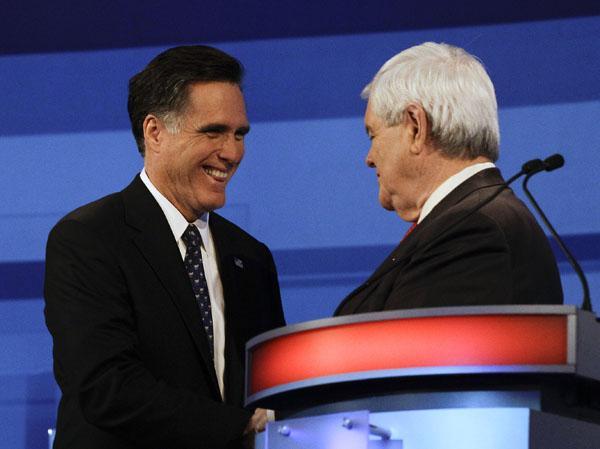
SIOUX CITY, Iowa — Mitt Romney had a strategy going into Thursday night’s final Republican debate before the January 3 Iowa caucuses. The former Massachusetts governor has been hitting rival Newt Gingrich hard in recent days, calling him “zany” and “unreliable” and even going after Gingrich’s infamous Tiffany bills. At the same time, Romney’s campaign has sent out a relentless stream of email attacks on Gingrich, many citing a new Romney website devoted to attacking Gingrich, unreliableleader.com. Meanwhile, a pro-Romney super PAC has been slashing Gingrich in ads across Iowa. The effect has been a full-scale Romney assault on the man Team Romney views as its most formidable rival.
The attacks have taken a toll. For days, well-connected Republicans across Iowa have had the sense that Gingrich is losing altitude, and a Rasmussen poll released early Thursday confirmed that sense, showing Gingrich at 20 percent, down from 32 percent last month. The new poll showed Romney re-taking the lead in the Republican race, with 23 percent.
Given all that, and given the fact that the debate, televised on Fox News, would be widely viewed not only in Iowa but in New Hampshire and South Carolina and across the country, and given the fact that Republican voters have clearly said they don’t like their candidates bickering with each other — given all that, Romney decided not to attack Gingrich. He’s already done a lot of damage; he didn’t need to keep at it in a forum in which his attacks might backfire.
“I think the governor was feeling very confident tonight, and that came through,” said top Romney aide Eric Fehrnstrom after the debate. “He kept most of his focus on the president and his failures. I think the overall impression that people have of Mitt’s performance is that he appeared presidential, and that Americans watching at home could easily imagine him sitting in the Oval Office.”
Fehrnstrom said he expects Romney will resume “contrasting” himself with Gingrich in the future. But with the national TV audience watching, Romney held off. “Our whole thinking about this is that this is the last debate before people vote here,” said another top Romney adviser, Stuart Stevens. “The image you want people to carry and to think about is who you want as president, and who do you want to wake up with for four years in times of crisis, and that is better served by talking about Barack Obama and where you want to take the country, rather than fighting with another candidate.”
The good news for Romney, of course, was that there were other candidates willing to take up the task of attacking Gingrich. Foremost among them was Rep. Michele Bachmann, who first attacked Gingrich’s work for Freddie Mac, and then slammed his record on the issue of partial birth abortion.
Bachmann had a solid point about the $1.6 million Gingrich’s company received from Freddie Mac. However much Gingrich relies on a technical definition of lobbying to claim he never lobbied for the group, Bachmann argued, he still used his influence on Freddie Mac’s behalf in exchange for a lot of money. It’s a persuasive case.
Bachmann was less effective on partial birth abortion. Back when he was speaker, Gingrich, who has an excellent rating from the National Right to Life Committee, pushed a partial birth abortion ban through the House twice. Both times, it was vetoed by Bill Clinton. Bachmann’s criticism of Gingrich is that after those efforts, he chose not to engage in retribution against Republicans who voted against the ban. “If they are the Republican nominee, I am going to actively campaign for them,” Gingrich said in 1998.
Some Republicans might view Gingrich’s position as something a leader with a very narrow majority has to do. Bachmann disagreed. “Speaker Gingrich said he would actively support and campaign for Republicans who got behind the barbaric practice of partial birth abortions,” she said. “This is not a small issue. This is a big issue.”
There’s no doubt Bachmann got under Gingrich’s skin; his face told that story. Even after a clearly irritated Gingrich began a response with, “Sometimes Congressman Bachmann doesn’t get her facts very accurate,” Bachmann was at him again, refusing to back down.
After the debate, Bachmann’s spokeswoman, Alice Stewart, didn’t back down either. “The truth hurts,” Stewart said. “She went up there and shone a light on his record, and he obviously doesn’t like that.”
Team Romney did like it. And afterward, Romney aides were happy to put in a good word for the congresswoman from Minnesota. “Michele Bachmann is good,” Stevens volunteered. “She is good. She’s cogent, she’s smart, unflappable — she must have been a heck of a lawyer. Very, very good. Very strong.” The message to Bachmann: Keep at it.
Where did it all leave Gingrich? In a tough spot. Under attack from nearly all quarters, the former speaker’s position is made more difficult by his decision to forgo attacks and to direct staff and supporters to do the same. Gingrich has vowed to respond to attacks, but not to launch any of his own. That decision, if it is adhered to, will leave Gingrich virtually disarmed in the crucial last days of the Iowa campaign.
After the debate, Gingrich spokesman R.C. Hammond chose to make the best of things. Asked his views on why Romney went easy on Gingrich, Hammond responded, “You kill ’em with kindness and they return the favor.” But Team Gingrich knows the truth is really nearly the opposite. In politics, if you try to kill ’em with kindness, they’ll kill you with attack ads. That’s Newt Gingrich’s dilemma after the last Iowa debate.
