
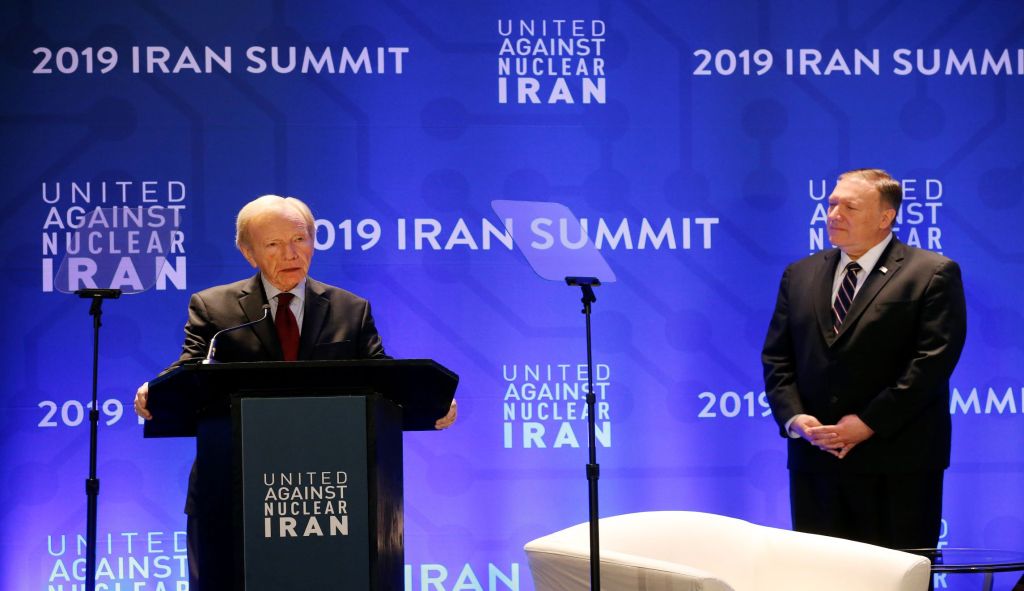
United Against Nuclear Iran is a nonprofit organization dedicated to preventing Iran from fulfilling its nuclear weapons ambitions. It began more than a decade ago toward the end of the George W. Bush administration and is among the few groups today that has continued through both Obama and Trump administrations, having retained its bipartisanship and managed to offer steady and serious assessment.
Alas, recent decisions by various UANI board members in their personal capacities threaten to undermine UANI’s reputation, if not reverse the good work that UANI has done. At issue is the Mujahedin-e Khalq, an Iranian opposition group that emerged as an outgrowth from the merging of Islamist and Marxist intellectual strains in the decade prior to the 1979 Islamic Revolution in Iran. During this period, the Mujahedin-e Khalq distinguished itself with its anti-Western fervor, often targeting American and Western businesses and personnel working in Iran. As opposition to the shah solidified, Ayatollah Ruhollah Khomeini gathered widespread public support for the 1979 revolution by obfuscating his goals. He promised Iranians and Westerners alike an Islamic democracy but denied he wanted or would accept personal power.
After the Islamic Revolution, Khomeini reversed course. He not only sought revenge against senior officials in the shah’s regime but also turned upon a succession of former coalition partners, including the Mujahedin-e Khalq. The Mujahedin-e Khalq responded in two ways that earned them not only the animus of Khomeini but also the broader Iranian public. First, it engaged in a terror campaign targeting senior Iranian officials, many of which killed Iranian passersby, and they took refuge in Saddam Hussein’s Iraq at a time when Iraq was waging a war of attrition against Iran. These actions, rather than Islamic Republic propaganda, solidified the perception of ordinary Iranians against the Mujahedin-e Khalq. Indeed, Iranians agree on little politically beyond their widespread distrust of their current government, though an exception is an even more pronounced hatred of a group that once backed Hussein.
Often, the Mujahedin-e Khalq points to its suffering at the hands of the regime to attest to its popular or democratic bona fide character. It is true that the regime has been particularly vicious toward the Mujahedin-e Khalq, including, most famously, the mass execution of Mujahedin-e Khalq political prisoners in 1988, something the late grand ayatollah and Khomeini deputy Husayn Ali Montazeri wrote about in memoirs censored inside Iran. But suffering does not make one a democrat. Rather, it can as easily breed militancy.
Now ensconced in exile, largely in Albania but also in France, the Mujahedin-e Khalq holds annual rallies declaring support for its self-appointed president, Maryam Rajavi. Those rallies are attended by a number of prominent United States and European politicians and former officials, most of who receive five-figure honoraria in exchange for short testaments to Rajavi and the group.
Last week, the group held its annual summit. While virtual, it continued to bring together foreign officials, most of who, while serving in government, knew better. Mujahedin-e Khalq press highlighted comments by former senator and current UANI co-chairman Joe Lieberman. Other UANI board members who frequently appear at Mujahedin-e Khalq rallies include former national security adviser John Bolton, former Bush-era counterterrorism official Francis Townsend, and Clinton-era U.N. Ambassador Bill Richardson. Last September, UANI founder and co-chairman Mark Wallace also appeared with the Mujahedin-e Khalq.
The Mujahedin-e Khalq is infamous for creating a web of shell organizations, many of which parallel legitimate groups. UANI is certainly not a Mujahedin-e Khalq front. It is a legitimate group that can add much to the debate. Cynics might say that all politicians only associate with the Mujahedin-e Khalq and Maryam Rajavi because they are tempted by the honoraria offered, more often than not, by innocuous-sounding third parties established by the Mujahedin-e Khalq for that purpose. That may be unfair. Some people may legitimately buy into Mujahedin rhetoric or believe that the enemy of an enemy is always a friend. Even should they be sincere in their embrace, there is no denying the polarization with which the Mujahedin-e Khalq poisons the debate.
Either way, to associate and endorse any Iranian opposition group is a counterproductive distraction that worsens the Iranian diaspora’s own political infighting. Any leader who truly cares about promoting UANI’s core mission of exposing and countering Iran’s military nuclear program should abide by a strict firewall toward not only the Mujahedin-e Khalq but also any other Iranian political group. No individual honorarium at this stage should be worth soiling the broader mission of analysis and trenchant UANI bipartisan policy prescription to counter Iran’s nuclear drive.
Michael Rubin (@Mrubin1971) is a contributor to the Washington Examiner’s Beltway Confidential blog. He is a resident scholar at the American Enterprise Institute and a former Pentagon official.
