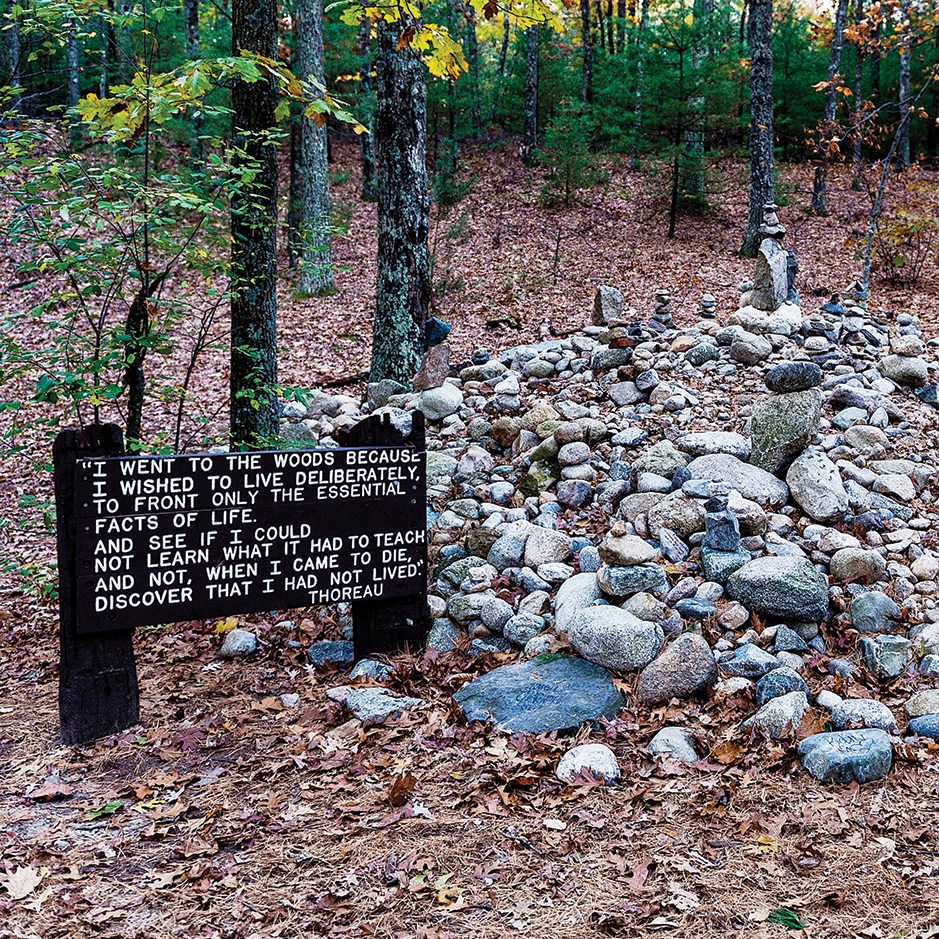
At his cabin near Walden Pond, Henry David Thoreau famously kept three chairs: “one for solitude, two for friendship, three for society.” Even when he sat alone, Thoreau contained multitudes. We know him best as the man who lived for two years in a hut in the woods, recording his experiment in simplicity in Walden, a seminal entry in what would become a thriving American genre, the self-help book.
Beyond his stature as the nation’s first decluttering expert, however, Thoreau (1817-1862) was a man of many angles. He lamented the speed and scale of the railroads, but liked that the train connected him with Harvard’s library. He celebrated solitude, but remained close to friends and family. He sniffed at newspapers as trivial distractions but drew on them as a social activist. Thoreau questioned the worth of commerce, but brought invaluable innovations to his family’s pencil business. He seemed an idler to many and wrote about the virtue of standing still, but he worked incredibly hard at his writing and endures as one of the world’s most industrious and ambitious naturalists.