

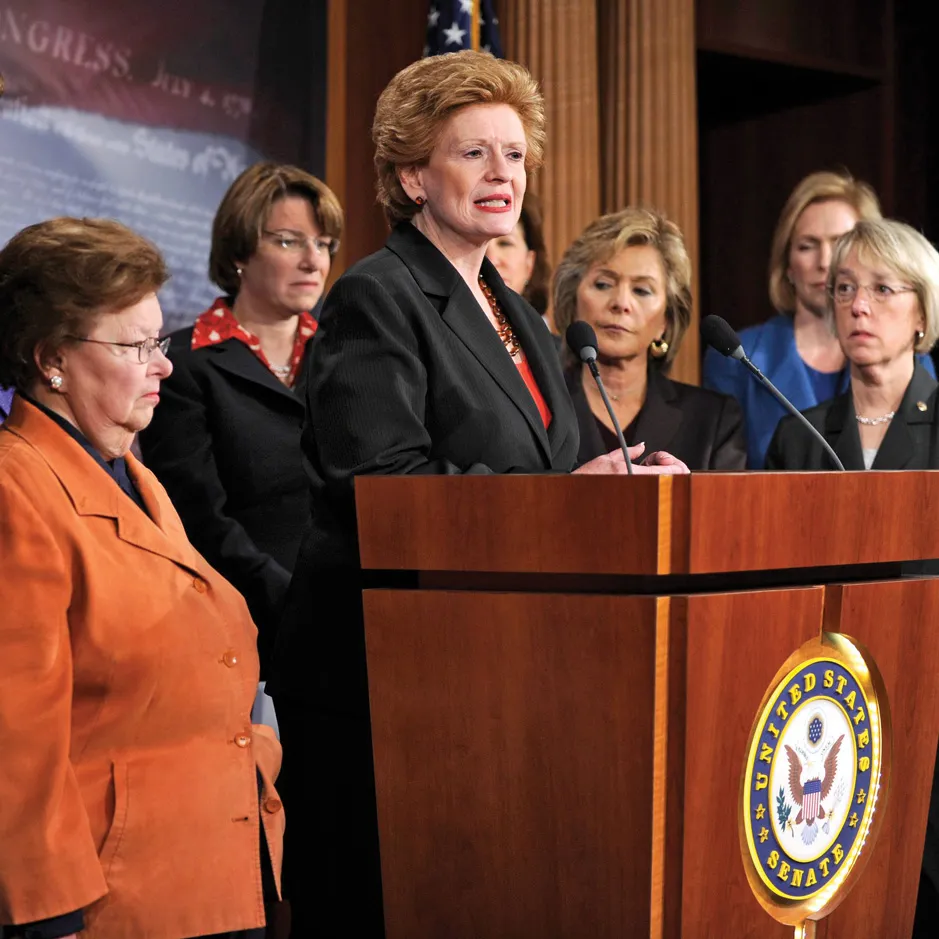
“A matriarchy is a social organizational form in which the mother or oldest female heads the family. . . . It is also government or rule by a woman or women,” runs the entry in Wikipedia, adding helpfully that it can be a description for a society in which “the culture centers around values and life events described as ‘feminine,’ ’’ or in which “women’s power is equal or superior to men’s.” If this reminds you of the modern-day Democrats you are not mistaken, as over the course of the last few decades the party has transformed itself into an estrogen entity, run by and increasingly for elderly women, focused heavily on what are described as “gender-themed issues,” with men in retreat, and nary an Alpha Male in sight.
What happened to the party of Andrew Jackson, John Kennedy, and Franklin D. Roosevelt; the frontiersmen and the midcentury’s hot and cold warriors, whose exploits as recently as the Ford-Carter contest led a bitter Bob Dole to complain of “Democrat wars”? It is a long story and often a strange one, and the ultimate twist has been this: In 2008, Hillary Clinton lost her bid to become the first female president, beaten by Barack Obama, the mixed-race Hawaiian who became the first nonwhite president, but whose policy choices in health care and other domestic concerns caused upheavals in party dynamics that made feminists the dominant voice. How did this happen? Let us look back and see.
Stay informed.Stay ahead.
Join Washington Examiner for unlimited access to the news, analysis, and commentary that matter most.
Already a member? Log in
Once upon a time, the Democrats were almost the warrior party, the one that led the country into both of the world wars (Woodrow Wilson reluctantly, but Franklin Roosevelt always ahead of the country’s opinion), the party that crafted the response to the Cold War under the guidance of Harry S. Truman, the party of John Kennedy, who on foreign policy ran to the right of every Republican he ever contested and claimed that Dwight Eisenhower had not armed the country enough. But in the mid-’70s, it became at once the antiwar and pro-feminist party, and such it has been ever since. In 1972, George McGovern cried, “Come home, America!” and was trounced by Richard M. Nixon; Jimmy Carter ran as a former naval officer (and protégé of the hard-bitten Admiral Hyman Rickover), but by 1980, when he faced Ronald Reagan, a series of defense cuts, unfortunate statements (“inordinate fear of communism” being just one of them), and the Iran hostage crisis, in which he seemed both hapless and helpless, had established his role as a wimp. In 1988, Michael Dukakis posed in a tank, in which he looked ludicrous, and a series of poor decisions on crime and punishment issues suggested he had no inclination to take on aggressors, whether at home or abroad.
George H. W. Bush, who succeeded Reagan and had been his vice president, presided skillfully over the fall of the Communist empire, but it was his decision to eject Saddam Hussein from the Kuwaiti oil fields that carved the two parties’ new stances in stone. It was in May 1991 that Christopher Matthews (not yet an MSNBC hothead) wrote a prescient column, “Mommy’s Love and Daddy’s Protection,” that described the Democrats as the Mommy party, taking care of health care and Social Security, and the Republicans as the Daddy party, taking care of war and peace, crime and punishment, and keeping the wolf from the door.
How allergic the Democrats had become to even the thought of armed power was shown at a leadership retreat of the party of Roosevelt, Truman, and Kennedy. Wrote Matthews: “A meeting of liberal Democrats in Chantilly, Virginia, on January 26—10 days into the Persian Gulf war—focused on matters close to home: health care, employment fairness, reproductive rights. A handout scolded attendees not to stray beyond the water’s edge but to stay fixed on domestic social worries like ‘national health programs.’ . . . The biggest applause line was a pitch for national health insurance [from Edward M. Kennedy].”
This is the party that was more than ready the following year for Bill and Hillary Clinton, the first presidential couple of the feminist era. They were the first couple in which the wife had a postgraduate degree (from Yale Law School) and was a careerist on a par with her husband, the family breadwinner while they were in Arkansas, and regarded by many as the tougher one of the two. Though a womanizer on the scale of John Kennedy (most Kennedy wannabes pick the wrong traits to emulate), Clinton evaded war service where Kennedy sought it, focused on the domestic, not the foreign, agenda, and radiated the feminine virtue of empathy, as opposed to a manly resolve. For the first time, the feminist agenda was pushed to the forefront of national policy via quotas—the slot of attorney general was reserved for a woman—the all-out embrace of abortion rights, and the championing of Anita Hill in the charges she brought against Clarence Thomas in his confirmation hearings the year prior to the election. Those hearings had mesmerized and then split the whole country, and led Democrats to dub 1992 the “Year of the Woman,” in which four female Democrats entered the Senate (where some remain to this day). Hillary herself would arrive in the Senate eight years later (with the help of sympathy resulting from the intern sex scandal that brought on Bill’s impeachment), from which everyone expected her to ascend to the presidency, much as the couple had planned decades earlier while still back in Arkansas. But “Hillary’s turn” would be deferred for eight years by Barack Obama, when her gender card was trumped by his bid to become the country’s first nonwhite president (and by his superior campaigning skills). But ironically, it was his tenure in office that would complete his party’s move towards becoming the party of women, to an extent that no one could ever have dreamed.
Obama’s first run in 2008 was based on the theme that he was the Messiah, the magical son of a mixed-race union, come to lead the country past its divisions and into a mystical state of harmonic convergence, both in the nation and world. But alas, his far-left agenda sparked partisan warfare, and by 2012, when he ran in his second election, hope had long vanished, change appeared threatening, his health care legislation proved very unpopular, and he had few achievements of which he could boast. As a result, his campaign consisted of attacks on his rival, who turned out to be a poor politician, and the “war on women” that he accused Republicans of waging.
Much was made of the plight of a fictional “Julia,” whose journey through life was cushioned at every turn by the benevolent hand of the federal government, and of a very real Sandra Fluke, a 30-year-old student of Georgetown law school, who complained that conservatives were trying to bankrupt her and ruin her life by forcing her to pay for birth control pills. It was the first time “women’s issues” had played such a central role in a major election, and it was enough to keep Obama safely in office, though with a sizable fall-off in votes. But the midterm elections in 2014 were a whole other story: The implementation of Obamacare in 2013 had kicked off another fierce round of resistance, and the explosion of ISIS in mid-2014, after Obama bragged he had ended two wars in the region, brought his foreign policy failures to light. This was an election that did not want for issues, but while Republicans attacked on a whole range of matters, Democrats fell back again on the “war on women” as the one card they thought they could play. As in 1991, with the Mideast on fire, they were told “not to stray beyond the water’s edge but to stay fixed on domestic social worries,” which this time meant subsidized access to abortion and birth control, and turned out not to worry women as much as was hoped. Hillary Clinton campaigned for “choice” with a long list of imperiled liberals, and helped save just one of them (Jeanne Shaheen of New Hampshire), while Kay Hagan, Michelle Nunn, Alison Lundergan Grimes, and numerous males were soundly defeated. Sandra Fluke, the poster girl of the previous cycle, lost her bid to attain a California state office; Wendy Davis, who stood firm in pink sneakers for late-term abortion, lost women in Texas, and the whole state, by about 20 points. In their second disastrous midterm in a row, Democrats had massive losses in the Senate, the House, and on the state level, and were at their lowest point since before the Depression. But what was bad for the party was very good for the feminists in it: It had become at long last the matriarchs’ party, with an issue-set focused on gender-themed matters, and with Hillary Clinton as the designated successor (and Elizabeth Warren her only rival), with no male of comparable standing in sight.
After George W. Bush’s reelection in 2004, Democrats launched a 50-state strategy, trying to pick candidates for both chambers of Congress who stood a chance of winning in the places they came from, which meant picking centrist or even conservative Democrats for contests in red or purple districts and states. This paid off for the party in 2006, when the war in Iraq times Katrina created a wave, and paid off again two years later, when the fiscal collapse swept them into office on a wave of still higher dimensions, with a filibuster-proof 60 seats in the Senate and a still greater edge in the House. But the effect of Obama’s unpopularity in the two midterms that followed was to undo and reverse all these triumphs, peeling away, by 2015, 69 seats in the House, 13 seats in the Senate, and 11 statehouses, along with massive losses in the state legislatures, from which candidates for Congress and governorships usually emerge.
Some women (and some women candidates) did of course lose, but the net effect of these years was to wipe out a generation or more of male politicians, especially those who tended to occupy spaces close to the center, where most presidential elections are fought. The Democrats who survived were from small states or blue states, and seen as much too left-wing to prevail in a national contest. And the party that was left when the dust settled was both very female and old. The few notable men left whom people might recognize had begun their careers in the ’60s or ’70s, such as Vice President Biden (elected to the Senate in 1972); Secretary of State John Kerry, who became an antiwar leader in the early ’70s; Senate minority leader Harry Reid, now in his 70s; and Governor Jerry Brown of California, 77 in April, who began his first stint as governor when he succeeded Ronald Reagan in 1975.
Amid this desert, Hillary Clinton stood tall indeed, but she too had mileage—she will be 69 in November 2016—and the handmaidens around her were older still: House minority leader Nancy Pelosi (74), Senator Dianne Feinstein (81), and Senator Barbara Boxer (74). And should Hillary face competition, it is likely to come from the female or old: Senator Bernie Sanders of Vermont, 73 and a Socialist, or Elizabeth Warren of Massachusetts, famous for being 1/32 Cherokee and a spring chicken of just 65. The only one younger is Martin O’Malley, 52, a former Maryland governor, lackluster at best, who can legitimately be labeled a failure, as his lieutenant governor lost when he ran to succeed him, even though Republican governors in Maryland are as rare as blue moons or hen’s teeth. The mere fact that O’Malley can be thought of as a potential contender tells you all you need to know about the current generation of Democrats, which is that their Alpha Male quotient is zip.
Save for Obama—a metrosexual if ever there was one—male stars in the party are few. While Republican politicians these days are often too interesting—every day, John McCain, Ted Cruz, or Rand Paul seems to be raising hell just for the hell of it—it’s not certain the average citizen could pick a Democratic senator out of a police lineup, and there’s no reason he should. To a man, they seem to be small, pale, and liberal, eager to follow the lead of their feminist masters, even when it’s not clear that they should. Last year Mark Udall of Colorado, known to his state as a rangy outdoorsman, meekly took the advice of his handlers to run his campaign on the “war on women” theme dear to the feminists, banging the drum on abortion, even as the liberal Denver Post called him out and a female reporter mocked him as Senator Uterus. Having entered the race close to a shoo-in, he lost by two points.
Is there a light at the end of this tunnel? Well, there is James Webb. Recruited to run in the 2006 cycle, when Democrats were trying to expand their party, he scored a surprise win in Virginia after unlucky George Allen uttered “macaca,” and he scraped into the Senate by less than a point. Even then, he was an outlier in his own party.
A self-styled Jacksonian (Andrew, not Jesse), a decorated Marine who called his memoir Born Fighting, a secretary of the Navy in the Reagan administration, Webb was a typical Democrat of the FDR-Truman-JFK persuasion. “An economic populist. A national security hawk. His Democratic politics are less concerned with social groups than with social equality (of opportunity, not outcome),” in the words of David Paul Kuhn, and he understands the problems of working-class voters, which might be just what the Democrats need.
Of course, most Democrats don’t see it that way and recoil from his opposition to “climate change,” quotas, and affirmative action based on anything other than need. Another reason may be that he’s simply too male for a party whose ideal seems to be Kirsten Gillibrand, the soignée New Yorker who became a feminist heroine when she wrote a memoir complaining that some years ago some old senator called her “porky.” What are the chances a party like this will nominate a man who lives in the world as it is, and not one where transgender concerns are called a priority? Gloria Steinem once said a woman needs a man like a fish needs a bicycle, and Democrats have decided this goes for their party. Some day they may regret having made the male animal persona non grata. But that moment has not happened yet.
Clearing the field of the Alpha Male menace was not the only thing Obama did for or to the feminists in his party: He also brought into politics a huge tidal wave of nonfeminist women, the last thing that he and his allies ever thought possible. First, John McCain’s surprise pick of Sarah Palin was enough to throw Obama’s campaign badly off balance for a time; then, Obama’s overreach on health care helped bring a flood tide of conservative women into politics. Democrats were familiar with the older conservative archetypes such as Phyllis Schlafly; they were familiar with the female Republican moderate, often from Maine, who was kinder and gentler than her more dogmatic male colleagues; they were prepared for the “church ladies” who proved easy to satirize. They were not prepared for Kelly Ayotte, Susana Martinez, Nikki Haley, Kristi Noem, Mia Love (the black Mormon from Utah), Air Force veteran Martha McSally, Joni Ernst, or Elise Stefanik (the youngest woman ever elected to Congress), only a few of the young, diverse, feisty, and very formidable conservative women who came in with the 2010 and 2014 elections.
In 2011, Slate’s Hanna Rosin took a look at this new kind of female conservative and found nothing to ridicule. She found instead that the Tea Party, often described as the last stand of the embattled male redneck, was by and large “an insta-network for ambitious women . . . aspiring candidates who could never get traction” and who might have been sidelined for years in the traditional two-party system, to crash the political heights from outside. Many got their start as insurgent reformers, battling the powers that were inside their own party, and were light years removed, in mindset and background, from the feminist corps on the left. They were often not from the coasts, but from the South and interior; they had not gone to Yale; they had backgrounds in farming or as small-business-women; they were (often) pro-life, though this was not their priority; they pushed not for bigger and better government programs but for reductions in taxes and in regulations; and, where feminists were quick to declare themselves spokesmen for all women, they had no use at all for identity politics, and even denied they exist. Haley downplayed her ethnicity and gender, Rosin wrote of the South Carolina governor’s first campaign, when she said, “We are going to make history on Tuesday, but it’s not history because there’s the first female governor. . . . It’s history because South Carolina will show what a good government looks like.”
Thus, at their moment of prime party power, feminist Democrats are confronting a rival force in the opposite party that produces large numbers of strong female political figures, while denying the existence of a specific women’s political consciousness. This creates a problem for Hillary feminists, as when Hillary said a place in Hell is reserved for women who don’t “help other women,” though Hillary herself naturally failed to help Republicans like Mia Love, Martha McSally, and Joni Ernst when they ran and won against men. Indeed, she went to Iowa to campaign for Bruce Braley, who ran against Ernst. Does Hillary think she herself deserves a hellish fate? And if she doesn’t—why not?
How are Democrats taking this unexpected development? Not all that well. In City Journal, Kay Hymowitz catalogued the reaction among feminists to Sarah Palin’s emergence, ranging from “turncoat bitch” to “insult to women” to “what I feel for her privately could be described as violent, nay, murderous rage.” Gloria Steinem dismissed Republican women as “female impersonators,” charging that many oppressors like to find and bribe victims who are willing to turn against their own kind. But this is hard to maintain when so many rise at one time from so many places—surely the Koch brothers can’t pay for all of them?
Meanwhile, the matriarchs’ party has to face the fact that while it has many more women in Congress, the Republicans have many more prominent women, more rising stars, more women governors, and more plausible candidates for national leadership. Save for Hillary and 81-year-old Dianne Feinstein, no female Democrat has the foreign policy chops of Senator Kelly Ayotte, who has made herself an authority on security issues. Senators Amy Klobuchar and Kirsten Gillibrand are also mentioned as potential national candidates, but their résumés are short on the commander-in-chief type of issues. Gillibrand is mainly known for sexual assault legislation, and for having invited as her guest to the most recent State of the Union a Columbia University undergrad who achieved notoriety by carrying her mattress around campus to protest the unfavorable resolution of a charge she brought that a classmate had raped her. This is not the background of your usual aspirant to the office once held by cold warriors such as Truman and Kennedy, to say nothing of generals like Washington, Eisenhower, Jackson, and Grant.
But Roosevelt, Truman, and Kennedy would never know their old party, which of course is no longer theirs. Hillary Clinton, who in 2008 ran as the candidate tough enough to answer the proverbial 3 a.m. phone call—though when the call really came she was missing in action—now plans, says Donna Brazile, to “run as a woman” (though what else she could run as is open to question), emphasizing her new role as a grandmother, and other gentle and fuzzy delights. She, Brazile tells us, “is comfortable talking at length about her own experiences being pregnant and giving birth while working as a partner in a law firm, and using that as a launching pad to discuss the importance of women in the workforce both here and around the world.” The question is how much voters will want to hear all this in a world in which our geopolitical enemies are growing much stronger, Russia and ISIS are both on the move, Jews are shot in the most civilized cities in Europe, Christians are beheaded, and Muslims of the wrong kind burned alive.
Have Democrats finally become the matriarchs’ party, at just the wrong moment in history? Can a party survive without Alpha Male figures? Where will the Democrats find them, assuming they want to? And how will the feminists face the onslaught of the new corps of contra-feminist women, who take their cues from Margaret Thatcher, not Gloria Steinem, and, vide Carly Fiorina vs. Hillary Clinton, aren’t shy about calling them out?
These and other questions cry out for an answer, before we find out if Mother Knows Best.
Noemie Emery is a contributing editor to The Weekly Standard and a columnist for the Washington Examiner.
