
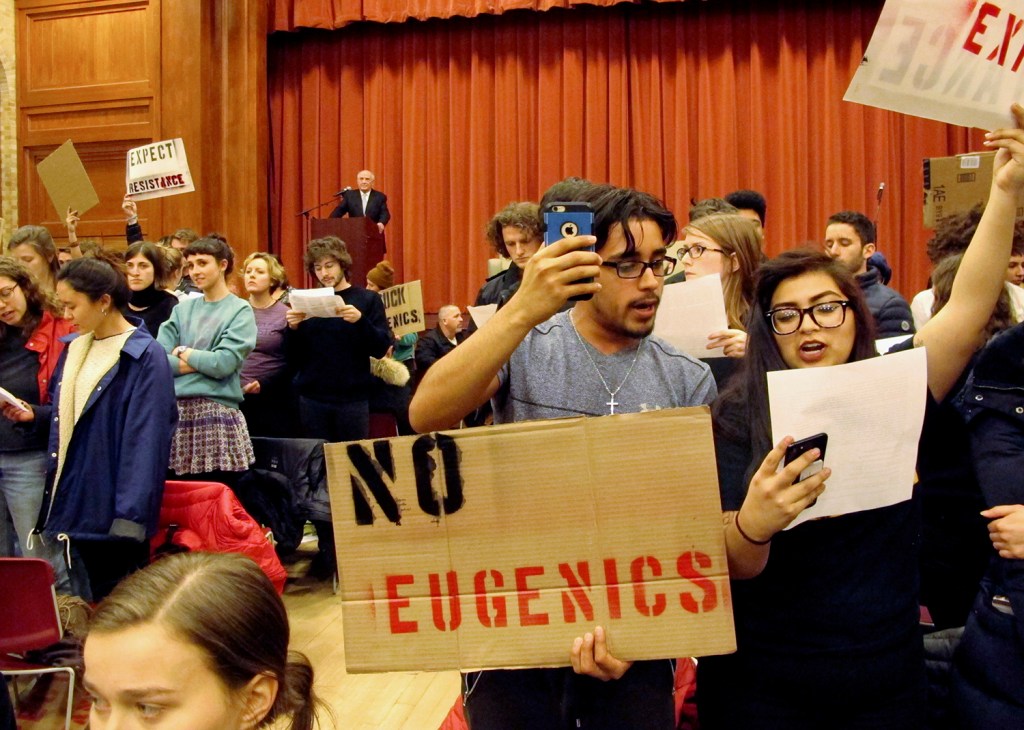
Middlebury College students weren’t hiding anything. This week they heckled Charles Murray, their invited speaker and author of a dozen books, as he crossed the stage. They waved vulgar and crude signs at him and turned their backs on him as he took the podium. Then they deliberately drowned him out with chants of, “Shut him down! Shut him down!”
While the scene was too common to be shocking or surprising, it was appalling to the sensibilities of anyone who values free speech and open debate, and the Enlightenment ideas of tolerance and pluralism.
Real journalism.Trusted by millions.
Unlimited access to in-depth reporting, expert analysis, and the stories that shape our country.
Already a member? Log in
But here’s the thing many critics haven’t realized: You can’t invoke those ideas to argue against the campus radicals at Middlebury, at the University of Missouri, at Yale, or at any other campus because these people don’t agree with the ideas.
Calling campus radicals “censorious” or “illiberal” is not, to their ears, a criticism. It would be like calling Ted Cruz “an Obamacare opponent.” It’s merely a description, not a counterargument.
The people we are arguing against don’t share our principles, so we can’t refute them by waving our principles at them.
Most political debate and political battles happen with certain agreed-upon ground rules, even if those rules are frequently broken. They include civility, tolerance, and freedom to disagree. But bigots such as those at Middlebury don’t accept those ground rules. That’s their point.
When liberal scriptwriter David Simon called similar student behavior “fascist,” progressive writer Elias Isquith made a cogent counterargument. “Social democracy is not classical liberalism,” Isquith wrote on Twitter. “It does not place the individual above all. It does not value process over outcome. It does not imagine a politics w/out … raw power. It doesn’t assume rules are handed on from high. I don’t think that makes it fascist.”
“Process” here is the ground rules of tolerance, freedom of speech, pluralism, and decency, that we take for granted. But maybe taking them for granted is the problem. Complacency has given room for growth to a generation of radicals who have no brief for these ideas.
So we need to defend these fundamental ideas, publicly, clearly and consistently. The ground rules of debate have become the matter we are debating.
So why value free and open debate, and tolerance of ideas you find wrong or even “hateful”?
Epistemic humility is a good place to start. No matter how certain you are that the other guy is wrong, it’s generally worth considering the possibility that maybe you’re the one who is wrong. And no matter how much error the other guy is in, there’s a good chance you can learn from him anyway.
Any honest and knowledgeable person would grant that college students could have learned something from Murray’s lecture. The presumed cause of these students’ ire is a passage in Chapter 13 of a 22-year-old book, The Bell Curve, in which Murray and his co-author wrote that data suggest that genetics, among other factors, plays a significant role in racial IQ differences.
But Murray (a fine scholar and thoroughly decent man) wasn’t at Middlebury to discuss The Bell Curve or genetics. He was there to discuss his indispensible 2012 book, Coming Apart, which isn’t about racial differences at all, but about the growing cultural chasm between upper-middle-class, highly educated white people, and less educated rural whites.
Certainly, students upset that Trump won the election could learn something useful from an account of the disenchantment of rural white America. Surely there’s some common ground between progressive crusaders and an author researching the social causes of inequality. Maybe, just maybe, Middlebury students could learn something from Murray’s findings about socio-economic bubbles.
They may think Murray is wrong, but even wrong people have right ideas or at least good questions. To reject that is to abandon the humility and curiosity that surely these college students must value.
A second case against the radicals’ censoriousness is that it relies on a physical, corporal advantage that they may not always have. Their yelling and accosting weren’t that far out of the ordinary. Recall Missouri assistant professor at Missouri who called for “some muscle” to keep a student journalist from covering protestors.
At Middlebury, radicals may be the majority. Certainly, they were the majority of that room. But when they walk off their leafy campus into the real world, they may not be a majority anymore. Do they really want a world in which the loudest, strongest and biggest get to determine which ideas are aired? Have they thought through the merits and dangers of suggesting, as they did, that might makes right?
The West has generally agreed to rules of “process” in part to lower the stakes of politics and debates. Not all societies do this now, and most have historically not done so. In some cultures, the losers are killed or exiled. Think of Vladimir Putin’s Russia or Saddam Hussein’s Iraq.
Then look at Middlebury on Thursday night. Here’s one account:
About half an hour after the event ended, [College Vice President Bill] Burger said, the two, accompanied by a college administrator and two public safety officers, tried to leave the building via a back entrance and hurry to a car. But protesters had surrounded various entrances and swarmed to the fleeing Murray and Stanger as they exited, he said.
Once Murray and Stanger were inside the car, and after Stanger had been assaulted, the crowd began jumping on the hood and banging on the windows, according to Burger. The driver tried to inch out of the parking space but the angry crowd surrounded the vehicle and tried to keep it from leaving.
Burger said someone threw a stop sign attached to a heavy cement base in front of the car. It finally got free of the crowd and then left campus.
It’s a telling episode, and maybe it can persuade some young people or some academics not yet convinced of the virtue of free speech, tolerance, pluralism, and decency.
The next generation will choose what sort of society we have. It will be either one in which Charles Murray is allowed to speak or one that looks like that dark driveway in Middlebury.