

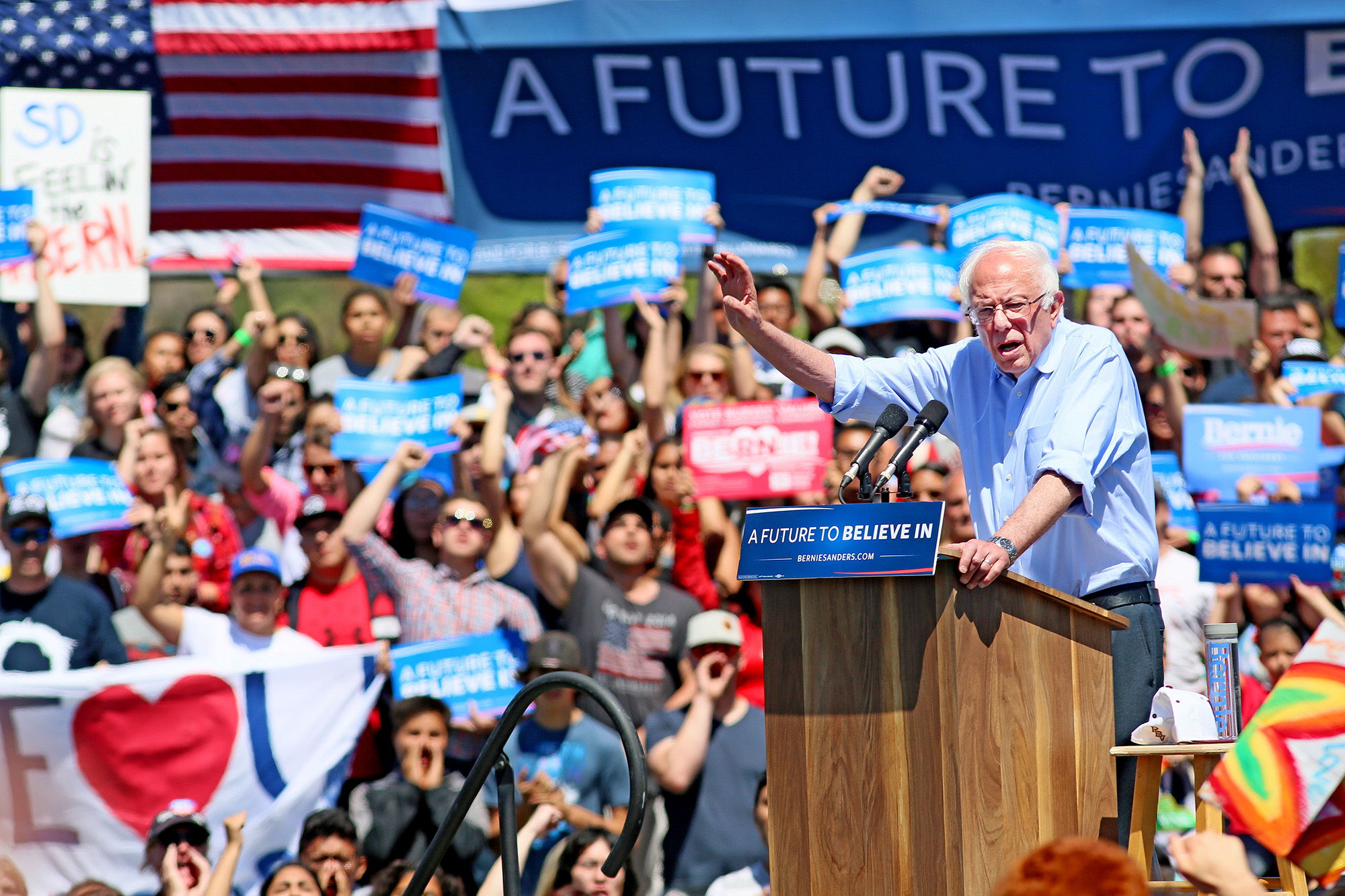
In a New York Times op-ed, political scientists Christopher Achen and Larry Bartels ask, “Do Sanders Supporters Favor His Policies?” The short answer is, not necessarily. The authors suggest that voters feeling the Bern are more attracted to his personality than his policies or ideology.
Achen and Bartels also puncture the widely held notion that the Vermont socialist has pulled Hillary Clinton left on issues like healthcare, trade, financial regulation and the minimum wage.
Recommended Stories


This belief is widely held because Hillary has altered her stances on these issues to more closely align with those of Sanders. I’d add immigration to their list, as in March Univision’s Jorge Ramos got Hillary to say that as president she wouldn’t deport any children in the United States illegally, a position Sanders has held for a long time.
The authors argue it is the “folk theory” of democracy that voters carefully weigh candidates’ positions on issues before voting. They further state that the underlying assumption “that Mr. Sanders’s surprising success in the primary race is because of his liberal policy positions … may be familiar and comforting, but it is greatly exaggerated.”
They note that decades of empirical evidence suggests that “voting behavior is primarily a product of inherited partisan loyalties, social identities and symbolic attachments. Over time, engaged citizens may construct policy preferences and ideologies that rationalize their choices, but those issues are seldom fundamental.”
In part, this means that voters in the center (the elusive 20 to 30 percent who aren’t tied to either party through ideology) end up supporting candidates who are more extreme because they identify with them more. The authors cite Mitt Romney, who was ideologically closer to most voters than was Barack Obama. But voters simply couldn’t identify with Romney.
I made a similar observation just after the 2012 election, which Obama won in no small part because voters identified with him and felt he identified with them:
“On Election Day, exit polls found more voters shared Romney’s values and felt he’d be a better steward of the economy. But Obama won the empathy vote going away. Voters had a more favorable view of Obama, and he won by 10 points on the question, ‘Who is more in touch with people like you?’ And for voters whose top attribute in a candidate was that he ‘cares about people like me,’ Obama won by a mind-blowing 63 points.”
Achen and Bartels write that it is a mistake to believe that Sanders voters favor him for his left-leaning policy views.
Examining the exit polls of two dozen primary and caucus states, they find “only modest evidence of ideological structure in Democratic voting patterns, but ample evidence of the importance of group loyalties.”
For instance, they write, “Mr. Sanders did just nine points better, on average, among liberals than he did among moderates. By comparison, he did 11 points worse among women than among men, 18 points worse among nonwhites than among whites and 28 points worse among those who identified as Democrats than among independents.”
These differences, “are reflections of social identities, symbolic commitments and partisan loyalties,” and not differences in policies, they write.
The authors cite more evidence that support for Sanders does not reflect a shift to the left by Democratic voters. In one study, while Sanders supporters fretted more about income inequality than Clinton supporters, they were actually less likely to support typical liberal remedies for these problems, including higher minimum wage laws and more government spending.
The bottom line is that ideological commitment is less important than sometimes imagined. Which perhaps explains why, as Washington Examiner columnist Lisa Boothe has noted, in one poll nearly half of Sanders voters in West Virginia said that, should Sanders drop out, they’d vote for Trump in November, while about half as many said they’ve vote for Clinton.
Even among young people, who have generally warm views of Sanders, ideology plays a relatively small role. “While young Democrats in the January survey were more likely than those over age 35 to call themselves liberals, their ideological self-designations seem to have been much more lightly held, varying significantly when they were reinterviewed.”
The authors find that for many young self-described liberals, their “liberal ideology seems to have been a short-term byproduct of enthusiasm for Mr. Sanders rather than a stable political conviction.” Young Democrats are less liberal in terms of policy than older Democrats. And “[t]heir distinctive liberalism is mostly a matter of adopting campaign labels, not policy preferences.”
The Examiner has alluded to this identity-over-policy phenomenon before. While the Vermont socialist garners headlines and attracts over-flow crowds, polls show that most voters, and millennials especially, don’t know what socialism actually is.
Daniel Allott is deputy commentary editor for the Washington Examiner
