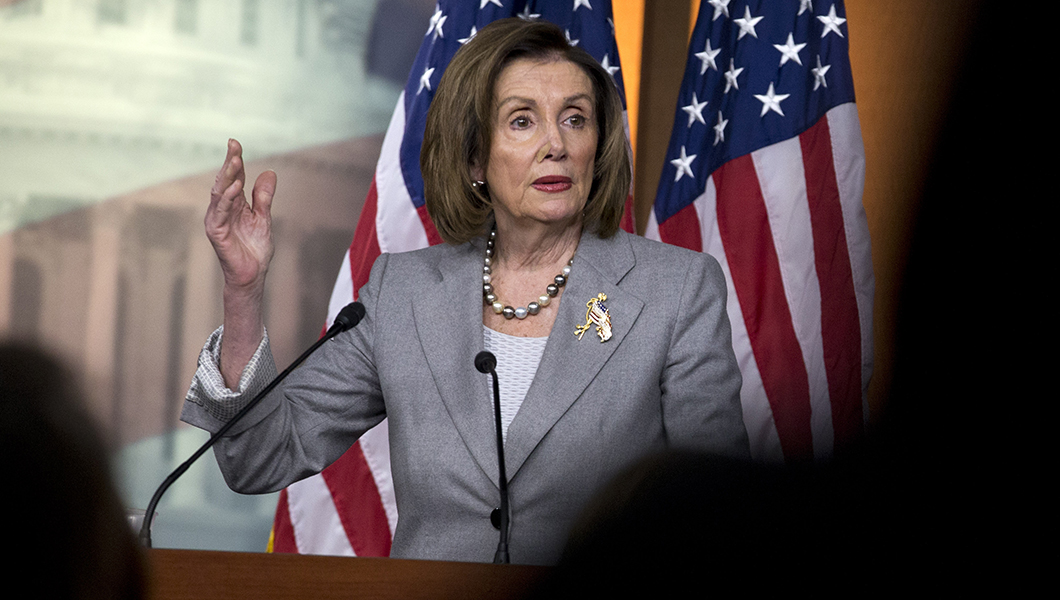
The House on Wednesday impeached President Trump in party-line votes charging him with abuse of power and obstruction of Congress.
Only Democrats and one independent voted in favor of the two articles. All Republicans voted against it. The matter now heads to the Senate, which will hold a trial in January that is likely to result in Trump’s acquittal.
Recommended Stories
The historic House vote makes Trump only the third president to be impeached. Presidents Andrew Johnson, impeached in 1868, and Bill Clinton, impeached in 1998, were also acquitted after Senate trials. In 1974, President Richard Nixon resigned over Watergate before a House impeachment vote and Senate trial.
The daylong impeachment debate and floor votes came after weeks of public and closed-door hearings and depositions featuring testimony from current and former Trump administration officials.
Democrats argued the House impeachment investigation yielded evidence that Trump sought Ukraine’s help investigating Democrats and former Vice President Joe Biden and that he withheld critical security aid from Ukraine to coerce government officials to pledge to conduct those investigations.
“After months of investigation, there can be no serious debate about the evidence at hand,” House Judiciary Committee Chairman Jerry Nadler, a New York Democrat, said.
Democrats based their case on a July 25 phone call between Trump and Ukraine’s president in which Trump asked Ukraine to investigate Biden and the Democrats. From there, they constructed a case they believe proves the president used $391 million in security aid to force Ukraine to pledge publicly to conduct those investigations.
“The first article charges that the president used his public office to coerce a foreign government into attacking his political rival,” Nadler said. “The second article charges that the president took extreme and unprecedented steps to conduct our investigation into his conduct.”
The two articles, Nadler said, “charge that President Trump placed his private, political interests above our national security, above our elections, and above our system of checks and balances.”
Republicans accused Democrats of abusing their power by using the impeachment process to overturn the will of the 63 million people who voted for Trump in 2016.
[Read more: ‘Payback’: Republicans vow to impeach next Democratic president]
Republicans argued the case put forward by Democrats does not include evidence justifying impeachment. The aid was ultimately delivered to Ukraine without any pledge to investigate Biden or the Democrats.
Republicans said the president had good reason to delay security aid to Ukraine, where corruption was rampant. Trump’s denial of subpoenas, the GOP said, was justified by executive privilege.
“This will set a dangerous precedent where impeachment becomes the norm rather than the exception,” said Rep. Steve Chabot, an Ohio Republican who voted to impeach Clinton in 1998. “The Democrats are pursuing a wacky theory under which all four presidents on Mount Rushmore could have been impeached. If it sounds absurd, it’s because it is absurd. It’s been absurd from the outset.”
Almost all Democrats voted for impeachment, even though dozens are defending swing districts that support Trump.
They voted to impeach Trump despite stagnant poll numbers that, after weeks of impeachment testimony, have not shown increased public support for the effort. The polling shows voters about evenly split on impeachment and mostly along party lines.
Democrats say they don’t care about the polls. Democrats cited the need to “do the right thing” and protect the country, the Constitution, and the office of the president.
“Today, I affirm my commitment to upholding the Constitution, the rule of law it defines, and the people it governs,” said Rep. Abigail Spanberger, a Democrat and former CIA operations officer who represents a swing district in Virginia.
Democrats must now appoint and approve impeachment managers to deliver the articles to the Senate. Democratic leaders are weighing a push by a couple dozen lawmakers in their liberal wing to withhold the articles of the Senate until the Republican majority leader, Mitch McConnell of Kentucky, relents on the witness request put forward by Minority Leader Chuck Schumer, a New York Democrat.
McConnell has rejected Schumer’s request.
Senate Republicans say they want the Senate to hear the case put forward by House Democrats and the response from Trump’s White House lawyers but no further witnesses.
“I’m not going to support witnesses being called by the president; I’m not going to support witnesses being called by Sen. Schumer,” Senate Judiciary Committee Chairman Lindsey Graham, a South Carolina Republican, said. “We are going to vote on the same product the House used for a final vote, and I think most senators are ready to move forward at the appropriate time.”
