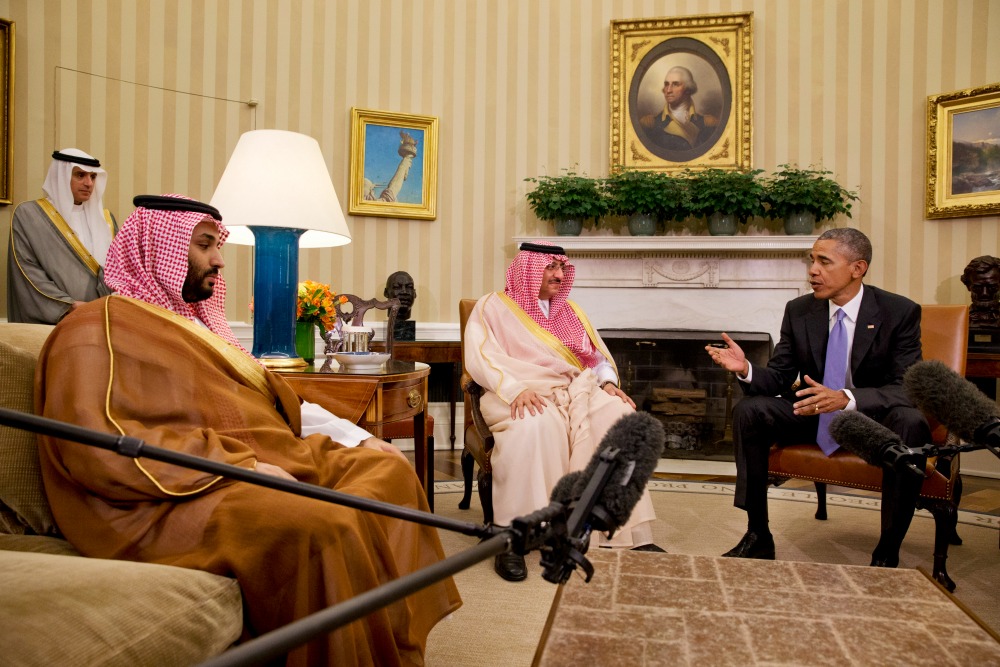
Obama sits down with Saudis to talk oil transition

Cabinet officials met with Saudi officials over the last several days to discuss oil, of course, but more importantly the country’s plan to transition its economy away from it.

Not surprisingly, President Obama focused more on climate change than the disastrous consequences of the global oil glut on U.S. shale producers that the Saudis had a hand in creating.

The timing of the visit wasn’t the best for the Saudis. A major terrorist attack in Orlando, Fla., on Sunday had them on the defensive, as presumptive Democratic presidential nominee Hillary Clinton called for clamping down on terrorist funding from Saudi Arabia.

But on the energy front, the discussions were even more telling. For the Saudis to make good on their Vision 2030 plan to pull the country away from oil, they need serious buy-in from the United States, which has the companies and expertise to make it happen.

Discussion about the plan preceded talks on terrorism that were part of Friday’s meeting with Obama.

Deputy Crown Prince Mohammed bin-Salman, the 30-year-old son of the king, led the talks with high-ranking Cabinet officials, including Energy Secretary Ernest Moniz.

“U.S. officials welcomed Saudi Arabia’s commitment to economic reform and underscored the United States’ desire to be a key partner in helping Saudi Arabia implement its ambitious economic reform program,” the White House said after the talks.

Both sides agreed that the kingdom should diversify its economy toward increased renewable and natural gas development, while underscoring the “beneficial role” U.S. companies could play in helping to reach the goals of Saudi Arabia’s plan.

Company’s such as manufacturing giant General Electric are already taking advantage of the Saudi plan to wean itself off oil. The company plans to invest $1.4 billion in the country to diversify its economy.

“The joint investment and collaboration will be a game changer for the kingdom’s industrial and digital sectors,” CEO Jeffrey Immelt said last month.

“The United States and Saudi Arabia intend to build on these conversations in the coming months, consistent with the strong partnership between our countries and the mutual benefit in further deepening our economic ties,” the White House statement said.

What the White House didn’t say may be more revealing than what it did. Substantive discussion about the oil glut that Saudi Arabia helped create to knock out American shale producers and force thousands of layoffs was not touched on, at least not publicly.

Many economists, in addition to prominent businessmen and policy chiefs, have accused Saudi Arabia of keeping production high while the U.S. shale oil production put more petroleum on the market, lessening the need for Mideast crude oil.

The result has been hundreds of thousands of layoffs in the U.S. oil patch, with families having to take out second mortgages and rack up credit card debt to survive.

But what may have brought the Saudis to the table is the fact that the oil glut hurt them just as badly. It is one reason they need the Vision 2030 plan in the first place. Oil is just not paying the bills.

The low cost of oil, dropping from more than $100 per barrel a few years ago to struggling to maintain $50, has crushed the Saudi economy, which now must contemplate selling shares of its oil assets to stay afloat.

Ahead of the Saudi visit, the Energy Department’s independent analysis arm released a report that shows members of the Organization of the Petroleum Exporting Countries, in which Saudi Arabia is a founding member, suffered the most significant drops in revenue in 2015 since 2004.

OPEC revenue effectively was cut in half from 2014 to 2015, plunging from nearly $754 billion to just about $400 billion, the Energy Information Administration said.

The sinking revenues are projected to continue through next year before picking up marginally in 2018, according to the EIA.

National security advocates say no one should kid themselves into thinking the Saudi plan was nothing less than highly thought out and strategic. The group Securing America’s Future Energy, made up of former high-level U.S. military officials and business CEOs, is advocating for policies that call out the Saudis for their policies, while seeking to reduce America’s dependence on oil imports and petroleum altogether.

Earlier this month, it underscored the Saudi strategy in a report, which shows how OPEC is delivering on its goal of returning the market to a condition of relative short-term scarcity,” whereby the sellers possess substantial leverage over buyers, increasing OPEC’s ability to “manipulate prices and extract large resource rents from oil consumers across the globe.”

“Contrary to assertions that Saudi Arabia and OPEC were simply rebalancing the market in November 2014, the kingdom flooded the market with its spare capacity reserves as prices dropped, increasing output from 9.6 million barrels per day (mbd) in November 2014 to 10.2 mbd as of March 2015,” the group said. “The impacts for the U.S. economy are stark.

“The oil price volatility harms investment, creates job losses, stifles innovation and creates economic dislocations. The shale industry alone has experienced dozens of bankruptcies and hundreds of thousands of job losses.”

Retired Adm. Dennis Blair, the nation’s former head of national intelligence, who serves on SAFE’s energy security team, said despite the substantial achievements of the “shale revolution,” it has not changed America’s dependence on other countries. “As both an oil producer and a consumer, we’re subject to economic harm whichever way the prices go.”

Obama in his meeting with the deputy crown prince focused on his climate change agenda and the need for Saudi Arabia to stick to its commitment to reduce greenhouse gas emissions to fight global warming by adhering to December’s Paris agreement.

“The deputy crown prince underscored Saudi Arabia’s strong support for the Paris agreement and welcomed cooperation with the United States on clean energy issues,” said White House deputy spokeswoman Jennifer Friedman. “And the president and deputy crown prince reaffirmed the strategic partnership between the United States and Saudi Arabia.”

Related Content
