

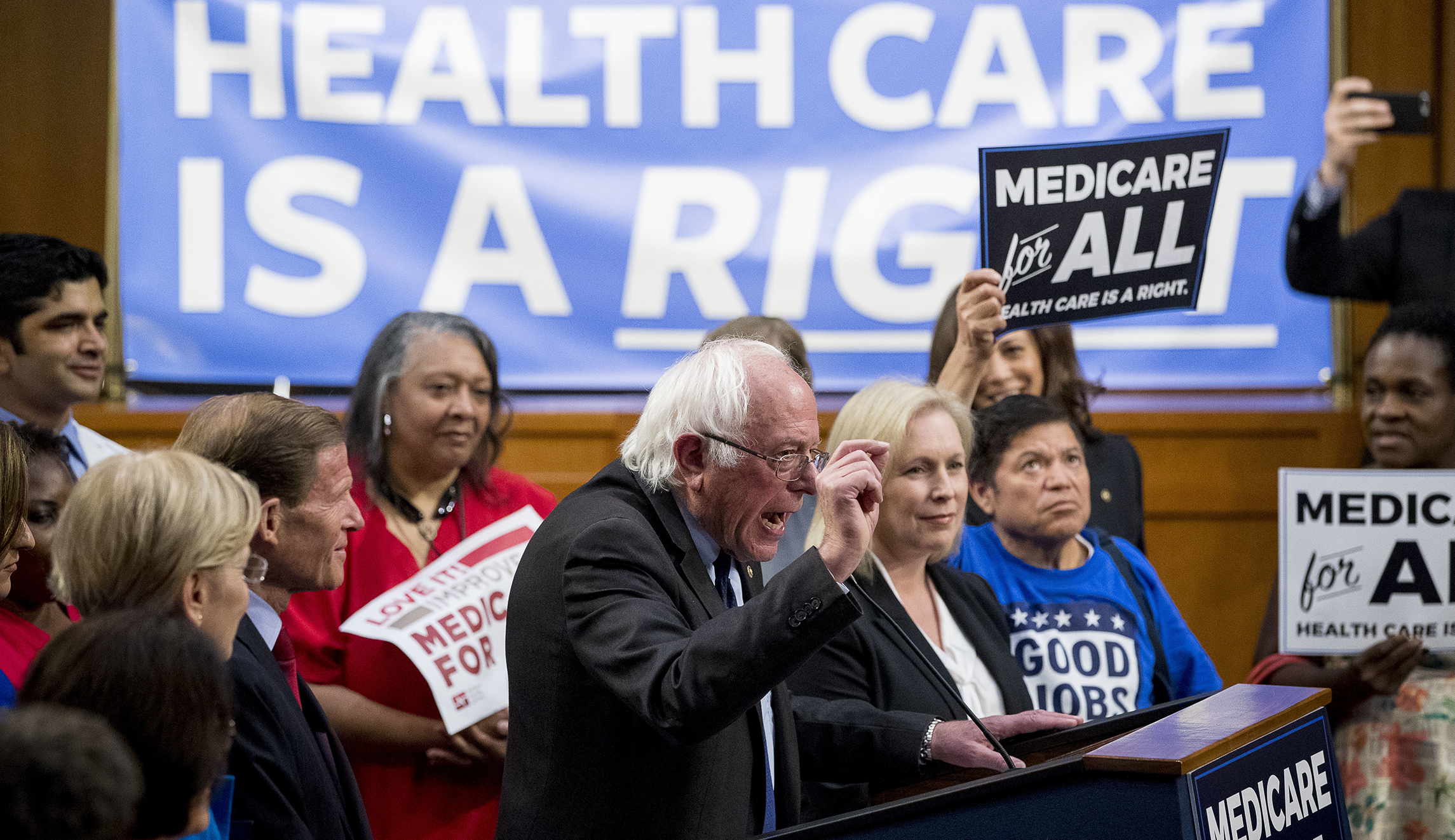
A bill from Sen. Bernie Sanders, I-Vt., to expand Medicare to all Americans would cost the federal government $32.6 trillion over the next decade, a new study finds.
The study released Monday from the Mercatus Center think tank at George Mason University, comes as progressive Democrats are making “Medicare for all” a top issue in their campaigns ahead of the 2018 midterms.
Recommended Stories


Mercatus, which is known for having a conservative lean, looks at the bill that Sanders released back in September 2017 to convert Medicare into a government-run, socialized healthcare system for all ages. Sanders’ bill would eliminate employer-provided insurance and have health insurance covered for everyone by the federal government.
Mercatus looked at the cost of running such a program over the next decade and found that “Medicare for all” would add $32.6 trillion in federal budget commitments over that time period.
“These estimates are conservative because they assume the legislation achieves its sponsors’ goals of dramatically reducing payments to health providers, in addition to substantially reducing drug prices and administrative costs,” the think tank said.
Single-payer advocates have said that the federal government could lower administrative and drug costs by negotiating directly with manufacturers. Sanders’ bill that was released during the campaign also included several new taxes to pay for it, including a new payroll tax and tax on the middle class.
The study also looked into how the $32 trillion could be paid.
“A doubling of all currently projected federal individual and corporate income tax collections would be insufficient to finance the added federal costs of the plan,” it said.
Doctors and hospitals would be paid far less under Sanders’ bill. The bill would pay all doctors and hospitals under the same rate as Medicare, which pays about 40 percent less compared to reimbursements from employer-sponsored plans.
Mercatus does not factor in the impact that these lower rates will have on the healthcare system in the study.
“It cannot be known how much providers will react to these losses by reducing the availability of existing health services, the quality of such services, or both,” the think tank said.
The study’s figure is similar to an analysis from the liberal Urban Institute in 2016, which looked at the plan that Sanders unveiled as a candidate for the Democratic presidential nomination.
Socialized healthcare has increased in popularity among Democrats. When Sanders introduced his new bill in September 2017, major potential 2020 candidates like Sens. Cory Booker, D-N.J., and Kirsten Gillibrand, D-N.Y., signed on to it.
Several progressive candidates for congressional races have also touted “Medicare for all.” Alexandria Ocasio-Cortez, a 28-year-old activist who scored a major upset over ten-term incumbent Rep. Joe Crowley, D-N.Y., made “Medicare for all” a key plank of her campaign.
