

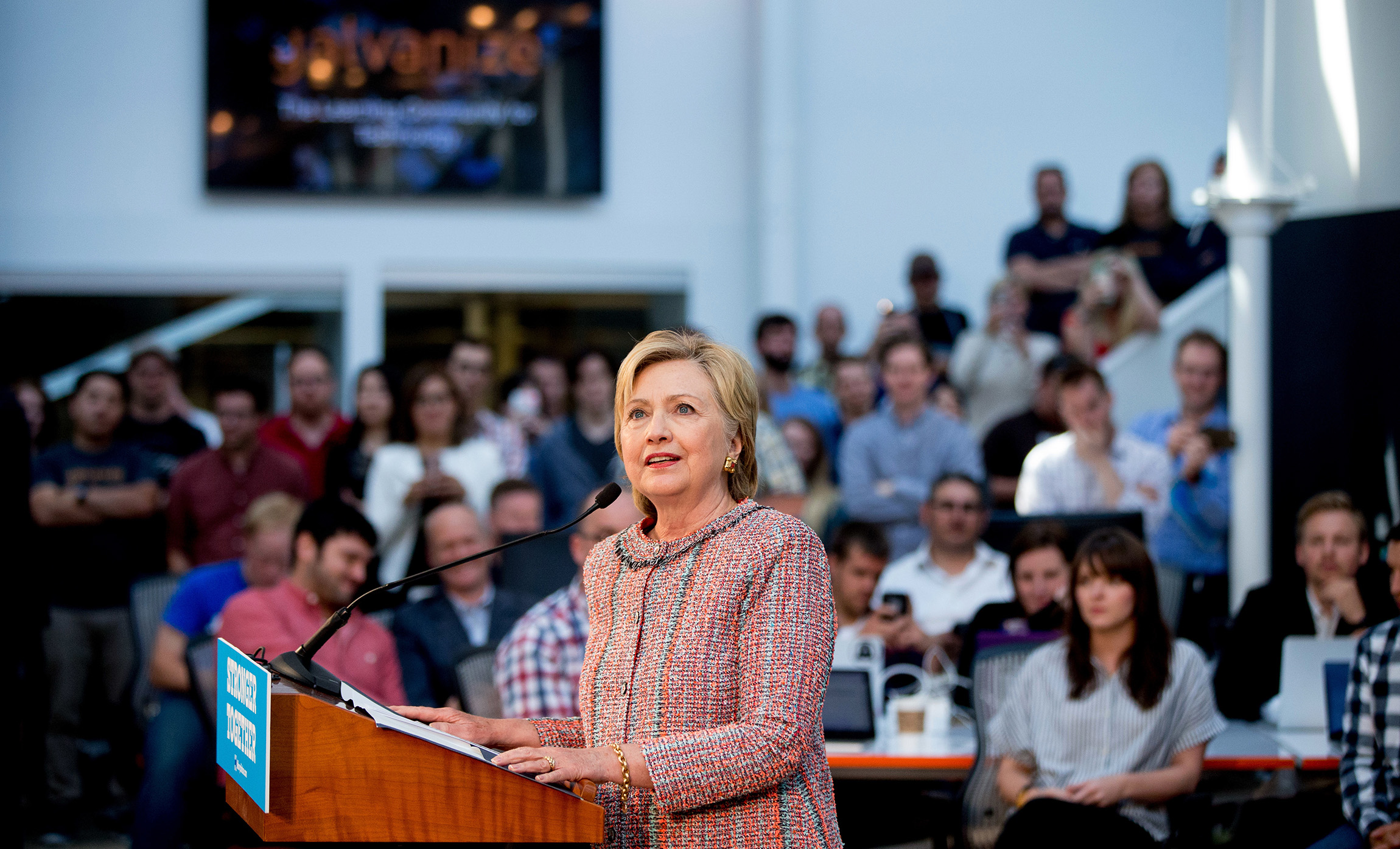
Hillary Clinton unveiled a three-part plan on Tuesday aimed at stimulating job creation and innovation by expanding public access to technology and enabling college students to postpone payments on student debt up to three years.
Shortly before traveling to Los Angeles for a town hall with digital developers, the Democratic presidential hopeful outlined her new tech policy agenda during a speech in Denver, Colo. The comprehensive plan features three key goals: installing high-speed internet in every American home by 2020, providing students with access to computer science courses before they pursue higher education and incentivizing entrepreneurship by permitting students to defer their federal student loans if they become involved in startups or develop their own small businesses.
Recommended Stories


Students who launch small businesses in “distressed communities” would also be eligible to have up to $17,500 in their student debt forgiven under Clinton’s plan.
“Saying that you want to make America ‘great again’ is code for saying, ‘We want to go back to the way it used to be, forget about technology, forget about inclusivity, forget about giving everybody an opportunity to have a real shot at the best possible future,'” Clinton said Tuesday, taking an obvious swipe at her Republican opponent Donald Trump.
“That is not who we are as Americans; we don’t go back, we go forward, but we’ve got to go forward with intelligence and a real sense of purpose,” she said. “That’s why today, I am releasing a comprehensive plan to keep America on the cutting edge of technology and innovation. It is one of our biggest assets, and I want it to be democratized.”
Clinton on Tuesday also vowed to defend the net neutrality rules backed by the Obama administration and upheld by a federal appeals court earlier this month, upgrade the government’s cybersecurity framework and increase funding for the National Science Foundation and Department of Energy.
One unnamed Clinton campaign adviser told the Washington Post that the candidate’s tech agenda could carry a price tag of $10 billion.
The former secretary of state’s latest policy agenda includes the development of new government programs as well. According to her plan, Clinton would create a federal grant intended for cities, regions and states that create “model digital communities” by making broadband internet accessible in public places and striving for “world-class connectivity.”
“In eastern Kentucky earlier this year, I learned about a successful program that trains former coal miners to be computer programmers, but the lack of affordable, high-speed broadband is a real barrier,” Clinton said in Denver.
Clinton’s tech agenda reinforces her campaign’s desire to contrast her with Trump by depicting the former secretary of state as a policy-focused candidate who wants voters to know what they’d be getting with her in the Oval Office.
