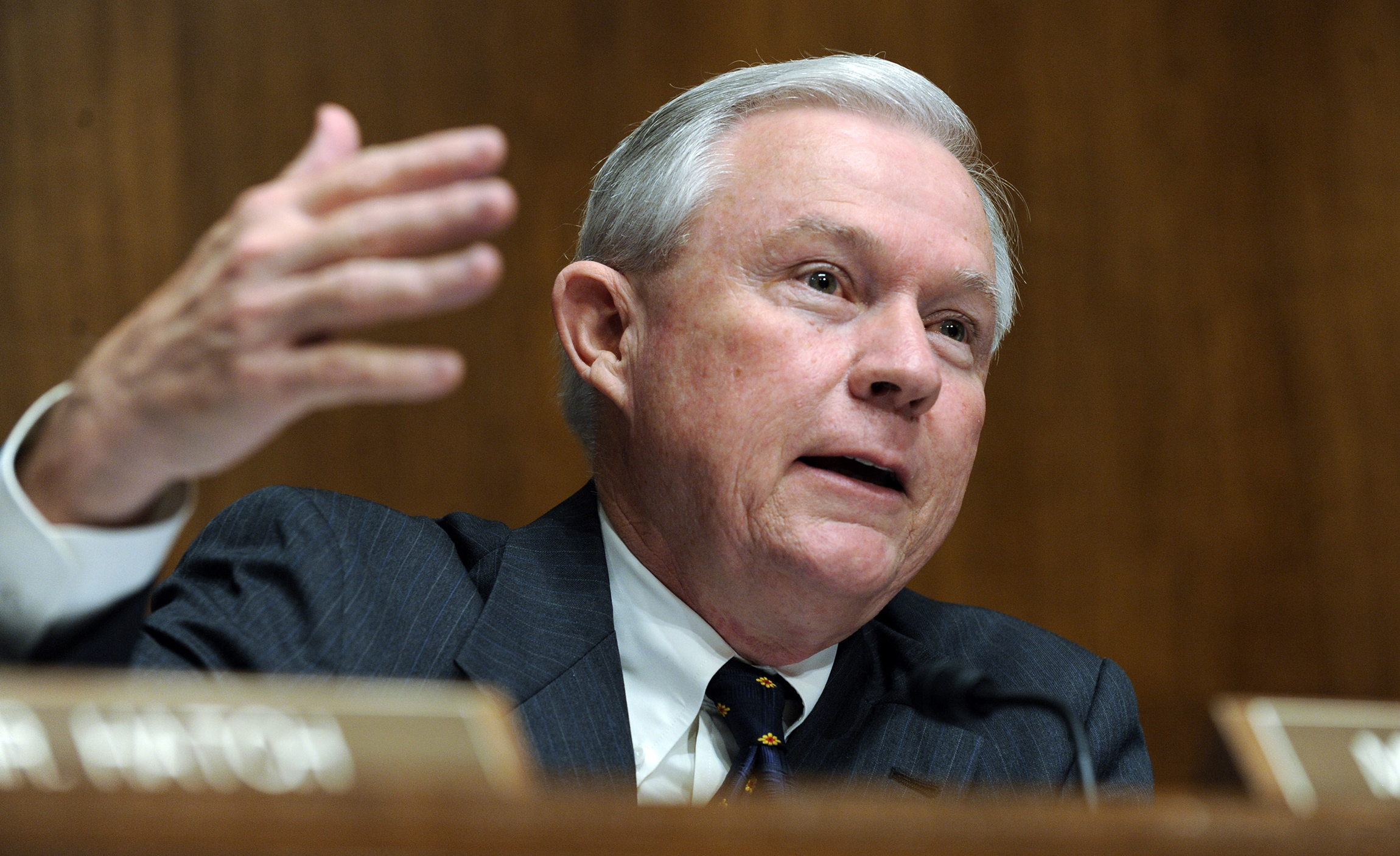
One of the harshest critics of Sen. Jeff Sessions’ nomination to become attorney general on civil rights grounds once heaped praise on him for his work to reduce prison sentences for crack-cocaine possession, a top priority for the black community and President Obama.
After President-elect Trump named the Alabama Republican as his choice to become the nation’s top law enforcer, Wade Henderson, the president of the Leadership Conference on Civil and Human Rights, issued a stinging statement demanding that Trump withdraw the nomination.
Henderson cited Sessions’ “long opposition” to federal intervention to protect voting rights, and called out Sessions’ “repeated votes” against measures to shield members of the LGBTQ community from discrimination.
But back in March 2010, Henderson was singing Sessions’ praises for his work on criminal justice reform. For several years leading up to the bill’s passage, Sessions worked closely with Democratic Sens. Dick Durbin, D-Ill., and Patrick Leahy, D-Vt., on the Fair Sentencing Act, which reduced sentences for crack possessions to make them more in line with penalties for powder cocaine.
“We applaud Sen. [Dick] Durbin for his persistence in seeking real reform, along with Chairman Patrick Leahy and Senators Jeff Sessions and Orrin Hatch for their steadfast commitment to addressing the issue,” Henderson said in a release after the Senate Judiciary Committee passed a version of a bill co-sponsored by Durbin and Sessions. “For nearly two decades the Leadership Conference has fought for the complete elimination of the unjustified and racially discriminatory disparity in sentencing between the crack and powder forms of cocaine.”
He noted that his group would have preferred Durbin’s original bill, which would have totally eliminated the disparity, but were still pleased that the Senate passed a measure reducing the disparity.
Henderson, in his recent condemnation of the Sessions attorney general pick, downplayed the senator’s work on behalf of sentencing reform, concluding that it wasn’t enough to overcome other deep worries about the nomination stemming from racist accusations during the 1980s that killed his nomination for a federal judgeship.
“People can certainly change over the course of 30 years, but despite glimmers of hope throughout his career — including his work on the Fair Sentencing Act of 2010 – the overall record shows that Senator Sessions has not,” Henderson said. “He has no place leading our nation’s enforcement of civil rights and voting rights laws or implementing our nation’s desperately needed reforms to policing.”
The statement of praise for Sessions’ work on a top issue before casting doubt over his nomination parallels similarly jarring past statements of support, then recent criticism from Democratic senators who have worked closely with Sessions to pass several bipartisan bills into law.
When Obama signed the Durbin-Sessions sentencing bill into law, Durbin said Congress had “finally addressed one of the greatest injustices in our war on drugs.” Durbin, who serves as the party’s whip, the No. 3 Senate leadership post, credited Sessions as well as four other Republican senators for negotiating a compromise bill that ensured a unanimous committee vote on the measure.
After Sessions’ nomination, however, Durbin signed onto a letter with other top Senate Judiciary Committee Democrats that questioned whether he is the “right man” to lead the agency charged with protecting the civil rights of all Americans, when “we see hate crimes on the rise nationwide and many people becoming more and more fearful of what the incoming administration will mean for them and their families.”
The sausage work of passing legislation in Washington often makes for strange bedfellows, but the some of the harshest criticism from Democrats about Sessions’ record has failed to acknowledge this work in helping key Democrats push measures past the legislative finish line and into law or praise from liberal-leaning groups for his efforts. That includes Sen. Ted Kennedy, who previously helped sink his nomination for the federal judgeship.
Here’s four other bipartisan bills and issues in which Sessions played a critical role:
1) The Prison Rape Elimination Act. In 2003, Sessions joined liberal lion Kennedy to pass this bill into law. The measure stiffened penalties for prison rape, adopted national standards for preventing sexual assault in prisons and created a review panel at the Justice Department to hold public hearings on the operation of prisons with the highest and lowest numbers of prison rapes. It also created grant funding for states so that budgetary circumstances do not compromise efforts to protect inmates. It passed both houses of Congress unanimously and became law in July 2003.
Liberal groups such as The NAACP, National Council of La Raza and the Open Society Forum, a group funded heavily by George Soros, and Human Rights Watch joined forces with conservative organizations, including Focus on the Family, Concerned Women of America and the National Association of Evangelicals, to support the bill.
After it became law, Justice Detention International, a nonprofit dedicated to ending prison rape, said the new law sparked a “dramatic culture change” within U.S. prisons and jails and called it “one of the most significant human rights victories in modern U.S. history.”
Human Rights Watch called its unanimous passage “an extraordinary accomplishment” and said it was “a first step towards ensuring that prison sentences are not sentences to sexual violence and abuse.”
2) The Ryan White HIV/AIDS Treatment Modernization Act of 2006. Sessions played a key role on the Committee on Health, Education, Labor and Pensions when the Senate reauthorized the Ryan White CARE Act. Though he offered no specific amendments in committee on or the floor, he worked with fellow panel members to alter the funding formula and direct more money through the program to Alabama.
At the time, Sessions argued that Alabama received $3,657 per AIDS patient compared to $5,264 per patient in California.
At a news conference promoting the law’s renewal, Sessions said the federal AIDS Drug Assistance Program wait list has swelled to more than 600 people in Alabama, a fact confirmed by Regina Prewitt of West Alabama AIDS Outreach in Tuscaloosa.
Under the previous formula, states with large metropolitan populations received more money disproportionately. In the years since, Sessions continued to fight for greater equity in funding for rural HIV/AIDS patients, hosting a roundtable by AIDS United with former Sen. Kay Hagan, D-N.C., as well as Reps. Hank Johnson, D-Ga., Barbara Lee, D-Calif., and Shelia Jackson Lee, D-Texas, in an attempt to strengthen the inadequate HIV treatment infrastructure in the South.
AIDS United’s Ronald Johnson during the roundtable said Sessions and other lawmakers were working to overcome several issues that were contributing to the alarming rate of new infections and inadequate treatment options in the region, including “higher rates of poverty, racism that helps drive and fuel the problem, cultural conservatism that serves as a barrier and stigma around HIV.”
3) The Military and Extraterritorial Jurisdiction Act. In 1999 and 2000, Sessions authored the bill with then Sen. Zell Miller, a conservative Democrat from Georgia. The measure amended the Uniform Code of Military Justice to make civilian employers of the Department of Defense and its contractors subject to U.S. law. It passed both chambers of Congress and became law in 2000.
The bill was a reaction to the heightened use of military contractors even before the wars in Afghanistan and Iraq and the dramatic rise of criminal incidents involving these workers. It was passed in order to facilitate the prosecution of former Marine Corps Sgt. Jose Luis Nazario, Jr. for the killing of unarmed Iraqi detainees, although he was ultimately acquitted.
Steven Green, an ex-soldier, was successfully prosecuted under the law for the rape and murder of an Iraqi girl and the mass murder of her family. In addition, the law helped put four former Blackwater employees behind bars for massacring 14 Iraqi civilians on Sept. 16, 2007.
4) The HEROES Act. Sessions joined Sen. Joe Lieberman, a conservative Democrat who later became an independent, to author the bill. The measure expanded death benefits for the families of fallen combat personnel from $12,000 to $100,000. It also increased servicemen’s group life insurance maximum benefit to $400,000 from $250,000. It was incorporated in the 2005 emergency supplemental appropriations bill and became law the same year.
After its passage, Lieberman thanked Sessions for “his leadership on this issue and so many other matters to our nation’s security and for those who fight and serve in uniform to protect us.”
“In some ways, the public, after listening to the chatter and the noise, would be surprised to hear we work so often in these committees with total nonpartisanship in the national interest, which is the way it ought to be.”
Several veterans and military family groups thanked both Sessions and Lieberman for writing that legislation. The Veterans of Foreign Wars said the bill would “help ensure that those families that have lost a loved one in the name of freedom receive the support and financial assistance that truly demonstrates our appreciation for those who sacrificed all.”
This story was corrected to show that Sessions supported the amended version of the Fair Sentencing Act, not the original version.
