

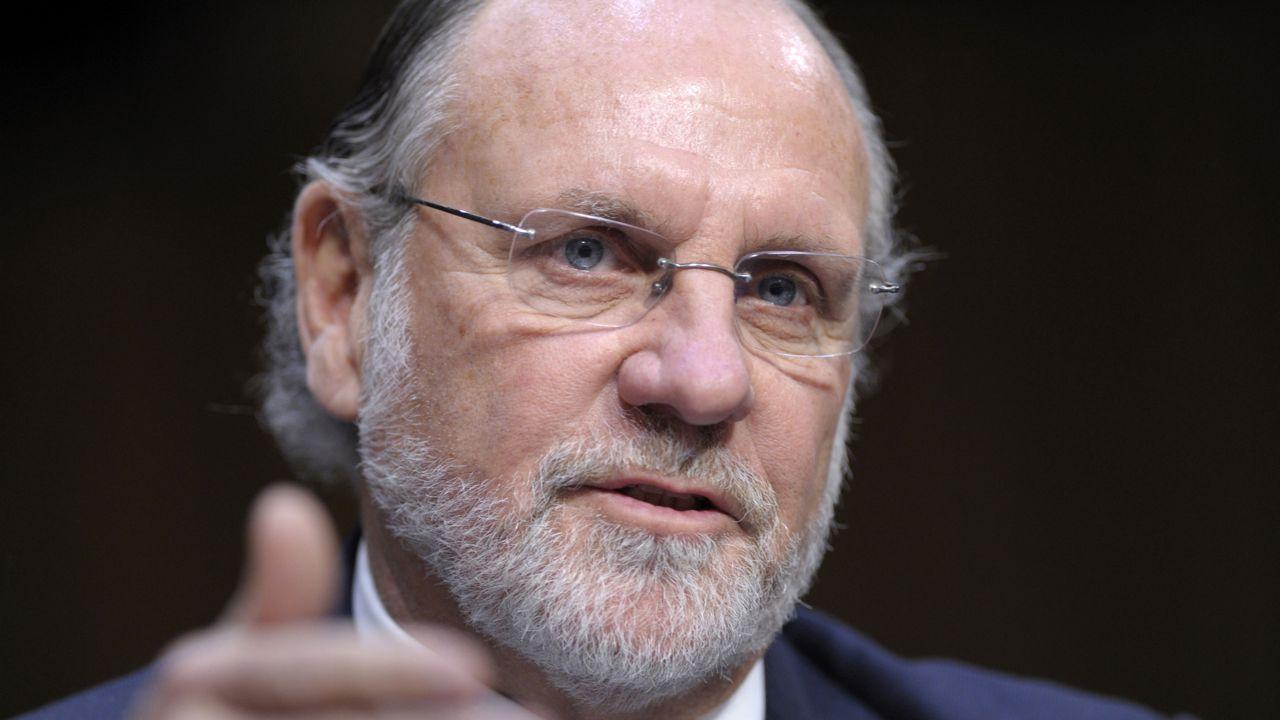
President Obama’s friend and fundraiser Jon Corzine, whose firm MF Global blew up in a spectacular bankruptcy this fall, was trying to make billions by betting on government bailouts. But more interestingly, Corzine — a former senator and a trusted adviser to the Obama administration — was aiming to profit off of big-government regulation.
What should upset both liberals concerned about special-interest influence and conservatives who value the free market is not that Corzine failed, but that he almost succeeded.
Corzine’s personal connections to regulators, his influence within the White House, and his pull inside the Senate’s Democratic majority cannot be questioned. His longtime personal and professional relationship with his main regulator, Commodity Futures Trading Commission Chairman Gary Gensler, was well depicted in a Wall Street Journal editorial.
Gensler and Corzine worked together at Goldman Sachs during the Clinton administration. When Corzine needed a guest lecturer at a course he taught at Princeton in fall 2010, Gensler stepped up. They have met and spoken repeatedly, and even attended a wedding together.
The Obama-Corzine ties are even tighter. Corzine, as Democratic Senatorial Campaign Committee chairman in 2004, he was the national Democrat most attentive to raising money for then-State Sen. Obama, and helping elect him. In 2008, the Obama campaign deployed Corzine as a spokesman on economic matters, while Corzine gave the maximum $28,500 to the Obama Victory Fund.
President Obama and Vice President Biden in 2009 hit the campaign trail hard for Corzine’s failed re-election bid, where Obama declared Corzine “our Wall Street guy.” The Republican National Committee has released a video of Biden repeatedly saying Corzine was “the first guy I called” for advice on stabilizing the economy.
Corzine has raised at least $500,000 for Obama’s 2012 re-election. The Obama campaign has not disclosed the exact number.
And while Corzine served only five years in the Senate, his 2004 stint at the head of the DSCC guaranteed that every Democratic senator would return his calls.
Corzine’s Rolodex was one asset that clients and creditors bought when they trusted their money with MF Global.
Politics were most plainly on display in MF Global’s European bets. While other investors were fleeing the debt of European governments, fearing default, Corzine was betting on a bailout. Corzine personally corralled more than $6 billion into this Europe wager on the belief, “that Europe would not let its brethren default,” as the New York Times reports it.
Ironically, Corzine’s bet on a euro bailout was right, and it actually would have paid off had skittish clients not made a run on their money. Europe got its lifelines from the U.S. Federal Reserve Bank and the International Monetary Fund after MF Global collapsed in a rush of client panic.
MF Global bankers were so sure these bailouts were coming, it seems, they went to extraordinary — and possibly illegal — lengths to keep the bet alive. Someone at the firm improperly moved client money to the firm’s own accounts in Europe, according to testimony by regulators.
But bailouts weren’t the only government interventions in which Corzine saw opportunity. He was also engaging in some regulatory profiteering.
Investment bank Sanders O’Neill wrote in a research note quoted by the Wall Street Journal, “We suspect that his contacts in Washington could prove useful as MF Global navigates a shifting regulatory environment.”
Specifically, the increased regulation created by the 2010 Dodd-Frank law multiplied the value of Corzine’s political connections. When a Democrat-run Congress is writing new laws, the influence and access of their former colleague and fundraiser suddenly matters more.
Give the Commodity Futures Trading Commission more power, and Gensler’s friend and former colleague becomes more valuable. And as the executive branch implements the law and decides what sort of money will be regulated what way, the guy whom the White House calls for advice — and campaign donations — is the right guy to have steering your investments.
As with all regulations, Dodd-Frank helped clear out some competition for the well-connected like Corzine. the Times explains: “Mr. Corzine arrived [at MF Global] just as Washington was pressing the big banks to curb their lucrative yet risky businesses. Spotting an opening, he fashioned new trading desks, including one just for mortgage securities and a separate unit to trade using the firm’s own capital, a business known as proprietary trading.”
MF Global is a legitimate White House scandal, but not primarily because Corzine oversaw the pillaging and squandering of investor money. The scandal is that Corzine played a game of turning public policy into profit, and almost succeeded.
Timothy P.Carney, The Examiner’s senior political columnist, can be contacted at [email protected]. His column appears Monday and Thursday, and his stories and blog posts appear on ExaminerPolitics.com.
