

DES MOINES — Donald Trump loves winning, but Iowa has trouble picking Republican winners.
Whether he wins the Iowa caucuses, or elevates another candidate, could shape the Republican presidential race from New Hampshire and South Carolina all the way to the GOP convention in Cleveland. Will Trump stay a winner? And will the candidate who prevails in the caucus be able to go all the way to the nomination?
Recommended Stories


The Donald is making his final play for victory in a state that seems hardly tailored to suit him best. Having held four events since Jan. 9, the national front-runner desperately wants to win over the white, born-again Christian voters who comprise a large bloc of caucus voters.
These conservative Christians overwhelmingly backed former Arkansas Gov. Mike Huckabee in 2008, and former Sen. Rick Santorum in 2012, helping deliver crucial wins to both of them. Trump is holding his own with evangelicals, with 27 percent backing him, according to a recent Quinnipiac poll, second only to Sen. Ted Cruz’s 34 percent.
But Trump’s past support of abortion, his three marriages, and what Cruz calls his “New York values” seem a poor fit for evangelicals, who were nearly 60 percent of Iowa caucus-goers in the last two elections. How does he hang on in the Hawkeye State? Some believe the answer is blue-collar voters.
“[Trump] has some blue-collar appeal, and I think that’s been overlooked,” said Craig Robinson, a former offical of the Republican Party of Iowa, who is editor-in-chief of The Iowa Republican newspaper. “Look, Mike Huckabee was a populist when he won the caucuses. Santorum had a very populist theme. So this year, the person that’s really talking to those blue-collar workers is Trump, more than anybody.
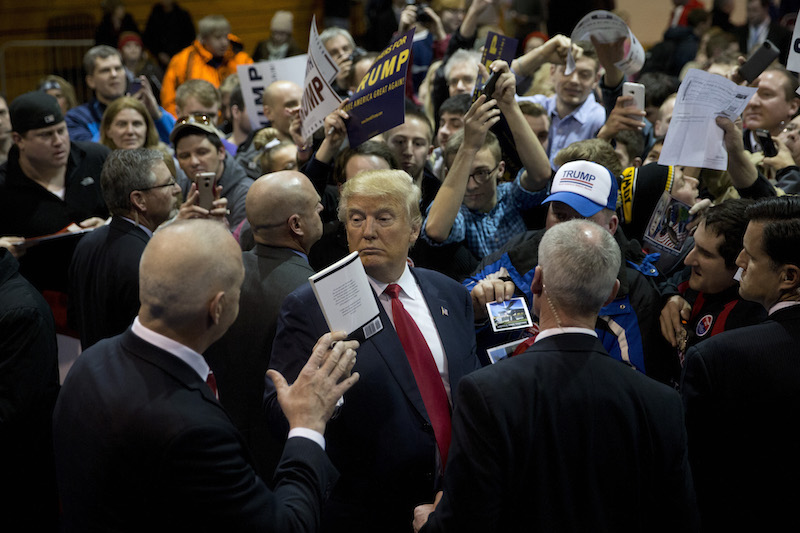
During the Cedar Rapids event, Republican presidential candidate Donald Trump told the crowd that he believes he can “run the table” and sweep the GOP primary calendar. (AP Photo)
“When he’s campaigning in Ottumwa, Iowa, that’s exactly who he’s getting down there — Burlington, some of those areas where he’s campaigned,” Robinson said. “There’s not a bunch of white-collar jobs in some of these more remote places in Iowa. It’s not like Des Moines, Iowa City or Cedar Rapids. His message appeals to them.”
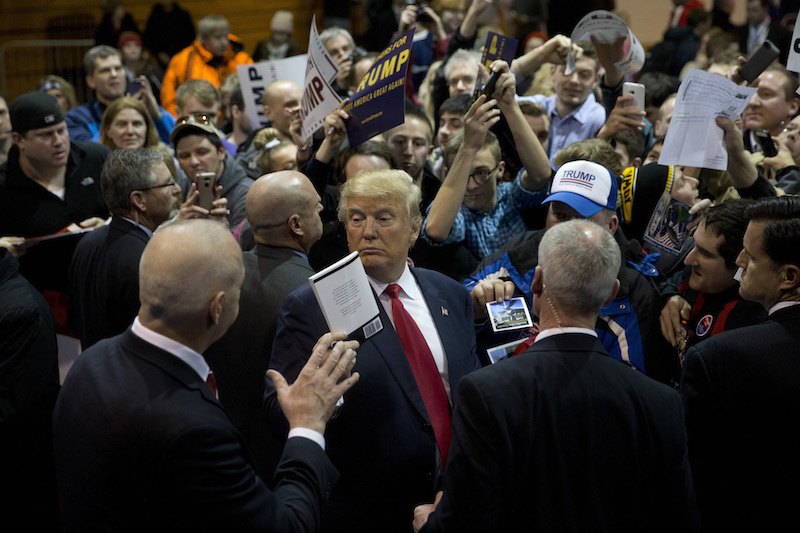
In recent rallies, Trump has made his pitch to caucus-goers more Iowa-centric by talking about his support for ethanol and for Iowa farmers, going so far as to tell a crowd in Cedar Falls that he will “get a farm and settle down here” if he wins the caucuses. The message seems to resonate with curious voters, with events in Ottumwa and Cedar Falls both overflowing with trying to get a glimpse of Trump in the flesh.
“I’m doing really well. We really have hit something. We have a really special relationship with the people of Iowa, and I think we’re going to do very well,” Trump told the Washington Examiner before the Cedar Rapids rally. “It’ll be much easier for me to say if we, you know, I’d like to be No. 1. A lot of people would say, ‘don’t say that,’ but I would like to be No. 1. I think we have a very good chance of being No. 1 in Iowa. We do very well with the evangelicals. We’re doing very well with the Tea Party. We’re doing well with the people of Iowa. And there is just a relationship, and I’ve been here a lot … we come back and we stay some nights.
“I think [Iowans] want strength. I think they want strong borders. Obamacare’s a very important issue for them. They are very upset with Obamacare,” Trump said. “But I think they really want strength. They want to take care of our vets, very interestingly, and they want see our military strong. I mean, these are all points I’m very strong on.”
RCP Current Poll Average for Iowa Republican Caucus InsideGov
Trump clearly sees Iowa as a launchpad. During the Cedar Rapids event, he told the crowd that he believes he can “run the table” and sweep the GOP primary calendar. Some, however, see problems ahead for him, in Iowa especially.
“I’d put the over/under for him at 20 [percent] with evangelicals and the reason is the way that vote works,” said Steve Deace, an Iowa-based radio host. Deace, who endorsed Cruz, argued that Trump’s lack of “organizational presence” will dampen any chance he has to turn out the voting bloc, adding that he won’t be the one to change how they vote en masse.
Consistently, Trump supporters, along with undecided voters who attend his events, point to his opposition to political correctness and their own displeasure with the condition of the economy.
“This particular county [Wapello] is depressed economically. There’s just some hard times going on, and I think people here are concerned about security, but they’re also concerend about their future … The economy’s a big one,” said Raymond Morrison, 61, a retired member of the military from Ottumwa, where Trump held a rally on Jan. 9. Morrison, who says he’s undecided between Trump, Cruz and Sen. Marco Rubio, does plan to caucus despite not having done so since George W. Bush was on the ballot.
“He says it like it is, and he talks about reality,” said Roger Hollingsworth, 21, who is studying manufacturing at the University of Northern Iowa. “It’s important for me to have a manufacturing economy in the United States. It’s the economy really … We need jobs here.”
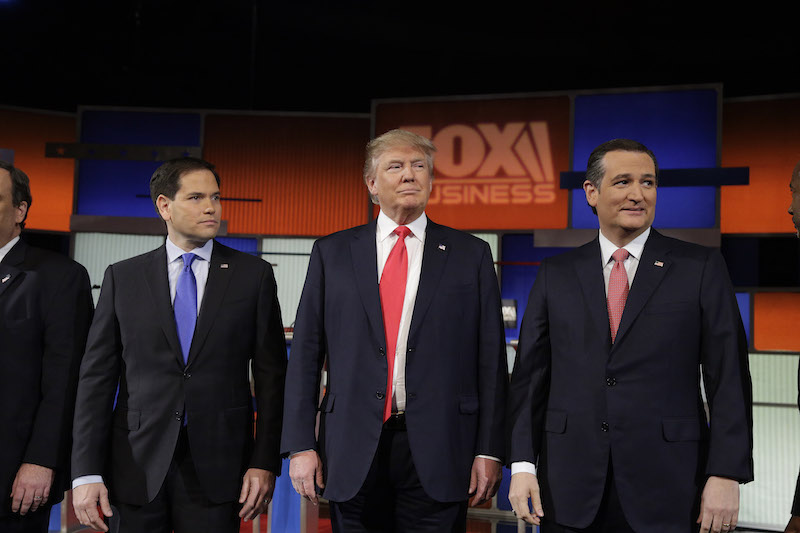
Trump is holding his own with evangelicals, with 27 percent backing him, according to a recent Quinnipiac poll, second only to Sen. Ted Cruz’s 34 percent. (AP Photo)
“He’s going to get it done. You can tell he’s going to get it done. He doesn’t care. He’s not worried what the media is going to say or how China’s president’s going to feel. He doesn’t care about the huggy stuff,” said Hollingsworth, who changed his registration from independant to Republican to vote for Sen. Joni Ernst in 2014. “It’s time Americans stop eating a sandwich that is s— and is covered in sugar, and we realize it’s just a s— sandwich.”
Deace predicts that if Trump loses Iowa to Cruz, the candidate will give Iowa a piece of his mind before moving on to New Hampshire.
“What’s going to happen when he loses on February 1st is he’s going to throw a tantrum that’s going to make Howard Dean’s scream look like the Gettysburg Address,” Deace predicted. “He’s going to blame his Iowa team … fire them all publicly, and he’ll blame them. But it’s his fault. He didn’t work the state. … Splashy events where I show up once a week and three, four, five thousand people come, that’s not the way this works. This is done with retail politics.”
In recent weeks, Trump has begun to look toward the general election, with a renewed focus on former Secretary of State Hillary Clinton, as well as former President Bill Clinton’s infidelities from before and during his tenure in the White House.
However, Trump has come to realize it all starts with Iowa. Barack Obama’s victory over Clinton in Iowa in 2008 sent him on a path to the nomination that his loss in New Hampshire could not prevent.
While Trump hopes his rendezvous with Iowans evolves from a fling to a full-blown relationship, challenges await. A lover and a fighter, he is embracing the challenge.
