
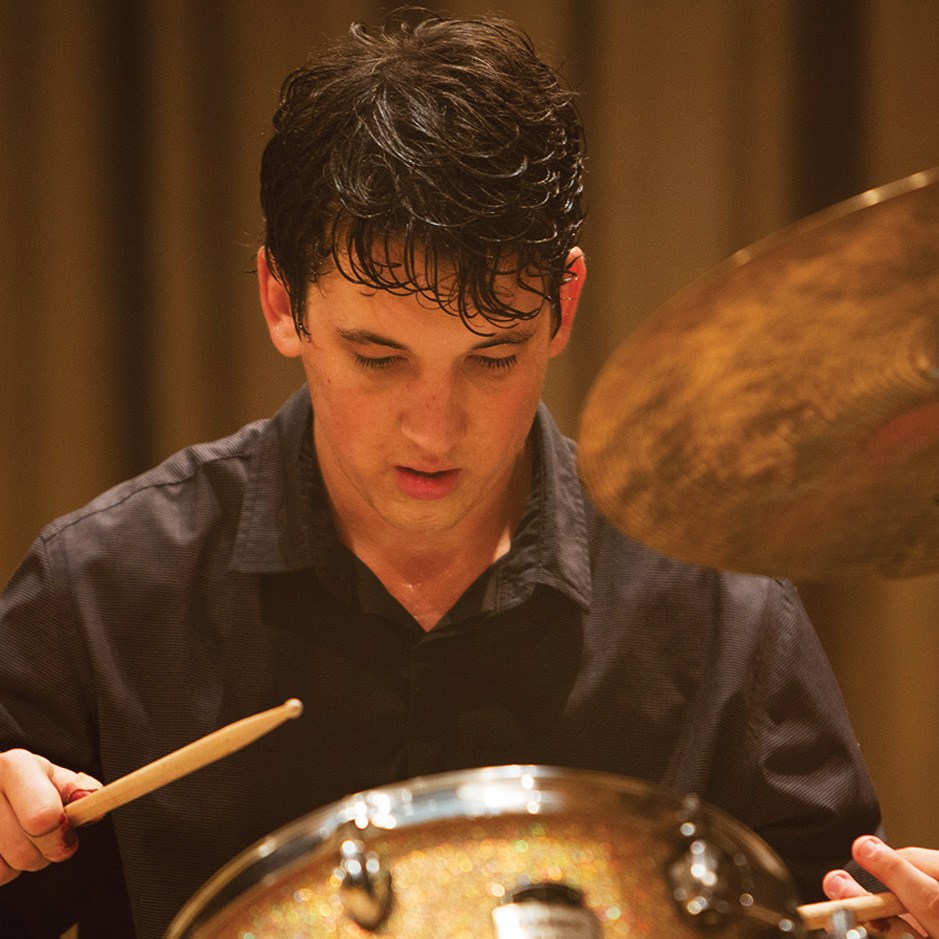
In Whiplash, a dislikable teenager runs afoul of a dislikable adult, and what emerges from their conflict is the movie of the year so far. It’s rare for an American film to offer such an unvarnished portrait of unattractive people, and rightly so: Why would people want to watch? Well, the tremendously exciting Whiplash, which provides more tension than Gone Girl and more thrills than a sports movie about a team of underdogs, provides an answer. While the two main characters of Whiplash are not likable, they are, in their own ways, profoundly admirable. They are not interested in being nice, or thoughtful, or pleasant. What they want is to be great.
Andrew (Miles Teller) is a first-year student at Juilliard (called something else in the movie, presumably for legal reasons). Andrew is a jazz drummer, and he is consumed by the instrument. He rehearses endlessly, and when he is not rehearsing, he is listening to Buddy Rich. He is isolated and friendless and only gets the gumption to ask out a pretty movie-theater popcorn-seller after he is suddenly recruited to play in his conservatory’s premier jazz orchestra by its imposing conductor, the black-clad and muscle-bound Fletcher (J. K. Simmons).
Real journalism.Trusted by millions.
Unlimited access to in-depth reporting, expert analysis, and the stories that shape our country.
Already a member? Log in
Andrew’s social problem isn’t really shyness. It’s arrogance, and the arrogance is only deepened by Fletcher’s favor. When he and the girl from the movie theater go out on a date, he is dismissive of her because she (at 18!) doesn’t know what she wants to do with her life. When he has dinner with his utterly conventional relatives, who are more excited by the college football played by one of their sons than by his drumming, Andrew is withering about the fact that his cousin goes to a Division III school and will never get the call from the NFL. “I’m sure you’ll make an excellent school board president,” Andrew says.
Whiplash is a movie about work: about Andrew practicing, and Fletcher conducting, and their band readying itself for competitions. Miles Teller brings a spooky, haunted intensity to his performance as Andrew, a character who is compelling only because he is deeply serious about something in a way few 18-year-olds ever are.
Andrew’s arrogance is about to take a beating. For Fletcher—who is portrayed, in a magnificent performance so sharp and uncompromising it seems to draw blood, by the whipsaw-smart character actor J. K. Simmons—is a monster. He insults Andrew’s well-meaning and ineffectual high school teacher-father (Paul Reiser) by suggesting Andrew’s long-absent mother left her family when she realized her husband was a lousy writer. Fletcher is physically threatening and psychologically abusive. Let a player in his band be even slightly behind the beat, or have an instrument ever so slightly out of tune, and he will let fly with invective—and throw a chair.
Yet it’s clear that Fletcher is himself a remarkable musician, and his pathological pursuit of excellence mirrors Andrew’s own determination not just to be good, not even just to be one of the best, but to be one of the greats—even the greatest. He wants to be Charlie Parker. Anything less would be a catastrophe for him. When his father points out that dying alone at 34 is hardly something to emulate, Andrew responds by saying that nearly 60 years after Parker’s death, they’re talking about him, and that’s what matters.
Andrew is not speaking for the writer-director Damien Chazelle here. Chazelle, who is all of 29, was himself a jazz drummer in high school. In interviews, he has said that he viewed his screenplay as a tragedy about an abusive relationship—but he recognizes the movie doesn’t play that way at all, a clear example of D. H. Lawrence’s adage to trust the tale and not the teller. Whiplash is not a movie about a mentor gone wrong or a boy brought low.
Whiplash could be considered a film-length exploration of Cyril Connolly’s most famous aperçu: “The more books we read,” Connolly wrote, “the clearer it becomes that the true function of a writer is to produce a masterpiece and that no other task is of any consequence.” There are a thousand things wrong with this observation, but it is certainly the case that artists rarely achieve timeless greatness without being possessed of a consuming, and often extraordinarily costly, hunger to achieve immortality of a kind. Whiplash is a serious, tough-minded movie about artistry and ambition, and when was the last time you saw something like that? I can promise you it’s been a long time since you’ve seen anything as good.
John Podhoretz, editor of Commentary, is The Weekly Standard’s movie critic.