
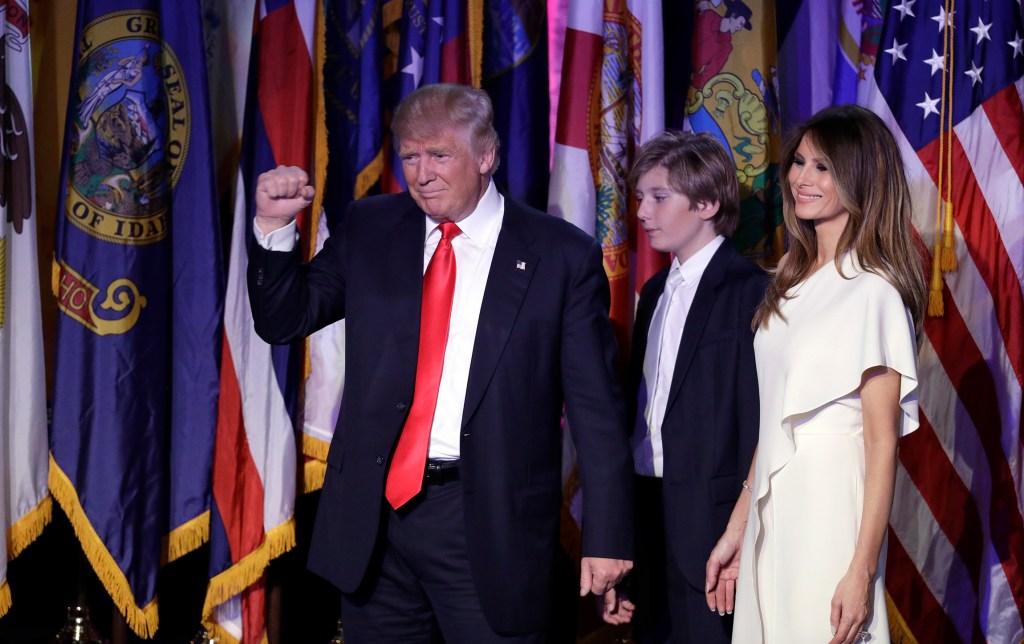
Barone: Trump’s astonishing victory

So Donald Trump has been elected the 45th president of the United States, with Fox News declaring at 2:40 am that he had won more than 270 electoral votes. Something that very few seasoned observers, including me, expected when he glided down that escalator in Trump Tower 17 months ago to announce he was running for president.

So what happened?

1. Turnout. My nephew Robert Wagamon, who lives in Eaton County, Mich., and spends time in family property in Iosco County, Mich. — both of which voted once for Barack Obama and both of which voted for Donald Trump — text-messaged me the following on election night: “Lots of white guys that are usually hunting on Election Day decided that they have had enough and had a dog in the fight. Big lines today.”

It’s too early to analyze turnout closely — because the totals reported election night are not in every case complete — but it seems to me that Trump won because his supporters were energized and came out to vote and Hillary Clinton’s did not do so to as great an extent.

It turns out that you can’t call people who live constructive lives, working at jobs and raising families, “deplorables” and “irredeemables,” without energizing them to come out and vote against you.

When you look at the returns from small counties in Ohio, in outstate Michigan, in western Pennsylvania, in Upstate New York (even though New York state was never in contention), in Wisconsin, in Iowa, what you see again and again are counties that voted something like 50 percent for Barack Obama but also voted something like 60 percent for Donald Trump.

2. A big victory for the Republican party. We will now have a Republican president, a Republican Senate and a Republican House, plus a big majority of Republican governors and attorneys general. The prevailing narrative in punditry has been that there is an inevitably increasing Democratic majority of blacks, Hispanics, single women and millennials who will dominate future elections. Doesn’t seem so inevitable right now.

It turns out that in a country that is roughly equally divided between two partisan political blocs — blocs that have been reshaped in this contest — nothing is inevitable.

3. Particularly when the two major signature initiatives of Barack Obama’s presidency — Obamacare and the Iran nuclear deal — have been and continue to be unpopular. Which is to say, issues matter. Remember that Hillary Clinton’s poll lead began to decline before FBI Director James Comey’s Oct. 28 announcement of the reopening of the Clinton secret email system investigation; it began with the announcement of the big Obamacare premium increases.

Barack Obama has never sweated much about the details — accepting dysfunctional provisions of Obamacare, conceding almost every point in the negotiation of the Iran nuclear deal — but it turns out that details can matter.

4. The Obama 2012 coalition that Hillary Clinton tried and failed to replicate turns out to be dangerously fragile.

Its core constituencies — blacks, Hispanics in some but not all states, millennials, single women — are geographically clustered in central cities, sympathetic suburbs and university towns. That has helped Democratic presidential candidates in the Electoral College, but has also hurt the party in elections to equal-population congressional and legislative districts.

In this election it did not help Democrats enough. In large part this was because Clinton couldn’t duplicate Obama’s turnout and black percentages, as you can see from the results in Philadelphia, Cleveland, Detroit and Milwaukee. And she obviously got nothing like Obama’s margins and turnout from millennials.

Young and downscale black voters are low-propensity voters; they need enthusiasm to turn them out; Hillary Clinton couldn’t deliver that. Can any other Democratic candidate you can think of? The kind of Democratic candidates who tend to win in heavily Democratic demographic clusters are poorly positioned to win statewide or nationwide, at least if they’re not the first black president.

5. It was often said that Donald Trump was the only Republican who couldn’t beat Hillary Clinton and that Clinton was the only Democrat who couldn’t beat Trump. But elections are a zero-sum game in which all but one player must lose but one must win, and it turned out that the first of these statements was wrong.

6. Finally, a reminiscence. In 1980 I was working as on off-air analyst to Lesley Stahl on CBS News’s election night coverage. The result that year — Ronald Reagan beating incumbent President Jimmy Carter in 44 of 50 states—was just as astounding as this night’s was, and came mercifully much earlier in the evening.

At some point around 10 p.m. — I don’t remember exactly when — I was asked to relinquish my under-the-scenes seat so that a special guest could climb into Lesley’s chair: it was former President Gerald Ford, who gracefully congratulated President-elect Ronald Reagan. Nothing analogous happened last night. We didn’t see members of the Bush family or the Clinton family or the Obama family on television all night. Astounding.

Related Content