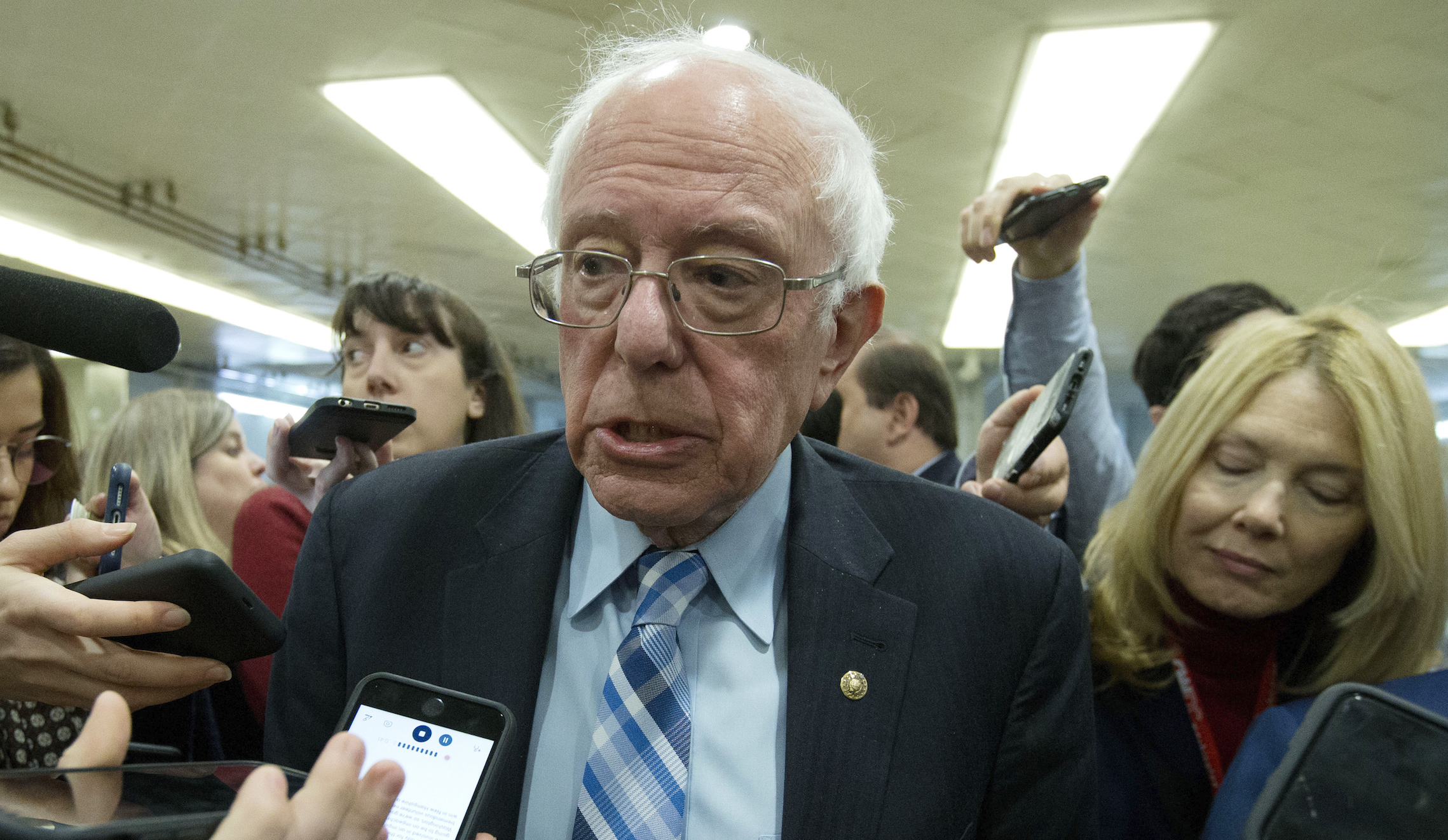
With less than two weeks until Iowa’s Feb. 3 opening caucuses, 2020 Democratic presidential candidates are running out of time to lob what many believe is the most obvious political attack against Bernie Sanders.
The Vermont senator’s hostility toward the party he’s now seeking to lead against President Trump and Republicans in the fall has barely been broached by his rivals for this year’s nomination.
For Cesar Conda, a GOP strategist at Navigators Global, Sanders’s opponents are not hitting Sanders on the issue out of self-interest.
“They eventually want his supporters,” the former Dick Cheney adviser and Marco Rubio chief of staff told the Washington Examiner.
Conda explained political observers had seen this conundrum before: in 2016 with then-candidate Trump, who had been a Democrat before running as a Republican. But Conda added that the counterpunch may not “move the needle that much, because voters in both parties are trending away from establishment labels.”
“Blasting Bernie for not being a Democrat probably helps him in the polls,” he said.
In comparison, Sanders’s ideological ally Massachusetts Sen. Elizabeth Warren, 70, hasn’t shied away from going after former Vice President Joe Biden, 77. Last November, Warren, who herself was a Republican until 1996 when she was well into her 40s, claimed he was “running in the wrong presidential primary” for defending insurance companies after he blasted her Medicare for All funding plan as “mathematical gymnastics.”
“On one level, it’s kind of funny,” Biden told donors in response. “I’ve been a Democrat my whole life.”
Biden was previously criticized for praising Republicans, including former GOP Sen. Strom Thurmond, a prominent segregationist.
Another contender who has switched parties is Michael Bloomberg. The billionaire media mogul, 77, only reregistered as a Democrat in 2018 after almost two decades as a Republican and then as an independent during his terms as New York City mayor. Concerns regarding his changing parties have been assuaged by his promise to donate his campaign infrastructure and an unlimited amount of money to the eventual standard-bearer in order to defeat Trump in the general election, as well as to boost Democrats further down the ballot.
Sanders, along with the rest of the field, was required by the Democratic National Committee to sign a candidate affirmation form. Under reforms introduced in 2018, a White House hopeful must “be a bona fide Democrat” whose record and public statements demonstrate they are faithful to the “interests, welfare, and success” of the organization.
Yet Sanders has a colorful history of slamming Democrats despite embracing the party for short bursts of time. He registered as a Democrat ahead of the 2016 presidential primary against Hillary Clinton and ran as a “D” in his 2006, 2012, and 2018 senatorial primary bids before declining the nomination and contesting the general as an independent.
Although he’s proud of being Congress’s longest-sitting independent, Sanders has caucused with Democrats since 1991 when he first arrived on Capitol Hill as the at-large representative for Vermont. Doing so meant he could be appointed to committees, a privilege he received in exchange for voting with Democrats on all procedural issues.
His shifting stance on the Democratic Party was foreshadowed in a 1982 letter he wrote to a constituent when he was mayor of Burlington, Vermont.
“I don’t think there is much difference between the ‘beliefs’ of the two major parties and that they are, in fact, one party,” he wrote. “I would consider joining or helping form a political party if I felt it would be an effective way to accomplish the things I think are important.”
He reiterated his anger at the two-party system during his first, losing, congressional campaign in 1988, arguing Democrats’ refusal to back a tax code overhaul showed both bodies were “dominated by big money interests.”
More recently, Sanders called for President Barack Obama to face a primary challenger during the 2012 cycle, telling the Nation in a 2011 interview people wished Obama stood up for the middle class “in a way that he has not done up to this point.”
“It would do this country a good deal of service if people started thinking about candidates out there to begin contrasting what is a progressive agenda as opposed to what Obama is doing,” Sanders said on Thom Hartman’s radio show that year.
When asked whether he could be that contender by WNYC, New York City’s public radio station, he replied: “Well, I’m not a Democrat, I am the longest-serving independent.” Sanders went on to tepidly endorse Obama in 2012 as “by far the preferable candidate.” After he finally decided to enter the presidential fray in 2016, he described his own bid as a “course-correction” from the Obama administration.
For former Republican Pennsylvania Rep. Phil English, Sanders supporters’ deprioritization of “fealty to the Democratic organization, brand, or community” was “fed by a perception that the Democratic Party essentially had a nomination process last time that disadvantaged Sanders.”
“I suspect that many Democratic campaigns competing with Sanders are probably finding that the argument itself might be counterproductive by painting them as establishment candidates or institutionalists, which is not a good thing in the Democratic space,” said English, who represented the Erie, Pennsylvania, area in the House from 1995 to 2009.
English noted that digs at Warren over her Republican past didn’t gain any traction.
“That tactic is not working. It doesn’t work well in Republican politics anymore. It doesn’t work well in Democratic politics anymore. Trying to brand a Warren or a Sanders or, for that matter, Bloomberg as not being lifelong Democrats simply has fallen flat,” he said.
Sanders’s White House aspirations experienced a second wind in the past month. He tops the field in terms of fundraising and leads the pack in several national and state-based polls. However, he still trails Biden in both metrics, according to polling averages compiled by RealClearPolitics.
