


The U.S. had fewer unemployed people for each available job to start 2016 than at any time since May 2001, according to a new Department of Labor report.
January saw just 1.4 unemployed workers for each advertised job opening, the Bureau of Labor Statistics’ Job Openings and Labor Turnover Survey showed.
Recommended Stories



That ratio was the lowest since the early days of the dotcom bubble’s bursting. It beat out the lowest level reached during the previous business cycle, when it touched 1.42 unemployed workers in April 2007, before the housing bubble fully collapsed and the recession began.
The ratio is considered an important signal of how “tight” the labor market is. With fewer workers available for any given job, in theory, employers should have to offer higher pay to hire new employees or keep their existing workers.
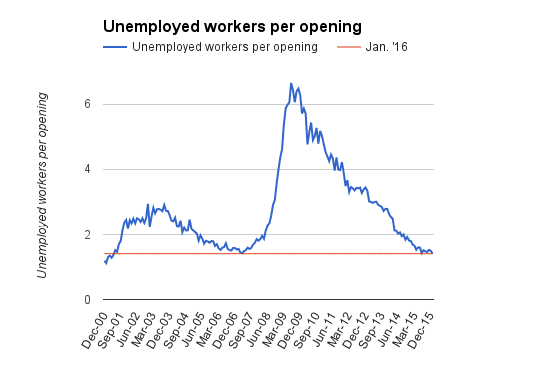
The improvement in January was driven by falling unemployment and by advertised job vacancies rising from 5.28 million to 5.54 million.
The news from the report, however, was not all good. Hiring, as opposed to advertised openings, fell. Only 5 million workers were hired in the month, down from 5.4 million the month before and the lowest such mark since November 2014.
The survey, known as JOLTS, follows the more widely cited jobs report on a one-month lag, but contains more detail about gross hiring and layoffs. The numbers are adjusted to smooth out predictable seasonal fluctuations.
