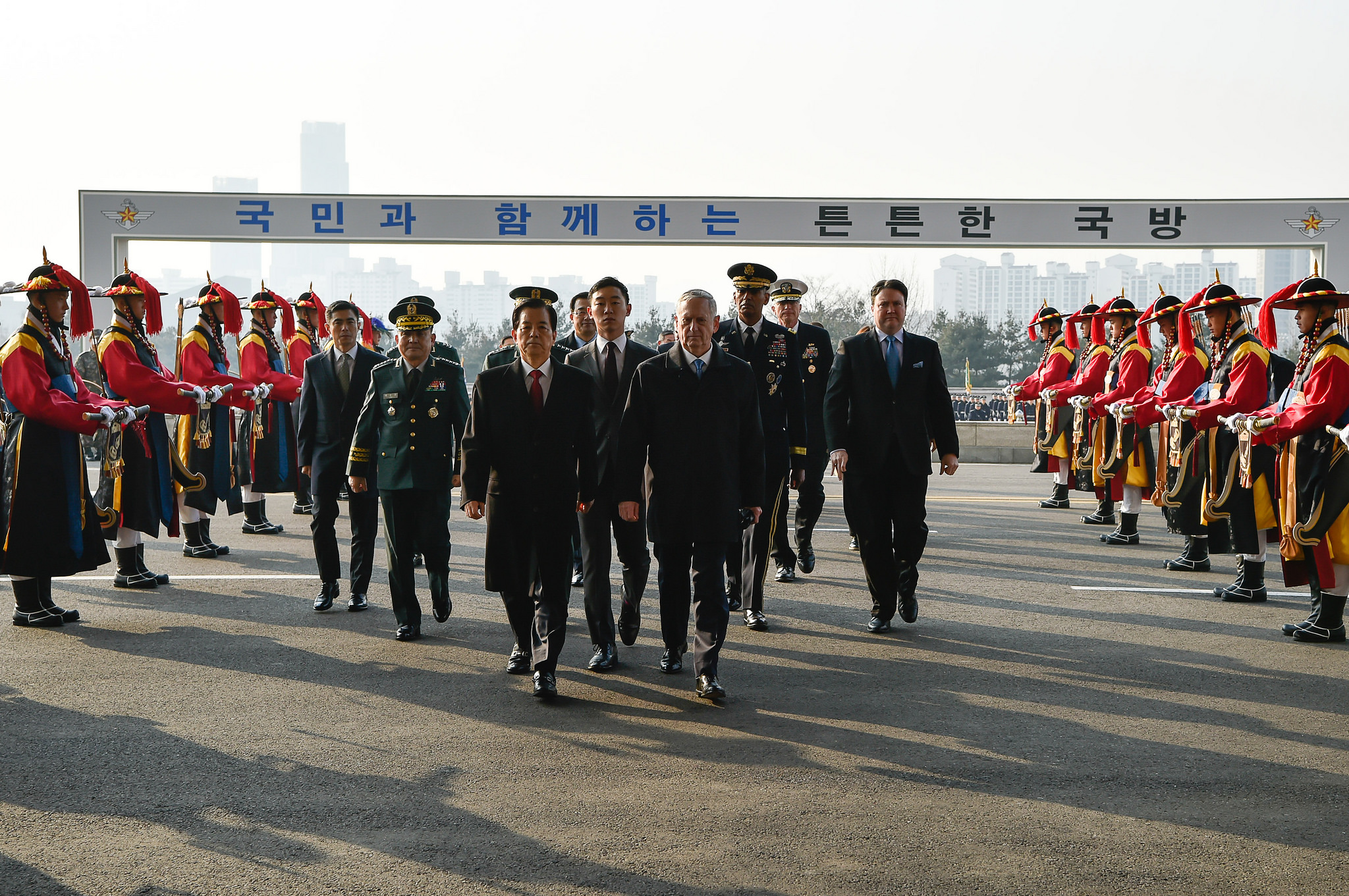
Any North Korean attack on an American ally will meet with an “overwhelming” counterattack from the United States, particularly if the regime uses nuclear weapons.
“Due to some of the provocations out of North Korea and other challenges that we jointly face, I want to make certain that Article Five of our mutual defense treaty is understood to be as real to us today as it was a year ago, five years ago and as it will be a year and 10 years from now,” Defense Secretary Jim Mattis told reporters before a meeting with Japanese Prime Minister Shinzo Abe on Friday.
“Any attack on the United States or on our allies will be defeated and any use of nuclear weapons would be met with the response that would be effective and overwhelming,” he added while meeting with South Korean Defense Minister Han Min Koo.
Mattis reinforced that warning by delivering it during his first overseas trip as leader of the Pentagon, which also made him the first emissary of President Trump to travel abroad. The message had layers of significance: first, Mattis’ comment offset Trump’s campaign trail warning that he would “be prepared to walk” away from Japan if they didn’t increase financing U.S. military deployments in the region. The explicit rebuke of North Korea included implicit rebuffs of Russian and Chinese attempts to diminish American influence in the region as well.
North Korean nuclear tests have been regarded with growing alarm by foreign policy leaders in Congress and the State Department. The United Nations Security Council imposed new sanctions on the regime in response to a recent spate of weapons program tests, but that didn’t deter North Korean dictator Kim Jong Un from announcing that an intercontinental ballistic missile test is “in its last stage” of preparation.
“Due to North Korea’s threatening rhetoric and destabilizing behavior, we are taking defensive steps, like deploying the highly effective THAAD antimissile unit to the Republic of Korea, to protect its people and our troops that stand beside our ally,” Mattis said. “We are also committed to expanding trilateral venues of cooperation with Japan where the mutual defense of our nations is best served through teamwork.”
That message will be heard beyond the Korean peninsula. China and Russia both regard the missile defense battery as a bulwark against their own militaries.
“Deployment of U.S. missile defense systems in South Korea clearly goes beyond the tasks of deterring ‘the North Korean threat,’ ” Russian deputy defense minister Anatoly Antonov said in October during a trip to China. “We do not have any doubts that U.S., with support of their allies, will continue to build up the potential of the Asia-Pacific segment of their global missile system, which will inevitably lead to disruption of established strategic balances both in the Asia Pacific and beyond.”
