

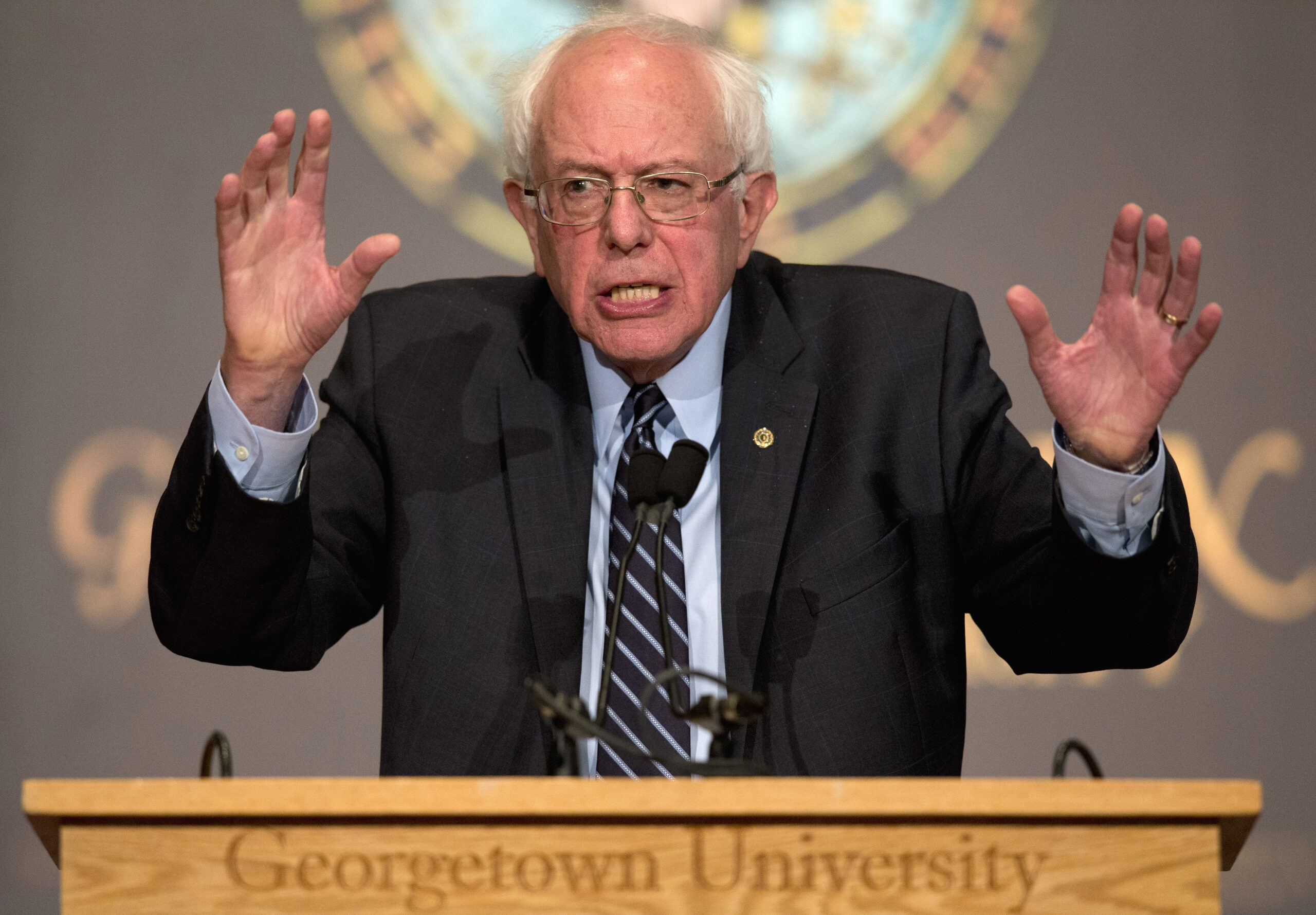
Just days after Bernie Sanders said he wouldn’t give a major foreign policy address because it takes too long to create “a serious speech on serious issues,” he spent part of his talk on democratic socialism detailing his plans for defeating the Islamic State.
Recommended Stories


“It is clear that the United States must pursue policies to destroy the brutal and barbaric ISIS regime, and to create conditions that prevent fanatical extremist ideologies from flourishing. But we cannot — and should not — do it alone,” Sanders said.
The second-place Democratic primary candidate was at Georgetown University Thursday to talk about his economic and political philosophy. But in the wake of the Islamic State attacks in Paris, candidates have received increased pressure to show off their foreign policy bona fides.
The talk came the same day Hillary Clinton gave her speech about how she would defeat the Islamic State. Sanders is usually content to criticize Clinton for her Iraq war vote, but on Thursday he appeared to try to offer an an alternative.
In his speech, Sanders called for the “destruction” of the radical terrorist group, as long as the United States is not going it alone.
Similar to Clinton, Sanders insisted that the United States should not send American boots on the ground in Syria or Iraq. He also called for the United States to create an organization similar to NATO to confront security threats and “defeat the rise of violent extremism.”
Unlike Clinton, who advocated for America to immediately begin air raids in Syria, Sanders said “unilateral military action should be a last resort, not a first resort.” Instead, the United States must rely on leaders in the region and the militaries of Middle Eastern countries to fight the Islamic State.
“While the U.S. and other Western nations have the strength of our militaries and political systems, the fight against ISIS is a struggle for the soul of Islam, and countering violent extremism and destroying ISIS must be done primarily by Muslim nations — with the strong support of their global partners,” he concluded.
