

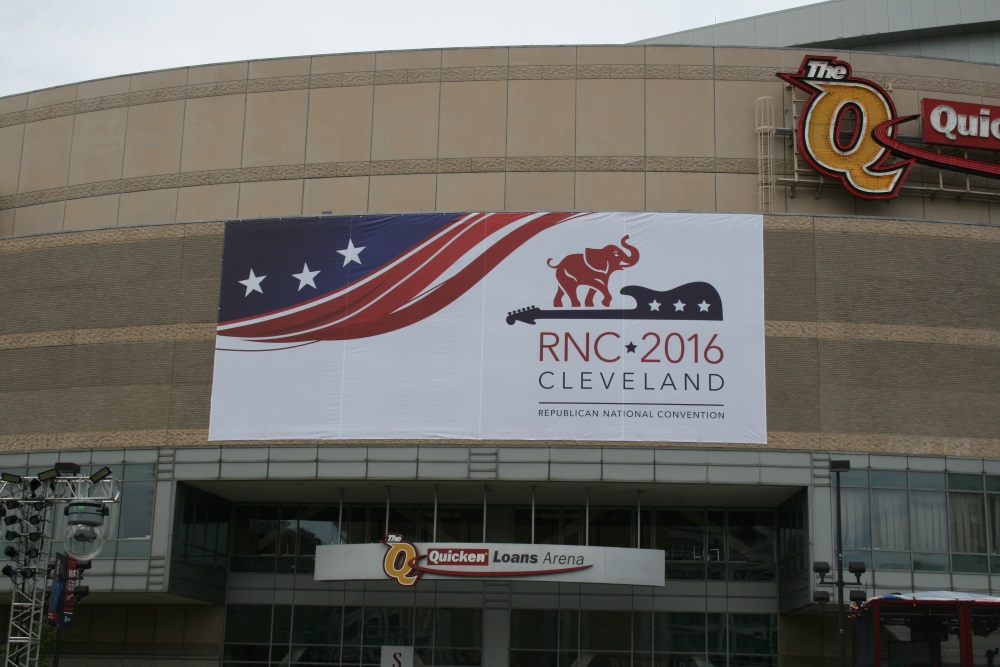
Well, it’s finally here, the moment we’ve all been waiting for, when Donald Trump is formally enshrined as the face, the body, and the soul of the Republican party. I hope it works out for them …
1) No one knows what’s going to happen in November. We may have an idea of the likelihood of certain outcomes, but that’s it. So even if you look at the environment/data/history and decide that Candidate X has an 80 percent chance of beating Candidate Y, it still means that Candidate Y will win the election one out of every five times. Which is a lot. Let’s stipulate a few things, right off the top, before we start talking about what Trump’s medium-term effect on the GOP is likely to be.
Put it this way, if I told you that you have a 1-in-5 chance to win the lottery, you’d run out to buy a ticket, no? Heck, let’s move the odds further and say that Candidate X has a 90 percent chance to beat Candidate Y. If I told you that there was a 1-in-10 chance that you’d get hit by a bus today if you left your house, you’d call in sick.
All of which is to say that even if you think that Clinton is an overwhelming favorite to beat Trump (or vice versa) the chance of the opposite happening is large enough that you really shouldn’t be surprised should it come to pass.
2) We’re going to have one of two outcomes in November. (There is a third possible outcome, but it’s too remote and too terrible to really contemplate. So let’s not.)
Either Donald Trump is going to be elected president, in which case his supporters’ belief in his electability will be vindicated and the Republican elites who threw in with him will be seen as having calculated correctly. Or Hillary Clinton will win, in which case the Republican primary voters who chose Trump will be shown to have been monumentally wrong and the Republican elites who capitulated to him ridiculously craven. In which case there will be recriminations.
3) Actually, it’s not as simple as that. You get “recriminations” when one half of the party foists a bland, sort-of-simpatico ham sandwich on the rest of the party, like it did in 2012. The Trump phenomenon was more like a hostile takeover of the party by an outsider with the support of a small rump of party regulars. Trump believes almost nothing that Republicans have believed for the last 40 years. He is, in almost every way, a liberal Democrat who decided to run for president on the other side since that’s where the opening was. Kind of like Frank Rizzo did in Philadelphia back in 1987.
So what will happen in the wake of a Trump loss would be more like a five-way war breaking out in a failed state following the sudden death of a military strongman. We’re not talking recriminations so much as total chaos. The people who want the GOP to be a National Front-style nativist party will still be activated. But the traditional Republicans and conservatives, who were good soldiers for Trump, are going to want their party back–if they’re going to lose anyway, they might as well lose with someone who shares their beliefs. The Chamber of Commerce, libertarian, amnesty types will probably decamp to the Democratic party. The social conservatives will have to figure out where they have a home.
After Romney lost, the GOP looked like post-Brexit England. If Trump loses, the Republican party is going to look like Somalia circa 1991.
4) Come to think of it, there are lots of similarities between Donald Trump and Frank Rizzo. You may not know who Frank Rizzo was: He was the Democratic mayor of Philadelphia from 1972 to 1980 and if you’d like a point of reference, think of him a more vulgar and brutalist Richard Daley.
(Rizzo’s most famous quote is so naturally Trumpian that I’m almost surprised Trump hasn’t cribbed it for himself yet. Then again, there’s time.)
Rizzo was also a naturally gifted politician. But in 1987 he registered as a Republican so that he could challenge the sitting Democratic mayor, Wilson Goode. Goode wasn’t quite the bumbling stooge that Hillary Clinton is, but he was a machine politician of no real distinction who happened to possess a number of structural and demographic advantages. And he beat the more talented and accomplished Rizzo like a drum.
5) This is the long way around the barn to say the following: Not just the next four years, but the entire future of the Republican party is being wagered in Cleveland this week. So either the people who have pushed for and toadied to Trump will be right, or they will have precipitated the death of the party.
Ben Domenech had a great line over the weekend explaining what (the plurality of) Republican voters have done in choosing Trump. “They are desperate for change,” Domenech said. “They are desperate for something different than the elites who have failed them for far too long. But they have turned, in their desperation, to a man who they don’t fully understand.” I agree with this assessment, 100 percent. And also with the analogy it implies.
6) I began by saying that no one knows what’s going to happen, and that’s true. But I’ll close with two thoughts. First, the events of the last two weeks–spree killings of police officers, a massive terrorist attack abroad, an attempted coup in Turkey–ought to hammer home how unpredictable events can be. There’s no reason not to expect more of the unexpected. And no one knows how these unforeseen events will affect the race.
Second, if there’s been any lesson about polling over the last few cycles, it’s that the aggregate weight of the polls tends to be right. Hillary Clinton led just about every poll in the Democratic primary; she won the nomination. Trump led most polls in the Republican primary; he won the nomination. Ditto Mitt Romney in the 2012 primary and then Barack Obama in the 2012 general. And dittos again for 2008, at both the primary and general levels. When you lead most all of the polls, all of the time, you tend to win.
To this point, Hillary Clinton has held a remarkably consistent lead over Trump. Go look at the RealClear graph and you’ll see. Going back to May 19, Trump has led in only 12 of the 120 or so major polls taken.
Maybe this will change. It certainly could.
And even if it doesn’t, one-in-five odds still aren’t bad. You’d buya lottery ticket with those odds. In a heartbeat.
The thing is, you probably wouldn’t want to bet your house on them. Which is exactly what the Republican party has done.
