
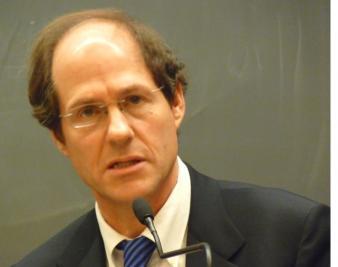
Barring any surprises in his confirmation hearing Tuesday, Harvard Law School Professor Cass Sunstein will become the new White House “regulatory czar.”
Best known off-campus for the best-selling book he co-authored last year with economist Richard Thaler (Nudge: Improving Decisions about Health, Wealth, and Happiness), President Obama’s choice to head the Office of Information and Regulatory Affairs (OIRA) has generally been a popular one.
Using government to “nudge” us toward better choices sounds good in theory. But now that Sunstein is in the position to put this idea into practice, Americans may want to start watching the typically under-the-radar OIRA more closely.
The Sunstein brand of nudge paternalism isn’t as new to public policy as it might seem. Take food, for instance. Local governments and interest groups have been trying to nudge us towards “better” dietary choices for years. And “better,” of course, is in the taste buds of the beholder.
Soda taxes. Restaurant zoning ordinances. Body-Mass Index monitoring. Mandatory ingredient labels. (And some ingredient-“free” labels too.) All of these seemingly benign interferences are designed to influence our choices without technically taking them away.
Proponents of these measures promise plenty of public-health miracles to sell them, including slimmer children or lower rates of chronic disease. But the interventions we’ve seen enacted have fallen far short of expectations.
For example, after three years of issuing Body Mass Index report cards to parents of Arkansas schoolchildren, officials reported that the experiment “did not put a dent” in obesity rates.
But there’s a larger problem with Sunstein’s “nudge” approach: Government simply shouldn’t be deciding ahead of time which choices are best for us, especially when it comes to food.
Despite years of trying, researchers have yet to pinpoint a diet that can make everyone healthy. Consider the salt-reduction scheme proposed in New York City. While some studies show that a low-sodium diet can decrease the risk of heart disease for some individuals, experts warn that others can actually boost their blood pressure by lowering their salt intake.
In other words, one size will not fit all.
The more emotionally charged our public food fights become, the more difficult it is to be impartial about which food choices are “best” for everyone. Whether it’s cutting greenhouse gas emissions, returning to our agricultural roots, or merely sticking it to “Big Food,” meal planning is more of a political exercise than ever before.
Our new OIRA administrator knows this all too well. Sunstein has been an active participant in the politicization of food as a proponent of animal rights.
As recently as 2007, Sunstein publicly argued in favor of a legal ban on hunting, and for the elimination of meat-eating. In 2004, he co-authored a book on the animal liberation philosophy, which sets out an ambitious plan to give animals the legal “right” to file lawsuits.
But a 2002 working paper Sunstein wrote at the University of Chicago contains the biggest red flag about what may lie ahead. “There should be,” Sunstein wrote, “extensive regulation of the use of animals.”
What kind of regulations could our newest czar have in mind? A cheeseburger tax? A steakhouse zoning ordinance? A PETA-style overhaul of the National School Lunch Program? (No matter what the vegan crowd claims, after all, milk still does a body good.)
Sunstein can eat all the tofu salads and veggie burgers he wants. He should always have that choice. But let’s hope he doesn’t plan on using his new position to nudge the rest of us away from a porterhouse and fries – or whatever else he might decide is bad for our health.
David Martosko is the director of research for the Center for Consumer Freedom, a nonprofit coalition supported by restaurants, food companies and consumers to promote personal responsibility and protect consumer choices.
Recommended Stories


Print subscriber? Click here to login/register your account
Digital subscriber? Click here to login/register your account.