

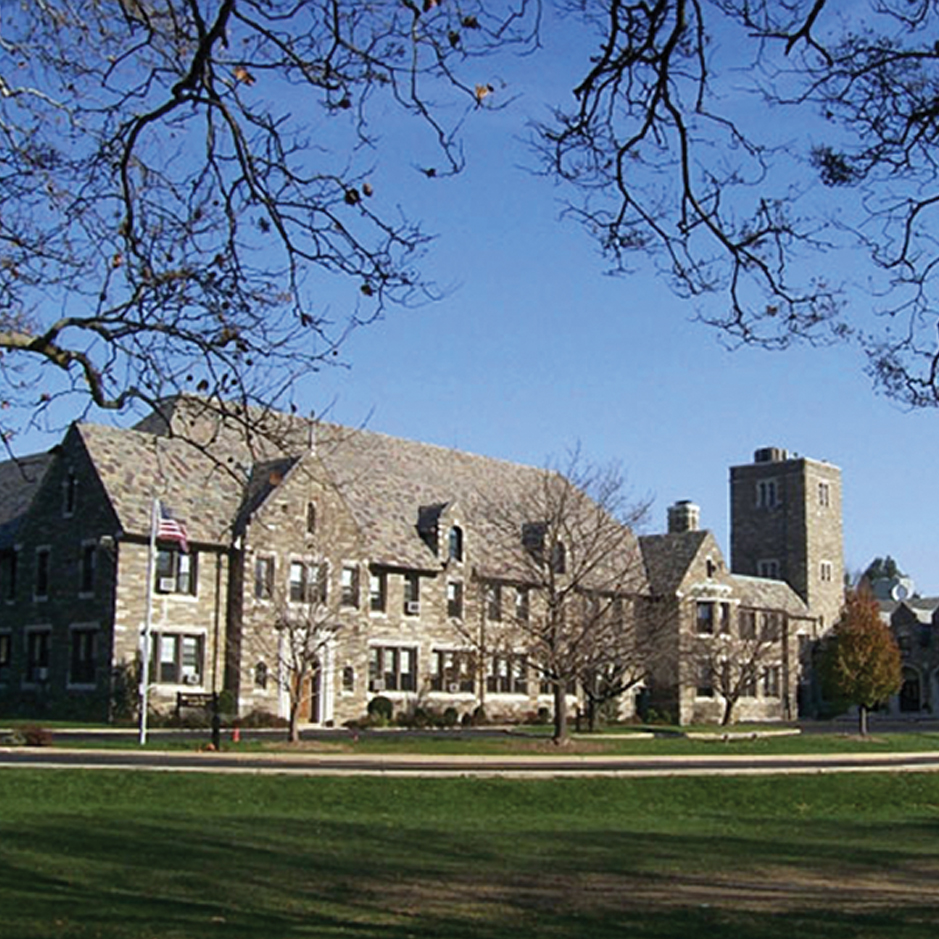
We turn now to the suburbs of Philadelphia. Waldron Mercy Academy is a private school in Merion Station which takes children all the way from daycare at three months through eighth grade. It is not cheap—tuition for grades one through eight is $13,250 per year. Its campus sits nestled around an old convent in an upscale suburb and boasts all the bells and whistles. It has a long, low stone wall surrounding green lawns and athletic fields. In 2009 it was designated a Blue Ribbon School of Excellence. It boasts a diverse student body, cataloguing gender, race, and ethnic make-up down to the tenth of a percent. Seriously: School administrators want you to know that 0.6 percent of the students are Muslim and 0.2 percent are Armenian Apostolic.
The only problem with Waldron Mercy is that the school is Catholic.
Stay informed.Stay ahead.
Join Washington Examiner for unlimited access to the news, analysis, and commentary that matter most.
Already a member? Log in
You might miss that from the “Who We Are” section of its website, where Waldron Mercy mentions “Faith” and talks obliquely about “Christian values” and the “charism of Mercy.” But the school doesn’t explicitly say, right there, that it’s Catholic; there’s no crucifix. And just to make sure you don’t get the wrong idea about what sort of “Christian values” they’re into, the school does explicitly say it teaches children “to serve not merely out of charity, but from a developing sense of social justice.”
But Catholic it is, and last week, as the radioactive fallout from the Obergefell ruling was settling across the country, Waldron Mercy fired its director of religious education, Margie Winters.
Winters had married her lesbian partner in Massachusetts in 2007. From 1996 until 2014, the state of Pennsylvania had in place a statutory ban on same-sex marriage. But in 2014 a federal district court ruled this statute unconstitutional, and Obergefell put an end to any hope that the state might once again decide its own laws. And so Waldron Mercy decided that it could not be Catholic and have a director of religious education for its students living in direct contravention of the church’s teachings.
What is most interesting about the case of Waldron Mercy, however, isn’t the firing of its director of religious ed—it’s the response of a local Democratic politician.
In 2010, Lower Merion Township passed an ordinance banning discrimination based on sexual orientation. The ordinance provided an exception for religious organizations, but this exception had its own exception: Religious organizations that are supported “in whole or in part by governmental appropriations” would not be allowed to discriminate. And so Democratic state senator Daylin Leach, who represents Merion, pointed out to the Philadelphia Inquirer that Waldron Mercy has gotten more than $270,000 in the last two years from the state’s Opportunity Scholarship Tax Credit program, and that 70 students have attended since 2005 under a similar state program, the Educational Improvement Tax Credit.
“So they’ve received a good bit of money from the State of Pennsylvania,” Leach noted ominously. The Inquirer concluded, “[Leach] said that state money might override the religious exemption for the township ordinance.” We shall see.
There’s a good reason why we, along with so many others, are concerned about religious freedom after Obergefell. Religious organizations—ranging from para-church groups and charities to schools, and even to churches themselves—are going to be, and in some cases already have been, targeted by lawmakers and government agencies. Here’s a partial catalogue:
* Any religious organization that requires a government license to operate—such as an adoption agency or hospital—may find its existence in jeopardy. The case study here is the Catholic Charities adoption service in Boston. After the Massachusetts Supreme Court decreed a right to gay marriage in the state, Catholic Charities announced it would not place children with same-sex couples. The state then refused to renew the group’s license, claiming that Catholic Charities was engaged in discriminatory behavior. Without a license, the archdiocese of Boston was forced to shut down its adoption services.
* Any religious charity that receives government money in the form of grants is now at risk of having those funds withdrawn. Consider the case of World Vision, an evangelical group devoted to helping poor children across the globe. In the course of its fundraising, World Vision sometimes benefits from government grants. In 2007, for instance, World Vision sought guidance from the Department of Justice concerning a $1.5 million grant it had applied for under the Juvenile Justice and Delinquency Prevention Act. World Vision maintains an ethical code for employees, insisting that they be practicing Christians and forbidding them from engaging in extramarital sex, including same-sex “marriages,” and they wanted to be sure they weren’t running afoul of nondiscrimination laws.
In 2007—remember, this is back when Barack Obama believed “in his faith” that “marriage is between a man and a woman”—the Justice Department advised that World Vision should be given an exemption from nondiscrimination law. What do you think the government will say the next time World Vision, or any other religious group that takes a traditional view of marriage, applies for a grant?
* Religious schools face three levels of exposure. They could be denied accreditation, which would threaten their long-term sustainability. (Why should the government accredit an institution that practices discrimination?) They could be denied government funding—either directly, in grants made to the school, or indirectly, in the form of government grants to students (such as Pell grants), which could be disallowed for use at schools that fail to recognize the state-mandated view of same-sex marriage. And, finally, they could lose their tax-exempt status.
A loss of tax exemption means both higher costs, as the organization must pay property taxes, and a drain on funds, since donations are no longer tax-deductible for donors. Such a loss increases the tax burden on the institution itself and on the individuals who support it.
There are 29,000 religiously affiliated pre-, primary-, and secondary-schools in America. There are 1,700 religiously affiliated colleges. As Waldron Mercy and a host of commentary and legal analysis from gleeful progressives over the last two weeks show, the fate of these schools will be the main front in the culture war for the immediate future.
It is important to remember that these assaults on religious freedom can come from legislative bodies, the courts, or even faceless government agency bureaucrats. And there are more subtle threats, too. Last week National Review’s David French reported that, cognizant of coming lawsuits, at least one large insurance company, Southern Mutual Church Insurance, had sent a memo to client churches informing them that their liability coverage would not apply to any lawsuits resulting from same-sex marriage claims. In other words, if a church is sued for declining to perform a same-sex wedding, it’s on its own.
So what is to be done? Congress could pass legislation designed to shore up protections for religious groups. Until a president who would sign such legislation is elected, that might simply be a marker, but it would be a helpful one to erect. After that, what’s needed is to elect a Republican in 2016 who pledges to appoint judges and justices willing to defend religious freedom.
Much, much more will need to be done to shore up religious freedom—indeed, freedom—against the ominous trends around us. But this would at least be a start.
