

Welcome to Byron York’s Daily Memo newsletter.
Was this email forwarded to you? Sign up here to receive the newsletter.
‘MISINFORMATION’ AND THE 2020 VOTE. When you think about reporting and discussion of the 2020 presidential campaign, has there been any word as often misused as “misinformation”? In much political debate, it was used to mean “information I don’t like” rather than something that was provably false. That confusion extends to a new survey of American attitudes done by Gallup and the John S. and James L. Knight Foundation. The survey questioned 2,752 respondents and was done in mid-November.
Gallup found that 64 percent of Americans believe they were subjected to more “misinformation” in the 2020 campaign than in earlier campaigns. That number included 52 percent of Democrats, 66 percent of independents, and 79 percent of Republicans. “Majorities of those who say they were exposed to misinformation this election year believe they were exposed to it on social media and cable TV news,” the study says. “This finding is in light of the fact that major internet companies handled misinformation differently in the run-up to the election and afterward by enacting measures to label false information — something they largely did not do before this year.”
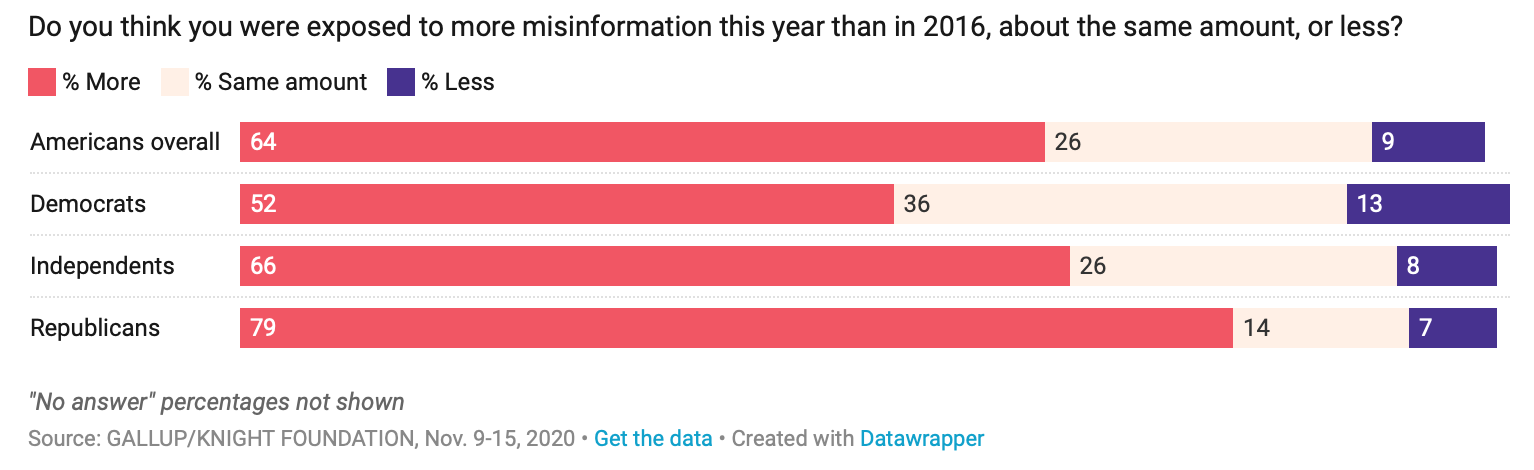
Something to note: Much press coverage and discussion focused on “misinformation” allegedly coming from the “right wing,” but a significantly larger number of Republicans than Democrats believe they were subjected to more “misinformation” in 2020 than earlier. It’s unlikely those Republicans were worried about an increase in “right wing” “misinformation,” rather than “misinformation” coming from the other side.
Subscribe today to the Washington Examiner magazine that will keep you up to date with what’s going on in Washington. SUBSCRIBE NOW: Just $1.00 an issue!
Look at where people believe “misinformation” is coming from. Gallup asked, “Where do you think you were exposed to misinformation about the election this year?” Everyone — Democrats, independents, Republicans — pointed to Facebook. But Facebook was mostly an aggregator of other media reports. And there were big differences between the parties about the original sources of “misinformation.”
Forty-four percent of Democrats said “misinformation” came from cable TV news — by that, they mostly meant Fox News — while 77 percent of Republicans pointed to cable TV as the source of “misinformation.” By that, they meant CNN and MSNBC. When it comes to traditional broadcast news — ABC, CBS, NBC — only 21 percent of Democrats saw that as a source of “misinformation,” while 81 percent of Republicans did. That’s a big difference.
And then there were the national newspapers. Only ten percent of Democrats pointed to the big papers — the New York Times, Washington Post — as sources of “misinformation,” while 57 percent of Republicans did.
The results are clear: Democrats believe “misinformation” is coming from the deepest recesses of Facebook and Twitter, while Republicans believe it is coming from ABC, CBS, CNN, MSNBC, NBC, the Washington Post, and New York Times.
Then there’s more. Remember how Facebook and Twitter clamped down on the Hunter Biden laptop story? Twitter even shut down the New York Post’s account. What about that? Was that “misinformation”? It appears the Biden material that was published was accurate, even though Democrats and their allies in the media did not want to see it. Gallup’s question related to internet censorship produced the most striking party disparity in the entire poll.
The first problem was the question: “Do you think major internet companies went too far, were about right, or did not go far enough in trying to prevent the spread of false information about the election on their websites and apps? The problem was the phrase “false information.” Were the emails on the Hunter Biden laptop “false information”? Certainly not the parts that were verified by some recipients. So it is entirely reasonable to think that the big social media companies clamped down on accurate information in the Hunter Biden case.
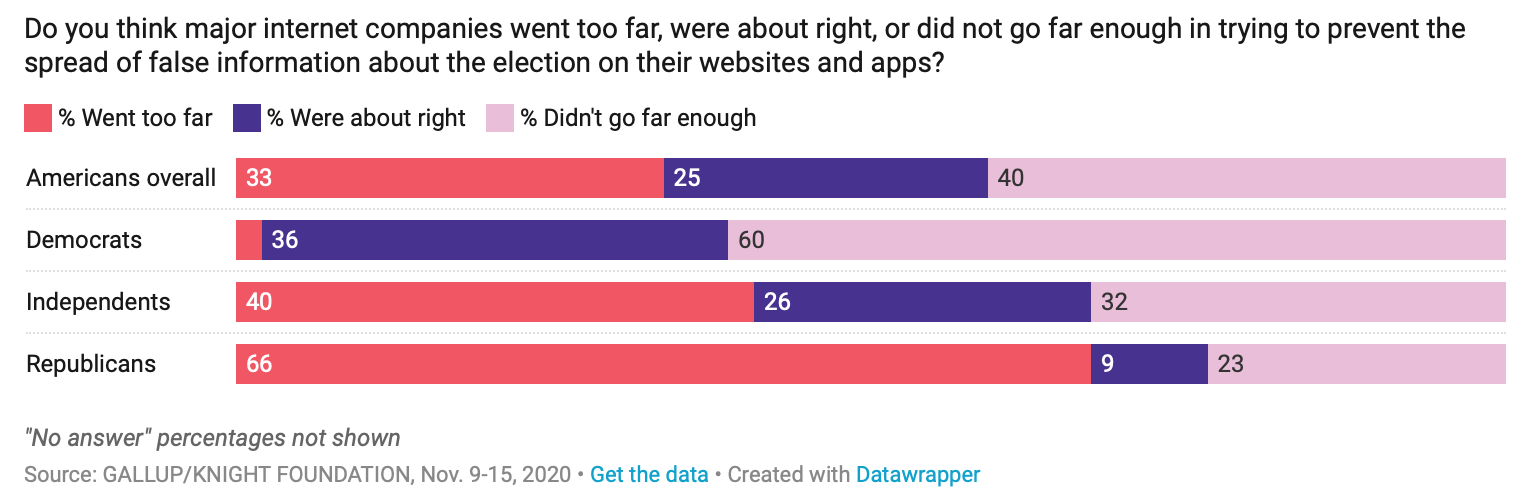
Nevertheless, in response to Gallup’s question, just two percent of Democrats said the social media companies went too far, while 66 percent of Republicans said they went too far. That is a huge, huge difference. On the other end, 60 percent of Democrats said the companies did not go far enough, while just 23 percent of Republicans said they did not go far enough.
Those two numbers undoubtedly reflect different things. Democrats would have been happy had there never been any mention of Hunter Biden at all — that’s their idea of “misinformation.” But Republicans have seen four years of false reports about President Trump colluding with Russia, about him being a Russian asset, about a pee tape and a dossier, and much, much more. They’ve seen “misinformation” in all of those news sources — ABC, CBS, CNN, MSNBC, NBC, Washington Post, New York Times — that Democrats trust. The new poll tells us a little about American attitudes toward the media and “misinformation.” But it doesn’t grapple with the dramatically divergent conceptions of what “misinformation” is.
